Sunday, February 17, 2008

Wyong field day 2008

HomeBrewDisplay.jpgJust returned from another excellent Wyong field day. I'm sure attendance is going up again - despite a rather threatening sky.

This year I participated in the NSW Home Brew display and was proud to show off my little 40m Direct Conversion receiver. Amongst all the vendors selling little black boxes it's great to see there are still a few of us wielding the soldering iron.

Attended a talk on the new digital radio system D-STAR. Although the presenters were very enthusiastic about it and their demo, which included talking to a bloke in England on a little hand held, went well - I can't help worrying that this system is based on a proprietary audio codec and that there are no manufacturers except Icom at this point.

When a bloke expressing interest in software defined radio applications asked about the codec, the presenter dismissed the question by saying "it's not proprietary, you can just buy the chip" so I don't think he gets the point.

There are also some signs that the engineering has a way to go, it was stressed that we must leave four seconds before replying so the system can do some handshaking, and further if you accidentally "double" with another station the repeater will go off air for several minutes!

I didn't come away empty handed, picked up a book on receiving antennas and also a wonderful Tektronics 2246 100MHz CRO which will be a great help with the kids science homework..

Saturday, February 16, 2008

Built a PVC pipe laptop stand

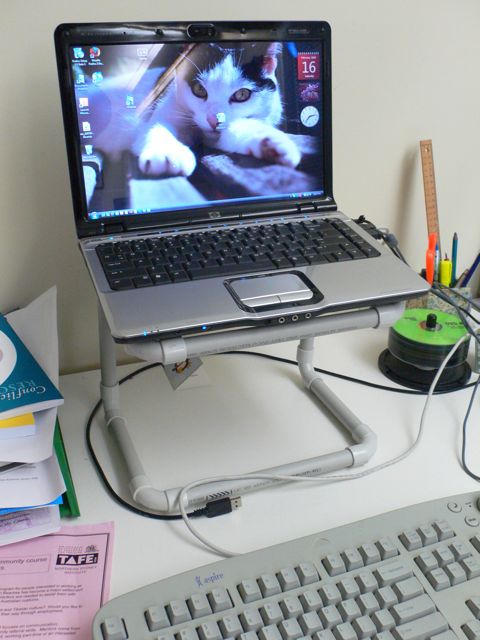
LaptopStand.jpgI'm using a laptop at work and have been searching the shops for some contraption to lift the laptop up so the screen is at eye height (I'm using an external keyboard and mouse).

Couldn't find anything I liked but searching on the net turned up a simple design for a stand constructed of PVC pipe. Marvellous stuff! Easy to cut, easy to join. I'm not using glue or anything, just friction will hold it together enough and still leave it with the ability to be pulled apart for carrying in my bag.

It droops forward a little (in the configuration shown here) which is fine. The laptop feels pretty secure on there but I am considering wrapping some rubber bands around the corners to give a little extra grip.

This little project went so well, I decided to make one for my wife as well (ideal romantic gift for Valentine's day I thought).

Friday, February 15, 2008

Another perspective on piracy


Denis Price, owner of "The Picture Show Man" twin cinema at Merimula gave an insightful talk on ABC Radio National tonight, but I feel he's missing an important point.

Denis has seen a "large chunk" of his market disappearing. I have great sympathy for him and can fully understand his interpretation of what he is experiencing - but I think he's missing the point.

The estimates of lost revenue by the record companies, studios and game makers are based on an assumption that everyone who has taken a copy of their works would have actually paid retail price for that work at current retail prices for physical copies. Clearly that's not the case.

Secondly, if Denis thinks that his cinema would be full except for the piracy of movies on the Interrnet, then how does he explain the fact that DVD/BluRay copies aren't available at the same time as the movie release? Surely if everyone was satisfied with the cinema experience then surely movies would be on DVD on the same day of the cinema release.

A new movie can be enjoyed in a variety of formats: iMAX, Digital Cinema, Standard Cinema (like Denis's), High Definition home cinema, standard definition TV, iPod Touch/iPhone, or iPod Video, and many others.

Sure, the film maker would like us to see their art in the iMAX cinema, but the reality is that not all of us will.

Downloading a movie from the "Internet" isn't free - users pay for the bandwidth, and it take real effort and concentration to locate and organise the download. Users must install special software and jump through all sorts of hoops to view the content.

The fact that Denis sees lots of people doing all this doesn't mean that they are criminals, it means that there is a clear consumer demand to get the content they value in new ways. Content providers have not kept pace with what consumers want and consumers will find a way until the providers come on board.

When a new movie comes out, I want to be able to choose how I will view it. Some movies should be seen in a wonderful cinema. Other movies might be best watched on the bus on my portable digital player. The point is that I want to pay the creators of this content but currently I can't.

If we can't buy the content in the format we want, well, I guess we'll look for other alternatives. That's not a threat, it's a marketplace that is being shunned by retroactive suppliers who refuse to keep up with the age of the internet.

The old model of distribution of content, where physical copies are shipped around the world is just silly.

Denis Price says "Indeed, we've now reached a tipping point." but he's got an axe to grind and he's picked the tipping the wrong way.

The cinema experience, where we go to a place with a great digital projector, great surround sound, great seats, and the vibe of experiencing the movie with other movie lovers I hope will live on - but it's just one of many possible ways to consume content.

Often when I go to the cinema, I get over priced food, out of focus projection, way too many ads, and bad seats plus annoying compatriots.

I respect creative people and I want to pay them their dues. We live in the age of the Internet and instant gratification. There is a huge opportunity here, don't fight it, satisfy it.

I urge you to read what Denis had to say. But I think the other perspective should be expressed.

Wednesday, February 13, 2008

Sorry, now for the Republic

Kevin Rudd said sorry today, on behalf of all Australians.

It was moving. Went very well, I was impressed.

Now it's time to address the other big issue in Australia - we should be a republic.

Last time we had a referendum we didn't get to vote properly, I think we should get another go at it.

Saturday, February 09, 2008

Built a better PSK31 interface box

pskVoxInterface.jpgStarted playing with PSK31 on my mac last year as reported earlier. As I said, I'm running the excellent CocoaModem software.

Until last week I was using the RTS line on a USB serial cable to key the transmitter which made for rather too many cables on my desk so I've jumped in and built a better interface box that has a VOX for keying PTT and includes level controls for both send and receive audio.

The box includes my old audio interface with 600/600 ohm transformers for audio in and out and ads a VOX board I built from a jaycar kit. Initially I ran in to some RF effects that caused the PTT relay to drop out during transmit, but the addition of RF chokes on all inputs and some bypass capacitors seems to have cleared up the problems.

On the back is a 5 pin DIN plug so I can make leads to connect to my rigs. To start I've made an Icom data cable.

So far I've had contacts with New Zealand and Queensland and can hear people in WA, SA and Victoria. We've had a lot of rain recently and I'm not sure that my home constructed balun has kept out the water. (The TV used to black out when I transmitted and it isn't any more - so in my book that's a bad sign...).

Very much hoping to catch up with VK3SL, Les, in Melbourne if he gets set up.

Friday, February 08, 2008

Wonderful documentaries by Louis Theroux

Since I discovered this series, about a week ago, I've become addicted to the BBC series by Louis Theroux- "Weird Weekends". They are charming and best of all seem to be available here on google video.

As an Australian viewer, (and note that the series hasn't turned up here as far as I know), his style reminds me of Andrew Denton. Covering topics such as UFO hunters, swingers, white supremacists and gambling, mostly in America, Louis is able to charm his subjects and get them to reveal their surprising world views.

Louis is not a "pure" journalist though, he does show his reactions and sometimes takes people to task. Clearly he invests considerable time becoming friends with the characters and he isn't afraid to become involved. In a piece on cosmetic surgery he even goes under the knife himself.

You wouldn't see Ray Martin doing that eh?

If anyone's listening in Australian television programming, can we please have this series and also the wonderful "Flight of the Conchords".

Both highly recommended.

Thursday, February 07, 2008

MacBook Air in Australia

My MacBook Air arrived this morning. Shipped direct from Shanghai. I do love it - light enough to carry around every day but with a lovely full sized keyboard and screen.

The remote DVD/CD software, which you install on other machines from the first install DVD works nicely. I didn't think I'd need it until I tried to install from a shared iWork 08 disk and it told me that it wouldn't let me do that.

Random thoughts so far:

The screen is really bright. The keyboard has FKeys for keyboard illumination brightness (I've never had a laptop with illuminated keys so maybe this isn't new). It has a disk eject key but it doesn't eject the remote disk. 2Gb of RAM is a good thing of course. The magnetic property of the magsafe power plug are a good thing in that they make it easy to plug in - it jumps to the right spot.

Part of the "thin" effect is an optical illusion. For me, being light weight is more important than being thin.

The big trackpad seems good, haven't fully tried all the features but two finger scrolling works very nicely thank you.

Great that it came with video adapters for both VGA and DVI, I'm sick of buying those. I think I'll have to buy the ethernet USB device to fit in with some workplaces.

At the office where I'm working at the moment I've hit a terrible networking bug that crashes anything that uses WebKit when I try to use a Microsoft authenticated proxy (even Dashboard crashes) so I've held off installing the 2007 security update in the hope that the problem started there - will report back with an answer in a few days. Update: Yes I can confirm that the crash bug when using an MS Authenticated proxy is not present before you apply "Security Update 2007-009, version 1.1". So, if you must use one of these proxys DO NOT apply this security update.

I'm being frugal about space but really 80Gb is quite sufficient. I won't be using this for my music or photo collections. I've installed my favourite apps and I still have 50Gb free.

Hey, it's missing the little Apple remote! Well, we have plenty of them so no problem here, and yes it does respond to a remote and Front Row is all there as you'd expect.

Too early to tell about battery life but right now it's showing 3:42 remaining.

These things will sell very well in my opinion.

Update: The single USB port is really high power, and that's handy. I have a serial ATA case that I've always had to plug in to two USB ports or a plug pack to power, turns out that the USB port on the Air is rated to 500mA and powers it without any problem.

Monday, February 04, 2008

A Chat with Ben and Pete - Episode 15

Microsoft! attempts! to! acquire! Yahoo!(sorry El Reg)
In this episode we chat about:Subscribe in:

Thursday, January 31, 2008

NSW/ERG TCard project, what went wrong

Like many who have worked on large software projects, I have been following the failure of the NSW State Government's unified transport card project with great interest.

OctopusCard.jpgMy family lived in Hong Kong for two years and we greatly enjoyed the "Octopus" stored value transport cards very much. Here's how it works: You go down to the station and pay an initial deposit of HK$150 (AU$22) and get an Octopus Card.

When you enter the MTR (Mass Transit Rail) system you wave the card past a contact-less reader as you go in. When you exit the MTR system you again wave your card and the amount of the fair is calculated and deducted from your balance. The barrier shows you the remaining balance. As needed you top it up either at a machine or one of many shops near the stations. It's quick and easy.

Now, a word about being contact-less. This is key, you can leave the card in your wallet or at the bottom of your bag and just wave it over the reader, no extraction of the card from a purse or unreliable reads due to corroded contacts or erased magnetic strips.

The same card works on busses, trams and ferries. I think the bus system was simplified to just have a flat fare for the route regardless of distance.

The system works well, is simple (once you know), and positively encourages use of public transport. Hong Kong is one of the densest populations in the world so it's not a fair comparison with Sydney, but there are lessons to be learned about the power of simplifying the system.

The most amazing thing I heard about the Octopus system is that it was designed by an Australian company, from Western Australia, none other than ERG Group.

I was surprised how badly this project had ended until I read in the SMH on January 31 that the State Government had "offered no co-operation in simplifying the fare structure of Sydney's public transport system". Apparently, ERG were trying to model the existing over complex system and this meant putting up to 73 fares on one ticket.

In my opinion, the introduction of a unified stored value ticket system should be accompanied by a drastic simplification of the fare system. Surely the costs of collecting all the current fares would be offset by the savings of the new efficient system, even with fare reductions for the longest travellers?

ERG has "lost $250 million building the system" so far. They have received no significant income from the government, (which is further threatening to sue them for $500 million), and worse it sounds like they haven't received the support needed for such a project.

The NSW State Government needs to have a good hard look at how they participate in IT projects. It's typical of government clients to go to market looking for existing software that closely matches their weird way of operating, riddled with perverse history, rather than going to market searching for worlds best practice and then bringing their operation into line with that.

Tuesday, January 29, 2008

A Chat with Ben and Pete - Episode 14

Musharraf is everwhere.
In this episode we talk about:Subscribe in:

Friday, January 25, 2008

Simple 40m Direct conversion (DC) receiver

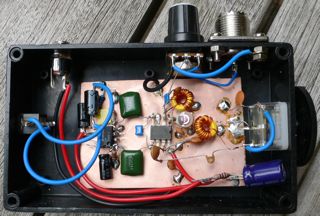
40mDCReceiver.jpgI'm very inexperienced at home building radio projects. Inductors, in particular, seem rather mysterious to me. Microprocessor projects seem much more predictable, signals are either on or off, but radio circuits may or may not be resonant, may or may not oscillate, and they certainly change whenever you try to measure anything.

The book "Experimental methods in RF Design" by Wes Hayward and others (aka EMRFD) it truly an inspiration and after reading it for months, and a few false starts, I've just completed the very first project in the book, a 40m (7MHz) direct conversion receiver with just two active components.

The design uses an NE612 oscillator/mixer to do most of the job and an LM386 as an audio amplifier suitable for driving headphones. NE612s don't have a lot of dynamic range so the only gain control is a pot at the antenna that serves as RF attenuator and overall "loudness" control. This works really nicely.

I can't reproduce the circuit here, but it's Figure 1.9 in EMRFD and uses only a handful of components. The design is very similar to this one.

My implementation is very ugly construction and I've mounted it in a rather over-engineered box with a transparent lid - I thought it might be a good bit of home brew art to show at the Wyong show.

Challenges

This project has taken some time to get started. First I soldered a trimmer and an off the shelf inductor the the board and attempted to confirm to myself that it was resonant at 7Mhz. I couldn't get a dip on my dip meter and couldn't see any sensible voltage peak when sweeping an RF oscillator. I was stumped for weeks.

(Thanks to VK2ZAY for his encouragement during this frustrating stage).

So I decided to follow the instructions...

I wound my own inductor using a toroid but still had trouble coupling to it. In the end a single loop of wire (soldered into a loop) running through the toroid and then around the coil on my dip meter worked and resonance was found. A few extra capacitors later and it was in the right place. This is a major breakthrough for me!

Next I built the circuit for the oscillator (active components inside the NE612). Holding a short wave radio near the circuit and sweeping the tuning cap quickly showed that it was indeed oscillating nicely.

Finally, an LM386 was ratted from another project and the audio stage built. It all worked on the bench, and would receive my GDO, so I installed it in a box and powered it from external batteries.

It stopped working.

Turns out the NE612 is a little voltage sensitive and my re-chargeable 4 AA battery pack had dropped in voltage. Fresh batteries and it now works.

The sound is very pleasant and there's no doubt that it's very satisfying to listen to a radio you've constructed yourself. Here's a recording of ZL2JR from New Zealand and some tuning around here.

Thursday, January 24, 2008

A Chat with Ben and Pete episode 13

Pete's ham radio holiday. This episode we chat about:Subscribe in:

Monday, January 21, 2008

Coffs Harbout Radio Expo

Attended the Coffs Harbour radio expo on Sunday.

While a lot smaller than the Wyong field day I'm looking forward to in a few weeks, it was a fine event with lots to look at including some excellent home brew electronics and a diverse trash and treasure sale.

I've been looking for an RF signal generator and was very pleased to pick up a nicely built Electronics Australia design which includes a frequency counter for $25.

There were lots of books on sale and I purchased a slightly damaged copy of the RSGB Radio Communications Handbook at a good price. A great read.

The home brew display, which regrettably didn't have anyone with it to talk to when I was there, had a fascinating 80m double side band transceiver and a little portable whip with antenna tuner built in - rather like those suspicious "miricle antennas" you see advertised.

Lee Andrews was there selling rigs and seemed to be having a good time, it's a pity he doesn't get to Dural from time to time if only to keep his mood positive.

A great day, I'll be back next year with any luck. Photos.

Friday, January 18, 2008

Currently on holiday at Coffs Harbour

Might be a little slow to respond this week as I'm on holiday at Coffs Harbour. Catching up with some friends and family and most importantly the radio expo on Sunday.

It's raining quite a bit here but the fun news is that the carnival is in town. A great old fashioned show with all the authentic gear. They certainly weren't making money when we visited last night - more staff than customers.

I'm sitting in the local internet cafe with about 10 others with internet addiction. Tried using their supplied windows computers but they are so bogged down with anti-virus measures that I gave up and today I'm pecking away on the eeePC keyboard (but with an external mouse).

See you next week.

Wednesday, January 16, 2008

MacWorld 2008 Keynote live blogging the live blogs

04:22 (local time) Engadget seems down.
04:23 Techcrunch is doing a fine job, a wireless backup device.
04:24 Macrumourslive has a feed that updates part of their page regularly. iPhone SDK coming February.
04:25 Only my friend Andrew is logged in to iChat down here, I think he was here last year too.
04:26 New iPhone software today. I'm running iTunes with my iPod Touch to see if there's anything there yet.. no.Picture 1.png
04:27 TechCrunch just put up a picture, gosh Steve is wearing a black turtle-neck skivvy and jeans - what a surprise!
04:24 Some clouns at Cunning.tv claimed to be sending out video of this, but they're unreachable.
04:33 More iPhone software stuff, which has previously leaked. MacRumoursLive doing a great job.
04:35 Can't ping Engadget, not sure if that's normal. You'd think AOL's servers could handle this but no apparently. acblogs.web.aol.com.websys.akadns.net 18 packets transmitted, 0 packets received, 100% packet loss
04:36 What! I have to pay to get a software update for my iTouch?
04:39 iTunes Movie rentals! Great, but when will it come to Australia?
04:42 Movies will be available 30 days after DVD release, hmm, that's not really moving technology forward, I thought this might replace DVDs. Just checked with software update, nope.Picture 2.png
04:46 Apple TV Take 2 No computer required. Just checked apple.com, there's still just something in the air. Gosh those AppleTV slides have a lot of words on them, I think Steve is loosing the plot in terms of minimalist presentation style. Perhaps he's got Bill Gates working for him now?
04:51 Engadget just reloaded, they have good commentary but I haven't been able to read it until now. They have a broken image in their page.
04:52 MacRumoursLive have ads in their feed. I guess that's fair enough.
04:55 He said there were four things to show: Leopard uptake success, iPhone success, iTunes movie rental, I count one important thing so far.
04:58 The Unofficial Apple Weblog is trying to load in my browser but going extremely slowly. Their coverage looks good but if you can't read it.. MacRumoursLive wins the liveblog hands down from here.
05:00 Apple TV update is free, well that's nice. Out in 2 weeks, so it's still got bugs.
05:04 "Fox wanted to make great movies, and get them into as many people's hands as possible" yeah but not until 30 days after physical distribution. They still don't get it, I'm surprised Steve went along with that backward step.
05:10 Worlds thinnest notebook! Now that's what we had a sleepless night for.
05:15 MacBook Air sounds awesome. I'm preparing my script for ABC Radio National breakfast.
05:20 First photos of the Air are up. Looks pretty ugly to me, are the keys really black?. Oh no, another video plug - Micro DVI. Converting units so it's 4mm to 19mm thin. You can "borrow" the optical drive from an existing machine (including a Windows box), very nice. 5 hours battery life - excellent!
05:26 US$1799 converts to AU$2002 (well, we'll see about that) Pre-order today, ships in two weeks.
05:28 I go to the Australia Apple store but it's down right now.Picture 3.png
06:04 I'm done. See you next year.
PS: I seem to be updating my iPod touch, not sure at what point it's going to ask for money..
Well done to MacRumoursLive for the best live blog of the 2008 MacWorld keynote.

Tuesday, January 15, 2008

A Chat with Ben and Pete - Episode 12

CES, Wikia and more.
This week we chat about:
  • Low cost laptops. Has the OLPC project created a new category?
    • Everex Cloudbook: http://tinyurl.com/26bfje
    • Lenovo has one for China: http://tinyurl.com/22w8up
    • Hasee Q540X notebook: http://tinyurl.com/2xao9m
    • Intel’s Classmate PC: http://tinyurl.com/ystz7h

  • CES. Is it just a bunch of thin displays?
    • Loren on the Gizmodo stupidity: http://tinyurl.com/2h9tvb
    • CEA bans Gizmodo staffer: http://tinyurl.com/2xg5xc
    • Multitouch trackpad: http://tinyurl.com/yrxrpj
    • Gibson’s self tuning guitar: http://tinyurl.com/2xub9f
    • Mitsubishi’s Laser TV: http://tinyurl.com/256np6
  • Xubuntu on the EeePC
  • Wikia, Jimmy Wales’ Google killer?
    • Wikia search engine: http://tinyurl.com/yp2fss
    • Arrington calls is a complete letdown: http://tinyurl.com/yw4zko
    • Why Wikia will change search: http://tinyurl.com/37he7j
    • A nice frontend to the MacOS firewall called WaterRoof
      • Check out WaterRoof: http://tinyurl.com/2mxl39
    • Parallels Server in beta and runs virtualised Leopard on Apple hardware
      • Report from the Unofficial Apple Weblog: http://tinyurl.com/2vm6cq
    • Mac file transfer application Interarchy hits version 9
      • Check out Interarchy version 9: http://tinyurl.com/2y8dt5
    • Sun to reduce data centres to zero by 2015

    Subscribe in:

Sunday, January 13, 2008

Free single sided ATMega8 PCB design

PCB Top.jpgHere at marxy.org I make printed circuit boards using the rather low-res iron on technique so I went looking for a single sided board design with no fine tracks. For example I can't reliably run a track between two IC pins.

Please correct me if you can, but I couldn't find a design out there so here is my contribution.

The circuit is a minimalist design, the chip runs without a crystal. I find this fine and given that ATMega8 series chips ship with their fuses set for the internal oscillator I'm surprised that more people don't do this for non time critical applications.

atmega8 circuit board.pngAside from four links, there are only a few components: 10k resister on the reset pin to +5v, a 100nF capacitor across the power rail, and a 1k and LED on the power to show that the board has power. So the LED and 1k resistor are optional.

I bring out all 8 lines of Port D and some spare ground connections along a board edge, Port C 0-5 are also available as are Port B 1 and 2. The pins used for programming go to the standard 6 pin header.

The square pins are pin 1.

There is a PDF version of the design here.

I laid out this board in OmniGraffle and the file is here.

You are free to use this design for whatever you want and hopefully improve on it. I did find some great PCB designs out there but they are all both double sided and often have very fine tracks which are beyond my home fabrication capabilities.

Friday, January 11, 2008

AVR Butterfly Mac experience

AVRButterfly.jpgI've been learning about the Atmel AVR microprocessors recently and ordered a very nifty little demo board called the AVR Butterfly. I bought mine from Mouser for US$21.

The board is handy in that it has an LCD display, a clock, temperature sensor, noise maker, 5 way switch (kind of a pokey little rocker), and a place for a light dependant resistor. (It no longer ships with an LDR as I guess they contain lead).

It comes flashed with a very comprehensive demo program that fully demonstrates the capabilities of the CPU and supplied hardware. The source code is in C and has been ported to gcc.

I installed the avr-gcc tool chain with this installer and use the java AvrFlasher with a Keyspan USB serial adapter at 19200 baud. Note that I needed to set line endings to LF in AvrFlasher's serial settings for things to work. Until I tried that I was getting mysterious flash failed message with no clue about what was wrong.

This board is an absolute bargain for the price, and the display is a great feature, but aside from working with the naked chip, like my favourite the ATMega8, my vote overall goes to the Arduino board.

Monday, January 07, 2008

A chat with Ben and Pete - Episode 11

Scoble’s fuss about Facebook and more.

This week we chat about Facebook locking out Robert Scoble for trying to extract his contacts, using OpenWRT in client mode, is OS X killing Linux as UNIX desktop environments, signs that BluRay might win the format war, Google’s distributed computing, and Pete reviews two books.

Interesting links talked about in the show:
  • Techmeme thread on the latest Facebook issue: http://tinyurl.com/39tx4g

  • Plaxo’s notification spamming: http://tinyurl.com/2fozv9

  • OpenWRT client mode howto: http://tinyurl.com/7z7qx
  • Is Apple killing Linux on the desktop: http://tinyurl.com/2wn7gj

  • Top 5 Engadget posts for 2007 are all about Apple: http://tinyurl.com/2e7h9c

  • Warner Bros. goes BluRay exclusive: http://tinyurl.com/22rdh6

  • David Lynch and watching movies on the phone: http://tinyurl.com/2yzqpr

  • Jeff Dean’s talk about Google’s infrastructure: http://tinyurl.com/2ehe3b

  • Similar Google developer day talk: http://tinyurl.com/2onu6e

  • RESTful web services: http://tinyurl.com/24pssf

  • The Django Book: http://tinyurl.com/224gkg
Subscribe in:

Thanks Ben for production.

Wednesday, January 02, 2008

Getting started with Atmel ATMEGA8-16

I mentioned in a previous post that I've been interested in learning about the Atmel AVR microcontrollers.

To get started I purchased an already constructed Arduino board and had a good experience using it's USB/Serial programming from my Mac.

I don't feel satisfied until a controller board has been built from components, here's what I did.
  • Purchased an ATMEGA8-16 from the local Jaycar for AU$19.95
  • Built a minimal circuit based on the Arduino but without the USB stuff.
    • I kept the power LED and bypass capacitors but that's all
  • Built a simple PC Parallel port programmer based on this circuit (yes, just two resistors!)
  • On a Fedora 8 machine, did "yum install avr-gcc avr-libc avrdude"
  • Add your user to /etc/groups under the lp group so you can access the parallel port
  • I followed the excellent instructions by The Real Elliot here to get a sample program going and make a Makefile.
One thing that caught me for a while is that while plugged in to the programmer, the chip doesn't run. I'm sure I can fix that by adjusting the reset line or something.

I've also changed the fuses on a chip so that I now get "avrdude: AVR device not responding", still trying to figure out how to get out of that issue.. All good fun.

Amateur Radio NSW Home Brew meeting


Here's some video from the ARNSW Home Brew meeting last night at the children's party room at McDonalds at North Paramatta.

Hopefully, this will convey the flavour of these meetings - a lovely bunch of blokes.

Monday, December 31, 2007

A chat with Ben and Pete - Episode 11

FlickrFan, the death of hi-fi and more.

This week we chat about the surprisingly technical Stephen Fry, Dave Winer's new application created using his OPML platform, FlickrFan, experiences with Kubuntu and KDE4, AOL cans Netscape Navigator, booting linux from a USB flash drive, and the death of high fidelity music.

Interesting links talked about in the show:

Subscribe in:

Killarney Heights space program


A very entertaining morning - thanks Pete and kids!

On a hot Killarney Heights morning, our intrepid gang of space heroes set out on a mission to launch a rocket high into the air. It was dangerous, possibly even fool-hardy (well, that's what my wife was suggesting).

The video shows just one launch but I think we did six until enough pieces had fallen off that the rocket became unstable in flight and was lost, presumably in a low earth orbit.

Friday, December 28, 2007

Newspapers not for breaking news any more

I remember a time when the morning newspaper had a box, outlined in red, with breaking news that was occurring as the paper was put to bed.

This morning, the Sydney Morning Herald arrived on the doorstep missing one of the biggest stories of the year - the assassination of Benazir Bhutto.

Now, I listen to the radio over night so it felt like the story was quite old by the time the paper came and it was surprising to see no mention of it.

In Wikipedia it is reported on her page that she died at 6:16pm local time, which is 12:16am Sydney time (a bit after midnight). Had the paper's front page been set in stone already?

Was the biggest story in the world the fact that NSW police didn't want a water cannon, or that the PM went to the cricket and didn't seem to enjoy it?

I know it's the silly season, but news doesn't stop and in recent years we've had some really big stories at this time of year, including a tsunami.

For three years I subscribed to Time magazine and there is some value to a publication that shows the news of the past week in a way that lets you get a feeling for what has transpired without any pretense of having the very latest news.

It's hard, (for me), to see the value of a broadsheet daily news paper. Our paper recycling bin is pretty much full of it. Perhaps it's time for a daily journal of opinion and analysis that doesn't pretend to have the news of the day any more.

Wednesday, December 26, 2007

Variable DC regulator V1

I'm getting really sick of those little "wall wart" power bricks for everything. My collection is getting silly, particularly as the multi-voltage ones seem to never quite have all the voltages I want.

My recent purchase of an Asus EEE PC is a good case in point, I imported it from Hong Kong so it has a power brick with a dodgy mains adapter plug on the back of it. This device needs 9.5V DC to charge - none of my existing adapters will provide this - hence this week's mini project.

It's a classic LM317 variable DC regulator in a box with a knob. The circuit is straight from the data sheet here. In my version I have 100R for r1 and the potentiometer is 1K. On the input I have a bridge rectifier so I can plug either polarity in to it without fear. Construction is on a tag board, probably a heatsink and some ventilation holes will be needed but the LM317 is well protected against over temperature and current problems.

I'm calling this project version 1 as it turns out it can't supply the 2.3A needed to charge the EEE PC, still useful for other things, but a version 2 is going to be needed for my original objective. Looks like I need an LM150 or LM138 for that.

Tuesday, December 25, 2007

A call for cheaper public wifi

We're staying at a nice hotel for xmas. The kids and I can't live without our internet fix for even 24 hours - is that addiction?

The internet is available here (Sydney) but only via an ethernet socket and it's AU$30 per day!

While I'm away, it's the Asus EEE PC for me, while my daughter in the next room has a PowerPC iBook running Tiger.

Obvious solution: plug the iBook into the wall ethernet, system preferences, sharing, internet tab, share internet connection over Airport - works really well. (Don't forget to adjust power management to avoid sleeping while plugged in).

While I'm on this topic, why don't cafes have free wifi? I've seen it in one cafe using an Unwired connection. This is presumably a very easy to deploy solution, an unwired (pre-WiMax I think) modem and a wireless router to share it in the cafe. Surely whatever the cost of this to the business would be outweighed by the extra sales to people staying longer to use the internet.

Finally, if we must use a commercial Wifi connection, provided by the same people that provide our home connections (Optus, Telstra) then why can't we log in with the account we already have at home?

Anyway, enough moaning from me, merry Xmas.

Monday, December 24, 2007

A Chat with Ben and Pete, episode 9

The Google Talk Babel Fish and more.

This week we chat about Google Talk's automatic translation service, developer frustration with the Android SDK, Firefox 3 and the large number of bug fixes, the Mac security update breaking Ben’s proxy functionality, Apple legal getting testy with Fake Steve Jobs and Think Secret, SSH configuration coolness, and comparing Windows and Mac vulnerabilities.

If you’re still listening, there’s a treat at the end of the show. We chat about the production and publishing of this podcast.

Subscribe.

Thanks Ben for production.

I'll be appearing on ABC Radio National Breakfast with Steve Cannane on Thursday this week to talk about electronic book readers.

Thursday, December 20, 2007

Arduino controller board on a Mac

Having played with PIC microprocessors for many years and had good times with the 16f628, it's been hard for me to jettison that knowledge and move to another chip even though it looks much better.

The Atmel AVR chips are low cost but designed for running code generated by "normal" compilers like good old gcc, rather than the PIC chips that need hacked c or basic compilers that know how to use that banked memory.

I use a Mac and always feel like a second class citizen when it comes to software and hardware for embedded systems. Make magazine featured a little board called Arduino that carries an ATMega168 chip.

It's the fastest "greet postie" to "das blinken lights" joy I've ever experienced.

Here's my list of observations so far:
  • The Arduino is open source so you can make your own
  • I bought the Diecimila for AU$37.50 with it's USB connection
  • Chip programmed with a boot loader so it is re-programmed via serial (over USB)
    • The boot loader is freely available so you can burn it into your own chips
  • There is an IDE for Windows, Linux and the Mac that works really well
  • The IDE for Mac comes with the driver you need for the USB interface
  • IDE has gcc-avr built in
    • It links against AVR Libc
    • Language is most of c
    • Syntax colouring
    • Seems actually to use a c++ compiler
    • Has some useful built in functions for doing i/o
    • Comes with libraries for things like printing to serial (and you can do serial comms to the board in the IDE so that's how you debug)
    • There are third party libraries available for stuff like digital servo control
    • Libraries are installed by simply dragging them in to a folder
  • The board can be powered by USB or a separate supply 6-12V
  • When you compile your source the output, including the intel hex file is dropped into a folder with the source so you can even burn it to another chip with your own programmer
What held me back from trying the Atmel AVR chips is the fact that there's so many of them! Where to start? Well, it seems like the ATMega8 is a good start. All the tools are free and if you have a PC with a parallel port you can make a really simple programmer.

Incidentally, I ordered my Arduino from Little Bird Electronics here in NSW on 9-December and it only turned up today 20-December. I think that's a little slow.

Tuesday, December 18, 2007

A look at Sun's Blackbox

Attended a very nice function by Sun at Darling Harbour in Sydney today to take a look at their server in a shipping container.

Racks are squeezed into a standard shipping container in a front to back packing arrangement. Between each rack are fans with heat exchangers that cool the air by using cold water. So the air flows into the front of one rack, out the back, through the heat exchangers and then in to the front of the next one.

Water is much more efficient for removing heat than air. I note that the standard unit contains a dehumidifier...

Racks slide out for access to both front and back. It's a clever idea and achieves higher density than you get in a normal data centre.

The warm water is cooled either in a building's system or in an external cooler and then it re-circulates. The air flow is a loop inside the box too so it all stays cool when closed.

Applications include things like:
  • Temporary data centre (perhaps for the Olympics or to render a film)
  • Building a data centre in a car park or warehouse (because you don't need an expensive space with false floors and airconditioning)
  • Door stop
  • Paper weight
It's a clever idea, although there must be some consternation about Google getting a patent on the same idea. Sun is a much more interesting company than it was a few years ago, there was a genuine buzz of enthusiasm from staff and customers at the event today.

Monday, December 17, 2007

Django Book 1.0 as an A4 PDF

I've been hanging out for this book for more than a year.

Having just done a formatting pass through it, I can confirm that it's truly a great piece of work. 

I ordered it over 12 months ago and can't wait to get the printed copy in my hands but in the mean time, I've grabbed it and done some basic formatting to turn it into a PDF with a useful table of contents which I present for your download entertainment here.

My reading of the licensing is that this is perfectly OK, and indeed others have done it, but they are in strange non-metric formats and none that I've seen have a useful (clickable) table of contents.

(If I have done the wrong thing, please let me know ASAP and I'll remove it).

I did the formatting rather manually by copying the web pages into Apple's Pages. Must say, Pages is a superb word processor these days and I have no desire to run anything else again.

A Chat with Ben and Pete - Episode 8

Amazon SimpleDB, Google Knol and more.

This week we chat about hulu.com and viewing long-form videos using flash, VoIP on the iPod Touch, Web services interfaces into databases, the Amazon SimpleDB announcement, KDE4, USB vs. Firewire, “upgrading” to Windows XP, and Google’s unit of knowledge.

Subscribe

Saturday, December 15, 2007

80m loop antenna experiment failure

Just a brief post about some experimentation that has failed.

I've been trying to build a loop antenna for 80m (3.5Mhz) to reduce local electrical noise.

The idea was a 2m diameter square loop built from 1m lengths of electrical conduit. First I built with 1 turn and a 300pF polyvaricon capacitor and it resonated nicely at about 20Mhz. Next went to 3 turns and it seemed to resonate around 9Mhz, then 4 turns and I can't get this thing to resonate at all.

No idea what I'm doing wrong or why this won't work. The family is a little bemused about the structure in the back yard - I tried to pass it off as my version of a Xmas decoration.

I did learn a bit about conduit - there are two main kinds around, electrical and water. Water pipe is designed to carry water under mains pressure so it's much stronger.

Update: Check out Alan's excellent response. I will get back to this project soon.

Monday, December 10, 2007

A Chat with Ben and Pete - Episode 7

Project Blackbox, Songbird and more.

We chat about the world of XWindows on Leopard, Sun’s Project Blackbox, developments in the python based web framework, Django, more wake from sleep problems with the Mac, an iPhone MMS application, the Google charts API, and an amazing iTunes clone, Songbird.

Subscribe or just download.

Sunday, December 09, 2007

Bus driver of the year 2007

What an honour, to be driven by the Bus Driver of the Year 2007. We know because he has it embroidered on his shirt sleeve.

Richard drives a shuttle bus around a local loop that includes some retirement villiages. He's amazing in that he seems to know everyone's name and is completely patient with those who take a while to get on or off.

When I took this shot, he said "this isn't going to turn up on MySpace is it?". I said no, not MySpace.

Sunday, December 02, 2007

A chat with Ben and Pete - Episode 6

Facebook Beacon, Google Maps and more. We chat about routers, Peter’s domain woes, Facebook backs down on Beacon, Google and the FCC 700Mhz auction, Google maps and cell triangulation, offline web apps, an interesting SPAM solution, broadband over powerlines and the Eee PC launch. Golly!

We’re now listed in the iTunes directory. Click here to subscribe directly in iTunes.

Also check out the Facebook group. Click here.

Subscribe.

Thanks again to Ben for production.

Thursday, November 29, 2007

Tracks for evaluating Hi Fi

Headphones and the amplifiers to drive them have become a bit of an obsession around here. For me, Alastair started it here for me. 

Clearly my hearing is not as good as it was when I was in my teens but there is a visceral pleasure in high quality audio even now.

Not all music shows it up and here is a little list of tracks I use to evaluate a new amplifier or headphone. It doesn't mean that these are particularly Hi Fi tracks, just that I know them and they reveal the differences for me. YMMV.
  • Jean Michelle Jarre, Equinox Part 4
  • Ry Cooder, Bop Till You Drop, I think it's going to work out fine.
  • Eagles, Hotel California, Hotel California - not really Hi Fi but so familiar that I can pick difference easily and hear the bad edit in the middle
  • Keith Jarrett, The Koln Concert, Part 1 (well any part really)
  • Dire Straits, Love Over Gold, Love over gold
  • Music for the Funeral of Queen Mary, John Eliot Gardiner; Monteverdi Choir, March 1
  • Steely Dan, Remastered: The best of steely dan then and now, Hey Nineteen
  • Talking Heads, Stop Making Sense, Psycho Killer
  • Eric Clapton, Unplugged, Tears in Heaven
Hmm, maybe this list reveals something about me rather than Hi Fi evaluation. Anyhow, it's my little list for what it's worth.

Wednesday, November 28, 2007

A chat with ben and pete - podcast episode 5

Latest episode of our podcast, we discuss:
  • Amazon Kindle
  • Australian Election
  • Google developer podcast

On traditional media I reviewed the Asus EEE PC in the morning on Radio National Breakfast with Fran Kelly you can hear it here.

Chu Moy Headphone amp PCB design

I've built a number of Chu Moy design headphone amplifiers over recent months and recommend them so highly to friends I end up giving them away. Previously written up here.

Ugly construction is fine for one or two off, but it was time to try manufacturing a printed circuit board.

When I last made a printed circuit board, it was done photographically, by exposing a chemical resist to ultra violet light. Having just dismantled my dark room, it was time to try a different technique.

I used some blue "press-n-peel" transfer film. The design was done manually in OmniGraffle, printed on the film with a little HP laser printer, ironed on to the board on a wool setting, etched and drilled all in a couple of hours.

This technique works pretty well, I've had a little trouble with the ironing phase, the transfer moves a bit when I iron it on. On one occasion I had to rub off the bad transfer and iron on again. The instructions say to set the iron to polyester, but our iron doesn't have it so I set it to wool.

The actual circuit for this board uses two OPA134 amp chips (rather than the dual chip) and a TLE2426 rail splitter. I don't include any volume control as the device driving it, generally a computer or digital player has one.

I present here revision 2 of a PCB design. It works but could be more compact and has two links. PDF here, OmniGraffle source here. Note that the writing will be mirrored on the copper side when you make it. (I haven't figured out how to mirror text in OmniGraffle..) 

You are free to use these for any purpose. (Let me know if you improve it).

Be careful that your printer is close enough to 100%, I suggest test printing and lining up the 8 pin IC which is the only critical spacing.

Sorry for the break in transmission

marxy.org expired and for various reasons I didn't realise until it was too late. Unfortunately it has taken five days for me to get it back and running again.

Very sorry to anyone who came to this humble blog over recent days. I'll try not to have this happen again.

Monday, November 19, 2007

Dismantled my darkroom - a sad day

I'm a habitual early adopter in every area except one, photography. I stuck with film long after it was becoming clear that digital was superior. Digital isn't better in every way, but that's a whole other topic...

Looking back at my prints I can see that I was somewhat blind to the dust and scratches that would not go uncorrected in these digital days.

I've had a darkroom in the house, on and off, pretty much since I was in my early teens. Many deeply satisfying hours have been spent huddled over the enlarger, with my fingers in the chemical trays, and walking with dripping prints to the laundry to wash. I will miss just having the room there, even though a year has gone by with no activity.

Digital equipment goes out of date within months, some of my darkroom gear is technology that hasn't changed in 40 years.

I'll still keep a few film cameras, they are pieces of industrial art. I wonder if there is a film processing service that develops the film and sends back a really high quality negative scan? Last time I tried Kodak Photo CD it was very disappointing.

A Chat with ben and pete - podcast episode 4

Latest episode here.

Advertising, Outages, Android and Eee PC.

We chat about Time Machine, Back to my Mac (still not working for us), the Rackspace outage, the Android SDK and I have an Eee PC.


Thursday, November 15, 2007

Asus Eee PC mini review

I've just spent a full day using the new Asus Eee PC as my main desktop computer. It was a surprisingly smooth experience.

This tiny laptop, with just a 4Gb solid state drive and 512Mb of RAM is amazingly snappy to use.

The built-in screen and keyboard are tiny but usable if necessary - today I plugged in an external USB keyboard, mouse and screen. The video output goes up to 1280x1024 and looks just fine.

All the applications I need are built right in, including:
  • Firefox web browser
  • Thunderbird email client
  • OpenOffice word processor, spreadsheet, presentation package.
  • Pidgeon instant messenger client
  • Skype telephone
  • KDE's excellent file manager
  • KDE's nice terminal
The Xandros linux distribution browsed my network well and found printers and samba shares with ease. Sometimes finding the local WiFi network was a little slow but worked in the end.

While there is only 1.3Gb of disk space free for documents, it was easy to mount a shared file system (included NFS) or plug in an SD card for document storage.

As a command line user, I welcome all the standard utilities such as ssh, wget, python (regrettably only 2.2.4), nano, java, and about 1600 others.

Criticisms

It's hard to complain about a highly portable notebook that costs just AU$500. Of course it would be nice if the screen was bigger and took up the available space, you can't make the keyboard larger without increasing over all size, the trackpad defaulted to a very insensitive setting but that was soon fixed.

Scanning for wireless networks seems a little slow, but gets there in the end. There are rather a lot of icons in the system tray and the overall look of the KDE based desktop looks unnervingly like Windows XP.

I'd like to leave a large SD card in the slot all the time, but each time I start up it pops up a dialog asking what I want to open it with - probably a work around involving fstab but this needs a gui solution

The single click button below the track pad seems very stiff and I've just realised that it's because it's actually a rocker switch with a left and right button part. Perhaps a little clue such as a line in the middle would avoid this mistake.

Conclusion

I'm writing this post on the device right now, still getting used to the keyboard, but certainly very usable. The only moving part is a small fan so it's very quiet, strange not to hear any disk activity at all.

I think these low cost but feature packed Linux based devices represent a new category of consumer devices. Cheap enough to give to the kids without taking out extra insurance, powerful enough for real work.

A chat about the Google phone

This morning on ABC Radio National, I had a chat with Fran Kelly about the new Google phone platform. You can hear it here.

Monday, November 12, 2007

A Chat with ben and pete - podcast episode 3

GPhone, AWS and Linux.

The big news of the week is the launch of the Open Handset Alliance and the Android OS backed by Google. We chat about its possible effects on the market and the developer scene. Other topics discussed include GMail IMAP, Amazon Web Services and Redhat, the Asus Eee PC, Radiohead and Fedora 8.

Saturday, November 10, 2007

ITunes feature creep getting out of control

iTunes started out as a fantastic tool for organising, searching, browsing and playing digital media files. The ability to browse by genre, album, date added and so on, was a revelation to me - and it was really fast too.

But now, iTunes has changed so much the name doesn't even suit it any more. 

Here's my list of features that have ended up in what used to be iTunes:
  • Update firmware in telephones
  • Purchase electronic books
  • Synchronise calendars
  • Monitor RSS feeds
  • Share music on the local network
  • Burn CDs
  • Enforce parental controls on content
  • Backup phones and one model of iPod
  • Movie rentals soon too?
Does this sound like feature creep to anyone else?

When Apple created iSync and the whole Sync Services concept, it sounded like we would get a single place for doing that hard task of synchronising our computers with our portable devices.

Of course it's more extreme on Windows where an install of iTunes also installs QuickTime, I think they should extend this software beach head and also install Safari 3 (weird how it's still a beta even though Leopard has shipped).

It's easy to be a critic, so here's what I'd suggest:
  • Split up the iTunes functionality, give us back that simple media player with fantastic slicing and dicing features
  • Create a "device manager" that is responsible for talking to devices, including media players, Apple TVs, phones, cameras, tablets, and doing the syncing that needs to be done.
  • Put the iTunes store on a web site and just make it part of the general excellent Apple online store experience, sure you can link from tracks but don't make me shop inside that little box.
iTunes must be well overdue for a re-write, I still see the old watch cursor from classic days so my guess is that it's still a carbon app - that must be a nightmare code base to work on!

There's no doubt that the iTunes team has been the first to show us new user interface features that have ended up in the OS: smart folders, live search, and now coverflow. That must be a hot team, but I think it's time to split up and focus.

Thursday, November 08, 2007

VNC client built right in to Leopard

After installing Leopard I've been gradually re-installing the apps I need only as required. Just now I wanted to connect to a server via VNC and was about to re-install ChickenVNC but instead thought I'd try something...

We know that Leopard supports screen sharing and that it's built on top of VNC. It turns out that you can do a Command-K in the finder, connect to server, and use a url like this: vnc://hostname to connect. If it's not running on the default VNC port of 5900 you can add the port in the usual way as shown in the picture.

As dreena is a a linux box, I get a warning dialog box as shown. The client seems very snappy and works nicely.

When I connect to an old Panther MacOS X Server it works just fine and obviously doesn't give the warning about keystroke encryption. Digg this.


Update
I've noticed that the built-in VNC doesn't interoperate too well with the RealVNC server for windows. In this case Chicken Of the VNC seems to start up the session much faster for some reason.

Monday, November 05, 2007

A chat with ben and pete - podcast episode 2

Episode 2

We discuss our thoughts on MacOS X 10.5 a week into installing it. Topics covered include Time machine experiences, launchd, Mac malware, XCode 3 and more DTrace. The big news of the week is Google's OpenSocial API and we chat about our thoughts on all things social.

Sunday, November 04, 2007

GNUstep quick start on Linux

I'm enjoying tinkering with Cocoa on my Leopard Mac and I thought it might be fun to take a peek at Objective C and the framework on Linux in particular for developing command line tools.

My thinking is that it would be nice to develop the code under XCode and then just compile for Linux if I can figure out where the frameworks diverge and keep to compatible code.

Here's a quick start guide for Fedora Core 5 assuming that you already have the basic gcc (I'm sure it's basically the same on others):
  • sudo yum install gcc-objc
  • wget ftp://ftp.gnustep.org/pub/gnustep/core/gnustep-startup-0.18.2.tar.gz
  • tar xzf gnustep-startup-0.18.2.tar.gz
  • cd gnustep-startup-0.18.2
  • sudo ./InstallGNUstep
  • Edit your ~/.bash_profile to add the line . /usr/GNUstep/System/Library/Makefiles/GNUstep.sh
  • (note the leading dot in the line above)
Here is a little test program, called first.m:

#import <foundation/foundation.h>

int main(int argc, char** argv, char** env)
{
NSLog(@"Hello");
NSAutoreleasePool *pool = [[NSAutoreleasePool alloc] init];

NSMutableArray * array = [NSMutableArray new];
[array addObject: [NSString stringWithString:@"one"]];
[array addObject:[NSString stringWithString:@"two"]];
[array addObject:[NSString stringWithString:@"three"]];
[array addObject:[NSString stringWithString:@"four"]];
[array addObject:[NSString stringWithString:@"five"]];
[array addObject: @"six"];

NSEnumerator * e = [array objectEnumerator];
NSString * string;
while ((string = [e nextObject]))
{
NSLog(string);
}
[pool release];
return 0;
}

Create a file called GNUmakefile:


include $(GNUSTEP_MAKEFILES)/common.make
TOOL_NAME = first
first_OBJC_FILES = first.m
include $(GNUSTEP_MAKEFILES)/tool.make

Then make and run:

[marksp@homelinux first]$ make
Making all for tool first...
Compiling file first.m ...
Linking tool first ...
[marksp@homelinux first]$ obj/first
2007-11-04 04:38:40.246 first[1257] Hello
2007-11-04 04:38:40.276 first[1257] one
2007-11-04 04:38:40.277 first[1257] two
2007-11-04 04:38:40.278 first[1257] three
2007-11-04 04:38:40.278 first[1257] four
2007-11-04 04:38:40.279 first[1257] five
2007-11-04 04:38:40.279 first[1257] six

The same code can be built in Xcode and will run on the mac.
The GNUstep framework is very well documented here. 

One immediate incompatibility I ran into was the starter code for a Foundation command line tool ended with [pool drain] instead of [pool release] - a little DTS humour no doubt!

A brief review of XCode 3

Spent much of Saturday getting in to XCode 3 which ships with Leopard. My project was to build a Cocoa native version of the AppleScript Studio app I built last week to read and ultimately control a Yaesu FT-817 radio via a serial interface.

Having used Microsoft's developer studio, Borland's C++ Builder and the beloved Metrowerks CodeWarrior, the old XCode seemed like a step backwards in programmer friendliness.

XCode 3 is a major step forward. 

It's taking me a little while to stop fighting it and go with the new work flow. Here's my observations:
  • You don't really need to go to the debugger window, variables are now inspected by rolling over them. The open up so you can inspect structures within objects very nicely.
  • The output console doesn't open automatically and until I found it I used the system-wide console to view my NSLog() printouts. 
  • Interface builder has been completely re-written and the vast array of available NIB objects are available in an easily searchable window.
  • I'm having a bit of trouble with the synchronizing between my XCode project and Interface Builder, I end up putting declarations in my .h file and dragging it to IB each time.
  • There's a handy link at the bottom of the IB window to take you to the XCode project.
  • When there are build errors they appear in red balloons right in between lines of your code. At first I found this a bit annoying but now I think it's pretty clever.
  • Code focus is where you put the mouse in a little left margin and blocks of code are highlighted - it's a bit alarming when you first do this by accident but now I think it's neat.
Still to try out
  • Cocoa 2 with garbage collection and automatic synthesis of getters and setters.
  • Project versioning - although I'm loving having Time Machine taking care of me all by itself (tip, watch the console for a while and see all the clever things it's doing)
Cocoa compared to AppleScript

It took me a lot longer to get this going in Cocoa compared to AppleScript mostly because I had to figure out how to drive the serial port. In AppleScript I found an extension that did it all for me, in Cocoa I found some classes from Andreas Mayer and others that are fantastic.

In AppleScript I used the idle handler, in Cocoa I had to use NSTimer.

I'm really enjoying Cocoa now that I'm up and running. It feels really solid and my only complaint is the sheer richness of the library, it's getting really huge and when you can't remember the method name you have to hunt through a huge list. It would be great if code completion could first show the most commonly used methods rather than the whole list.

We desperately need a new edition of Hillegass.