Showing posts with label ipod. Show all posts

Sunday, August 10, 2008

Back on 20m, doing PSK31 and Bitx20

Picture 2.pngMy primary antenna for the past few months has been an 80m dipole. It works pretty well and I hear lots of regular groups chatting but I really miss my PSK31 contacts.

There is a digital mode range on 80m (3.620 - 3.640) and I've been calling CQ there for some time but have only had one PSK31 contact on 80m and that was a conversation I stumbled across on 3.66Mhz.

The other reason to abandon 80m for now is that I've just constructed a bitx20 transceiver and am trying to get it going.

As you can see from the waterfall on the right, there's lots of PSK31 activity on 20m and I'm seeing US stations pretty well here at 3 in the afternoon.

Sunday, April 27, 2008

Clothesline style antenna hoist for experiments

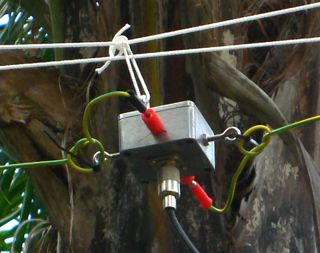
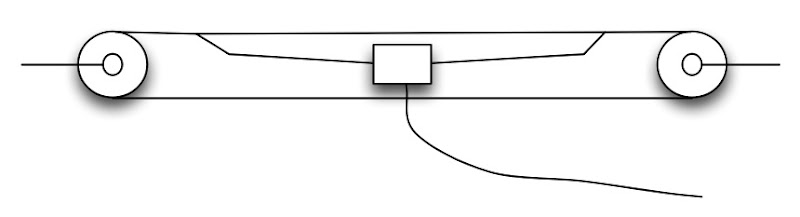
AntennaHoist.jpgI'm experimenting with antennas again and wanted a way to string up a dipole so that I could easily pull it down and make adjustments.

My best antenna is a dipole tuned for PSK31 on 14.070Mhz that is over the roof of the house but while playing with a simple wire dipole between some trees next to the house I noticed it it appeared to pick up less electrical hash and it got me wondering if I should try suspending the dipole out beside the house where I currently have an end fed long wire (that picks up tons of noise).

This is a very simple idea, I'm positive others have used it too. I bought 30m of 3mm venetian blind cord and two little pulleys. (I already have a pulley up a tree from previous squid pole activities that was used to hold up the far end).

antenna hoist diagram.jpg
It's too early to tell if having the dipole away from the house is better than having it up higher but over the house but it's great to be able to drag it out and back in again for tuning. (I've got this dipole perfectly tuned on my second clipping).

Yes, I will need some weather proofing before leaving the balun out too long.

Saturday, December 15, 2007

80m loop antenna experiment failure

Just a brief post about some experimentation that has failed.

I've been trying to build a loop antenna for 80m (3.5Mhz) to reduce local electrical noise.

The idea was a 2m diameter square loop built from 1m lengths of electrical conduit. First I built with 1 turn and a 300pF polyvaricon capacitor and it resonated nicely at about 20Mhz. Next went to 3 turns and it seemed to resonate around 9Mhz, then 4 turns and I can't get this thing to resonate at all.

No idea what I'm doing wrong or why this won't work. The family is a little bemused about the structure in the back yard - I tried to pass it off as my version of a Xmas decoration.

I did learn a bit about conduit - there are two main kinds around, electrical and water. Water pipe is designed to carry water under mains pressure so it's much stronger.

Update: Check out Alan's excellent response. I will get back to this project soon.

Saturday, November 10, 2007

ITunes feature creep getting out of control

iTunes started out as a fantastic tool for organising, searching, browsing and playing digital media files. The ability to browse by genre, album, date added and so on, was a revelation to me - and it was really fast too.

But now, iTunes has changed so much the name doesn't even suit it any more. 

Here's my list of features that have ended up in what used to be iTunes:
  • Update firmware in telephones
  • Purchase electronic books
  • Synchronise calendars
  • Monitor RSS feeds
  • Share music on the local network
  • Burn CDs
  • Enforce parental controls on content
  • Backup phones and one model of iPod
  • Movie rentals soon too?
Does this sound like feature creep to anyone else?

When Apple created iSync and the whole Sync Services concept, it sounded like we would get a single place for doing that hard task of synchronising our computers with our portable devices.

Of course it's more extreme on Windows where an install of iTunes also installs QuickTime, I think they should extend this software beach head and also install Safari 3 (weird how it's still a beta even though Leopard has shipped).

It's easy to be a critic, so here's what I'd suggest:
  • Split up the iTunes functionality, give us back that simple media player with fantastic slicing and dicing features
  • Create a "device manager" that is responsible for talking to devices, including media players, Apple TVs, phones, cameras, tablets, and doing the syncing that needs to be done.
  • Put the iTunes store on a web site and just make it part of the general excellent Apple online store experience, sure you can link from tracks but don't make me shop inside that little box.
iTunes must be well overdue for a re-write, I still see the old watch cursor from classic days so my guess is that it's still a carbon app - that must be a nightmare code base to work on!

There's no doubt that the iTunes team has been the first to show us new user interface features that have ended up in the OS: smart folders, live search, and now coverflow. That must be a hot team, but I think it's time to split up and focus.

Sunday, October 28, 2007

An AppleScript studio application

AppleScript studio is kind of the Visual Basic of MacOS X. (I'm sure some people will correct me firmly on that statement).

In order to try it out under Leopard I picked a simple project to give me something to shoot for.

I have a little Yaesu FT-817 that supports a remote control serial protocol they call CAT. It's 4800 baud, 8 bit, 2 stop bits. Each packet is 5 bytes, the last byte being the command and the other bytes are the data to go with it.

My objective is the program shown above, it periodically retrieves the current frequency and mode from the transceiver and shows it.

To interface with a common PL-2303 USB serial device, I installed the excellent (and free) Serialport X scripting addition. Thanks Art Coughlin!

To install you create a folder called ~/Library/Scripting Additions/ and stick it in there.

Prototyping was done in straight AppleScript until I was able to read and display the frequency. Next to XCode where I created an "Applescript Application". It reminds me a bit of HyperCard, you open the .nib file and in the Applescript properties tab you can set a handler for a button to call an "on clicked theObject" method in your script for example.

After some frustrating messing about, I've achieved my objective. Once you've chosen the serial device an idle handler refreshes the frequency. 

To make the built application run on a machine without the Serialport X applescript already installed you need to bundle it in the application. Thanks to the instructions here I was able to automate this. Note that I needed a -r after CpMac to copy recursively.

I find the AppleScript language frustrating for reasons I can't fully fathom, this "Applescript for python programmers" table was a great help to me as I'm very comfortable with python.

For what it's worth, I've put my xcode project here, hope it helps someone.

Sunday, October 21, 2007

Dxpedition with OziPole at Sydney's North Head

Alan VK2ZAY and I went bush this morning in search of a low noise HF location where we could play with antennas, balans, tuners and annoying flies.

I recently built the excellent Ozipole kit and this was a good opportunity to try it out, primarily on 7Mhz.

I've been searching for a location close to Sydney but as far as possible from power lines and houses and Fairfax Walk at North Head seems perfect.


View Larger Map

As expected, this was a superbly low noise location, and as it was the Scout Jamboree of the Air today there were tons of stations about. Unfortunately VK2WI was on low power on 40m and pretty hard to hear.

We played with several antennas and generally had a pleasant time. Notes for the next outing:
  • Take a table of some sort
  • Shade if possible
  • Find a way to carry the gear, (the battery is rather heavy)
  • Something to repel flies
It was wonderful to hear stations perfectly clearly at less than S1, at my home they need to be overwhelmingly strong to be heard. I'll go back to this location - any other suggestions around Sydney would be most welcome.

Thanks Alan for the fine company. He has blogged about this outing here, which refers back to this post so I hope the internet doesn't get runaway feedback and explode.

Update: Turned on 80m this morning at home at 6am and there is no noise. Here's a sample. So the band noise at my QTH must be from an appliance or power supply or something. I need to go hunting for it and I'm also reading up on receiving loop antennas that might let me null out the signal.

Friday, October 05, 2007

HF QRP pleasure with an FT-817

I've just spent a few very pleasant days south of Sydney at Gerroa.

We hired a house on a hill looking out over the beach and I took a Yaesu FT-817 and a slightly modified MFJ random wire tuner along for fun (all I did was add banana sockets for attaching a wire to it).

I strung out about 20m of wire from the balcony to a piece of wood in the yard and it tuned up nicely on 80m, 40m, and 20m. Had a few contacts running just 2.5W (on the in-built rechargeable batteries).

80m is blotted with interference at home. At this location it was magnificently quiet until about 5:30pm when bad televisions get turned on. I really want to find a location with no noisy power lines or TV sets to disturb by HF listening.

Only a few contacts, mostly listening. Just before we packed up I tuned around on 2m and found a very active local community.

Spent the time reading the ARRL Handbook, 2007 and a book by Melvyn Bragg, both really dense and fascinating.

On our last morning, went for a walk with my wife who slipped on a ramp and broke her leg. So quick, so easy. My thanks go out to the good folks of Gerroa who helped us to a car, a doctor and a hospital.

It's amazing how easily we can be injured. Such fragile creatures.

Sunday, July 08, 2007

Antenna hoist installed

It's great to be back home after a few weeks away. Apart from cleaning up the pool (which had gone green), doing my washing, and trying to sync up with local time, I've been trying as always to improve my HF antennas.

Hanging an 80m dipole on a suburban house is no easy task, my goal is an inverted V from the tree at the front of the house to the tree at the back of the block with the feed point above the roof of the (two story) house. 

Shown here is a vertical pole with a pulley at the top that raises up the balun feed point. This arrangement is still not idea, it doesn't clear the peak of the roof and those palm trees you can see in the image are a real problem on our block - they invariably grow and catch on wires I string up.

Just before I went away, "Experimental Methods in RF Design" by Wes Hayward and others, arrived. What a fantastic book! For anyone interested in designing and building RF projects, this is a must get book, clearly it has influenced many other designers.

Monday, June 04, 2007

Enjoying MIT physics lectures

Ben put me on to a gem in the new iTunes U area. There are freely available university lectures available and I've been watching the wonderful Prof. Walter Lewin going through the basics (to him) of electromagnetism.

The series is available either through the iTunes store or directly from MIT.

The good professor has a wonderful sense of humour and jokes about the dangers of working with 300KV gear, "if something goes wrong you'll get a replacement lecturer on Monday". I found the basic concepts of charge and how dialectics work utterly fascinating and the maths isn't terribly complex.

It's amazing how much basic physics is not common sense. His mix of lecture style with simple experiments to show the principles works really well and is highly accessible.

Seems to me that publicly funded educational institutions should put all of their course material up in the public domain, after all we've all paid for it. If MIT and Stamford can do it, what about TAFE?

Sunday, May 13, 2007

Built a roll-up 2m j-pole antenna

I saw Dom Bragge's posting about a 2m J-Pole antenna made out of 300 ohm TV ribbon and thought I'd give it a go.

Although the design specifies 51 inches in length, Dom notes that other builders have found this resonates too high in frequency and they suggest you start at 52 inches. I did that but found that the lowest SWR was at 148Mhz so even that's too short.

Perhaps 300 ohm twinlead material is different to the original designer.

I do have one contribution to make on this topic, it's really hard to strip the insulation from this twinlead. The insulation seems very strongly bonded to the conductors and they always rip out for me. The solution is to melt your way through with a soldering iron.

Some toxic vapour comes off but it seems pretty easy to tin the wires after the plastic melts away. Shown above is the bottom of the antenna where the co-ax connects and the shorting bar at the base. The melting works quite nicely as you can see.

Thanks to Dom for the pointer to this simple and highly portable VHF antenna design.

Sunday, May 06, 2007

Antenna activity

To maximise my procrastination on the morse code front, I've spent the weekend improving the antenna situation here. There are two HF antennas, a 40/80m trap dipole, and a recently improved (by lifting it high into a tree with a squid pole) long wire.

The long wire was used with an excellent Emtron matcher but with just a wire counterpoise in place of a real earth. I had a lot of RF in the room so I've now run that wire down to an attachment on a copper water pipe in the yard pretty close to the house. See picture above.

The dipole was in a sharp V shape from the middle of the house to two trees in the back yard, but with the help of the squid pole and a daughter, I've swung one arm right around, over the house and hung it from a tree in front of the house. So now the dipole is nicely in line and up pretty high.

The feed point is on a TV gutter mount on the second floor, the arm that goes over the roof just grazes the peak of the roof and the ends are both about 3m up. Pretty much as good as I can manage without a tower.

Disappointingly, a comparison with the long wire shows that the long wire antenna performs much better. The coax feed line to the dipole is RG58 but it's crummy stuff with aluminium foil mixed with only a few strands of copper in the shield. Next step is to upgrade that coax.

Tuesday, January 23, 2007

iTunes love it or hate it


Noticed a great feature of iTunes. Listening to a Podcast/Netcast on an iPod, didn't get all the way to the end, docked the iPod then thought I'd scroll through the program to the spot I was up to and listen to the rest. When I clicked on the podcast it knew where I was up to and played from there. Really neat.

At a party on Saturday, I spoke to a friend, Kati. Her kids have iPods, she hates the way they work. The iPods were opened at a friend's house where they immediately plugged them in to his computer, whereupon they sync'd with his music collection. Of course when they went home and plugged the iPods in to their home computer it told them that all the music would be erased!

I think iPods should have a simple mode where they mount as a disk and you just drag music on to them. The sync method is great for many people but for some it's counter-intuitive and infuriating.

Moved my kids from one Mac to another the other day. Naturally, they wanted all their tunes and pictures on the new machines. All I had to do was copy the "iTunes Music" folder from the Music folder on the old to the Music folder on the new machine. (Same with the iPhoto Library folder in Pictures). Great stuff!

The only painful part is the DRM which means I have to deauthorise and authorise to move the few purchased tracks over. My kids are mystified about DRM. It punishes consumers.

iTunes is good and bad. Personally, I think Apple's losing the plot on this one. It's getting too complex, there are menu items I can't explain. Why is "Transfer Purchases from iPod" needed? Why is "Subscribe to Podcast" in the Advanced menu. For that matter, any application with an Advanced menu doesn't belong in the Apple in-house design stable.

Sunday, October 15, 2006

Belkin TuneTalk mini review


From time to time I record stories for radio and these need to be recorded in the field in "HiFi" quality. Currently I use a Marantz PMD660 digital recorder, which is fantastic quality, but rather large.

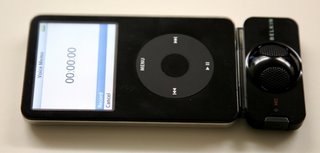
I was excited by the idea of using my Video iPod to record "CD Quality" audio in the field and so rushed out to get a Belkin Tunetalk.

It's physically a neat little unit that clips on to dock connector on a Video iPod as shown above.

The recording quality is good, using the built in microphone, and on "High" quality setting is recorded in WAV format at 44,100 Hz sampling.

There is no way to see the audio level on the iPod and you only have the choice of turning "Autogain" on or off. Basically, on means mic level and off means line level. The recording for me is rather low in level but I guess that's needed to avoid clipping. It's here.

I tried an external mic, a high quality Sony mic, and it sounded rather thin and low level compared to the built in mic.

Apple must have changed the software since the manual was printed as recordings now seem to be automatically transferred into your iTunes library rather than needing to be dragged or respond to a prompt to get them over. This mystified me for a while and I thought it was not saving my recordings.

High quality recordings are going to be big. My 12 second test is already 2.2Mb so this is not a dictation machine. I guess the application is recording interviews for podcasts or radio, which suits me but I find the lack of a VU meter and any way to monitor the recording a bit worrying.

Summary

Yes, it works and the internal mics sound really great. iPod user interface for recording is not great, it needs a VU meter, monitoring of the recording in the headphones, and it seems to take a long time to "Save" the recording when you stop.

Oddly the Belkin device includes one of those mini USB sockets (why can't they standardise these) and a cable so you can charge your iPod while recording. Wouldn't it have been better to repeat the dock connector on the device?

Note that this product only works with the iPod with video.

Thursday, October 12, 2006

One image spam

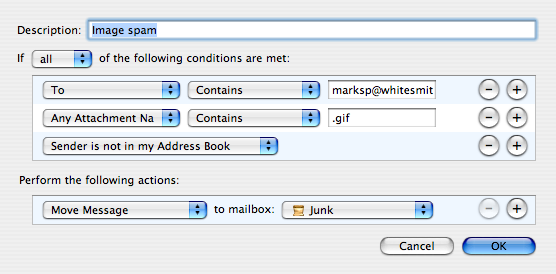
I've been getting tons of spam that gets through our office's SpamAssasin filter. This was brought home to me big time after being away from the internet for 10 days. I was faced with almost 300 emails - mostly spam to plough through.

Apple Mail's spam filter is good if it has something to munch on, but these messages have one big gif image and then a random few lines of text from a story.

I created this little mail rule to filter them and it works nicely. Note that I get mail from several servers so I only do this filtering on mail direct to the office server.

I check the Junk folder and if there's somebody there I do want to get mail from I simply right click their name and "Add to Address Book".