Tuesday, August 12, 2008

Amazing first iPhone bill from Vodafone Australia

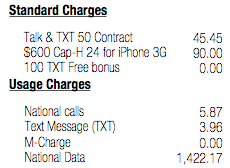
bill.pngI've just received my first bill for iPhone 3G from Vodafone Australia.

As you can see it's rather excessive. I was unsure about what my data usage would be so I initially signed up on a business capped plan that would give me 500Mb per month.

There's a number of anomalies here, according to the online usage Vodafone say I'm entitled to 500Mb and that I've used 12.11Mb so far with 487.89Mb remaining:

usage.png


On the phone it reports a total of 98.2Mb:
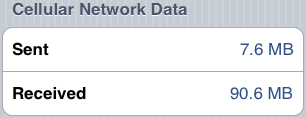
IMG_0003.PNG


From the 15 page bill I've been sent, it looks like their billing system is continuing the old practice of charging in units of 5 minutes for any internet traffic:

Picture 2.png


Certainly not the way it's expressed in the plan agreement.

Presumably I'm not alone but I'll hop on the phone to them today and try to sort it out. Wow, that iPhone sure does increase data usage.

pastUsage.png


Did anyone else experience this?

Update 1

Lara seems to be having hickups this morning.. Anyhow, it turns out that when I purchased the iPhone, which can only be done on an iPhone plan, it was not immediately put on the iPhone plan but rather stayed on my old (high data cost) plan until the end of my billing cycle.

Gavin at Vodafone politely told me that nothing could be done and that I should talk to the store where the phone was purchased to take it up with them.

I've now spoken with Reggie at the dealer and he was sympathetic and said he'd call Retail Support about the issue and call me back...

Update 2

Reggie called back to let me know that the problem has been escalated to the "iPhone Taskforce" who are working through these issues. They will call me in about two weeks and I shouldn't worry about the bill in the mean time.

Update 3

Thanks to "tester" for the link to a thread on Whirlpool where "Kirsty from Vodafone" says:

"Hi guys,

Vodafone addressed the issue some of our customers have experienced with purchasing their iPhone cap plans midway through their normal billing cycle in a press release dated 25/07/2008. In the past, plans were only changed on the bill cycle date. We acknowledge that this is not practical for customers signing up for the new iPhone 3G caps. From 23 July, anyone signing up for a iPhone 3G cap will immediately be able to enjoy the benefits of their new plan, rather than waiting for their bill cycle date.

Vodafone is reviewing the excess data usage of it's customers who signed up to an iPhone 3G cap mid way through their bill cycle, and will waive any charges that would not have been incurred if the customer had been able to use their iPhone 3G cap, with its voice and data allowance, from the outset."

This is certainly good to hear.

Update 4

7-September-2008

I'm pleased to report that my bill has been re-issued and I've received a credit for $1,500 on that bill.

Monday, August 11, 2008

Working with Django 1.0 and Google App Engine

logo160.pngI've taken some time off regular work to build BaristaReview.com, a site where you can find and review your local coffee shops.

To build this new site, I decided to use Google App Engine and Django.

Right now, Django is racing towards the version 1.0 release and it's changing fast. Unfortunately, due to some constraints in the runtime and the fact that you have to use Google's Database, it's not all smooth sailing.

Most things are working quite well, and the site is very responsive (certainly to django hosting I've tried elsewhere), but I've run into some roadblocks when I come to upload image files.

On App Engine you can only run pure python code, so using the latest Django I see log entries like this:

Could not import "fcntl": Disallowed C-extension or built-in module


More seriously, there is no local file system, so when I try to upload an image file, it fails with:

NotImplementedError: This class/method is not available.


When django tries to get a temporary file like this:

self._file = tempfile.NamedTemporaryFile(suffix='.upload')


Which is fair enough.

Anyhow, it's early days and there's lots of other people playing with this technology. Certainly it's a great deal from Google and I'm totally excited about the state of Django. I'm in geek heaven.

Sunday, August 10, 2008

Back on 20m, doing PSK31 and Bitx20

Picture 2.pngMy primary antenna for the past few months has been an 80m dipole. It works pretty well and I hear lots of regular groups chatting but I really miss my PSK31 contacts.
There is a digital mode range on 80m (3.620 - 3.640) and I've been calling CQ there for some time but have only had one PSK31 contact on 80m and that was a conversation I stumbled across on 3.66Mhz.

The other reason to abandon 80m for now is that I've just constructed a bitx20 transceiver and am trying to get it going.

As you can see from the waterfall on the right, there's lots of PSK31 activity on 20m and I'm seeing US stations pretty well here at 3 in the afternoon.

Saturday, August 09, 2008

Apple store opens at Chatswood

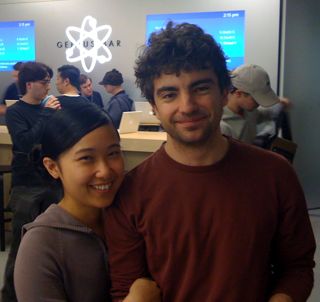
GeniusBar.jpgDropped in to the new Apple store at Chatswood Chase this afternoon and ran in to well known blogger Ben and his wife (trying to get his hair cut).

On the way there I walked passed the excellent Maccentric store that has taken care of us so well in Chatswood for many years. Maccentric has a 10% off store wide sale but I must report that it was looking pretty empty.

The new Apple store, even at 3pm in the afternoon was extremely busy. Several of the staff have been imported from the US, presumably to kick things off on the right foot.

It must be tough for an existing store when your supplier opens up within a block of you. I hope they got plenty of notice and perhaps some help in moving if they so choose.

The guy that served me had a badge saying "Ask me about MobileMe" so I did.. he apologised and said that while there were still some bugs, the major outages hopefully are over. I asked about my problems with the backup phase of my iPhone sync and he wasn't able to help.

The store looks great, I'm sure they'll do well, and it seemed like a good size for the number of products.

Wednesday, August 06, 2008

iPhone 2.0.1 still not quite right yet, 2.0.2 better

Like everyone I had a few annoying issues with the original software but I still feel it's the best phone/pocket internet device, I've ever used.

One of the most annoying little issues I've had is that syncing the phone would hang during the phone backup. Once I thought it was going to finish without me cancelling but then a call came in.

My update to 2.0.1 went smoothly and during my first sync I hoped the problem would be gone but no. Amusingly the log says:

not the droid.png


Backups still don't complete so I've done this:


defaults write com.apple.iTunes DeviceBackupsDisabled -bool true


Anyhow, my problems aren't nearly as annoying as Ben's so I count myself lucky.

The phone does seem smoother with 2.0.1, the annoying pauses have gone away and I think the 3G switching problem I had might have improved a bit.

Update 2.0.2

After a day with 2.0.2, I'm pleased to report that it drops back to 2G in my bad 3G signal environment much more smoothly than before.

It still won't backup my phone, so I've disabled that.

The Console log says:


20/08/08 10:40:13 AM [0x0-0x27027].com.apple.iTunes[365] MobileDevice: receive_message: Could not receive size of message: 0 Unknown error: 0
20/08/08 10:40:13 AM [0x0-0x27027].com.apple.iTunes[365] MobileDevice: _read_callback: Could not receive message
20/08/08 10:40:13 AM [0x0-0x27027].com.apple.iTunes[365] MobileDevice: send_message: Could not send message size: Bad file descriptor
20/08/08 10:40:40 AM [0x0-0x27027].com.apple.iTunes[365] Created child to sync device with pid 738...

And it hangs at that point.

Jury duty - well worth while

I've just completed a short stint as a juror on a criminal trial here in NSW.

On several occasions in the past I've been called and have either got out of it or not been balloted. This time it was all go.

The case was a federal crime, importing drugs into the country. I think the jurors all felt deep sympathy for the defendant and the predicament he'd ended up in.

Out of this experience I have gained respect for the legal system, the police, barristers and most of all for the ability of 12 citizens, chosen at random, to work together to decide facts that will have a major impact on someone's life.

Parts of the process were a little tedious, sometimes gross, but always enlightening.

We've all seen way too much court room action on TV, it wasn't like that at all. We all took notes and back in the jury room it was a bit like a comprehension test where we gently formed a view on what we had seen and heard.

In the end we found the defendant guilty without too much deliberation, but as we said our farewells outside we all wondered what would become of this poor man.

Sunday, August 03, 2008

Building a BITX20 20m SSB transceiver

The current project on the bench is a single sideband transceiver for 14Mhz. It's a kit from Hendricks.

bitx20.jpg


I'm following the instructions and testing as I go rather than one big "smoke" test at the end. So far receive/transmit switching works, the audio amplifier and mic pre-amp and mixer work. Very encouraging.

I first heard about this design on the Soldersmoke podcast. It's by Ashhar Farhan VU2ESE, his article is here.

There is much to commend this circuit, coming out of India it is designed to use low cost easily obtained components. Ashhar comments that if you can't get (or afford) torroid transformer cores, tap washers may be substituted.

amp.gifThe circuit is "bi-directional" in that it uses the narrow crystal filter for both receive and transmit and switches amplifier stages using diode switches. The amplifier stage is pretty much the same throughout so despite the switching it's pretty easy to see how it works.
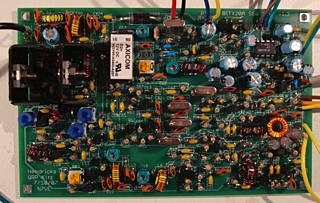
The kit I'm constructing is revision 3 and has push pull IRF510s in the output so it should deliver about 10 watts which is quite substantial with a reasonable antenna on 20m.

I plan to build this into a box including the frequency counter from Doug N3ZI mentioned earlier.

Update

Construction is going well although I found a few missing and substituted components in the kit.

bitxcomplete.jpg

I'm looking for a signal on 20m to use for receive alignment.

Tuesday, July 29, 2008

Sony DSC W300 review

I'm a keen photographer, not a great one, but keen. Over the years I've captured a few shots, perhaps 10, that I'm happy with. The transition from film to digital has been tinged with grief and nostalgia for the feel of mechanical film cameras.

The "money" shots, have mostly been because I was there and had a camera with me. (Was it Robert Frank who gave the advice to aspiring photographers asking about equipment, "F8 and be there"?)

I also appreciate "exhibition quality" photographs. After comparing a fine ink jet print compared to my best darkroom effort, I threw out the chemical darkroom.

When I want great quality, I use a DSLR. For every day, I use a pocket point and shoot. 99% of my images are shot with the pocket camera.

Recently it was time to hand down my camera and after careful consideration I opted for the little Sony DSC W300. Here are my comments after more than 500 shots.

w300 front.jpg


It's a lovely looking camera with a titanium coating that I think resists scratching while being light weight. Small and flat enough to really fit in my top pocket was one of my primary requirements.

Only a 3X zoom which is not outstanding but the lens is a maximum of f2.8 so it's worth it. (Those huge zooms are incredibly slow even though the font element might look big).

13.6 megapixels is more than I need so I run it at 5Mp normally.

Starts up reasonably fast, not as quick as a film camera though.

The display on the back is great, the UI is a little bit flashy, with animation and so on. Sometimes I hunt around for things but generally I find them. The main features: macro, flash, and self timer are directly available except for exposure override (+- EV) which requires you to go through the menu button and then possibly more pushes.

The dial has the useful functions I want including High ISO and higher ISO. (More on this later).

Battery life seems very good. I would take it away for a week without worrying.

There's a bunch of fancy functions like recognising faces and focussing on them, even recognising faces and focusing on children's faces rather than adults! (Really, I kid you not). But generally I don't use these.

The best feature is that it has an optical view finder. Very small but there. Being able to hold the camera steady against my face is a great feature for me even if it isn't very accurate.

Complaints

Doesn't take standard memory. Like SD. I had to buy some mysterious Sony Memory stick to put in this thing. For the features I was prepared to suffer this pain but this is a real negative. Just give me an SD slot next time!

The cable for plugging into the computer is not only proprietary, but I always plug it in the wrong way up first.

w300 socket.jpg


It looks almost the same on both sides and there is no visual clue as to which way is "up".

Photos

This is all academic, until you see some shots. I took the shot in this early blog post in a lift under very strange lighting. The point is, I had the camera on me.

In daylight, the photos look great:

team.jpg


What's really impressive is that in near dark like the shot below, available light f2.8 1/20th sec, ISO6400, pictures are still somewhat usable:

Vanessa.jpg


Overall, I'm happy with this camera. As I said above, I hate the storage card, the cable and I'd like to tweak the options that are available directly on the buttons. I love the high ISO, screen, and viewfinder.

This review was inspired by the other camera I considered, the Ricoh digital reviewed by Alastair.

Monday, July 28, 2008

Starstuff is back! (as a podcast)

Saw some great news in the paper this morning, Stuart Gary's StarStuff which was taken off ABC NewsRadio has returned as a podcast here.

Indeed it's true. In the first episode of the new series, Gary explains that he's able to use the ABC science podcast platform and promises to maintain the high standard. There is some mention of content changes due to licensing restrictions - something that hindered StarStuff's original attempts at a podcast.

Stuart thanks everyone for their support and says "it's been most humbling".

Like many others, I was outspoken about the loss of this fine program. It's great to have it back.

Great (star) stuff.

Water and pyro rocket test

Neighbour Peter hatched a plan to combine traditional (fired) rocket motors with the new sustainable water and air propulsion. Unfortunately the water pressure seal failed and launched prematurely on us:


We were joined on this test by Alan who had a good time and wrote it up here. Here's Peter's video:


As usual, the rocket video is shot with a little transmitting video camera which has survived amazingly well give the rough treatment.

That dark sky over Sydney came through and dropped snow-like hail on our suburb.

snow.jpg

Saturday, July 26, 2008

GutterTool Pro Turbo (with clearvu leaf mirror)!

GuttMaster.jpgThe gutters here at Marxy Manor are full of leaves and when it rains they overflow in all the wrong places.
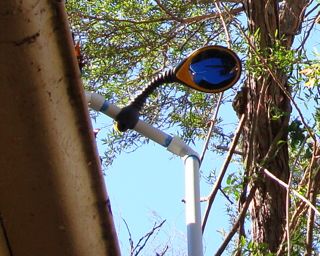
Being a fan of PVC pipe constructions (see the laptop stand) I had a bright idea that a quick trip to the "$2.50" shop provided the bits for.

To be honest, it doesn't work too well, the mirror goes out of alignment very quickly and the force required to lift the twigs and leaves it too much for the flexible pipe I'm using - perhaps pressure pipe is the answer.

GuttMasterView.jpg


Anyhow, a bit of home invention is great fun. Could this be the next "stump jump plough"?

Friday, July 25, 2008

Low cost embedable frequency counter

Frequency Counter.jpgHeard about this on the wonderful Soldersmoke blog. A flexible digital display for home home brew radios, from Doug N3ZI.

The pre-scaler is configurable to make it useful in ranges up to 50Mhz or so. It uses an Atmel ATtiny24 which comes pre-programmed. The software includes clever things like handling the IF offset.

Normally, low cost frequency counters tend to show annoying jitter in the last digit but the author has overcome this so it seems very stable in operation.

There are three versions of the kit, from $10 to $30 for the full kit. I bought the full kit and it came quickly, went together easily, and worked first time.

I'm thinking of pairing it with a Bitx20.

Thanks Doug!

Update

I've hooked it up to an MMR40 7Mhz rig.

MMR40 counter.jpg


I needed to make a buffer amplifier to boost the local oscillator level enough for the counter. It's based on a snippet from Experimental Methods in RF Design.

rf amplifier.png


The local oscillator output is 0.27V peak to peak, after the transistor buffer it's 1V peak to peak. I used a 2N2222a that I had on hand.

The counter was set to an IF offset of -10Mhz. Doug's software lets you do this with ease using up and down buttons that accelerate if you hold them down.

There's a plastic box HB5970 that fits pretty much perfectly. It's 140 x 110 x 35mm the CPU board slides into slots and I've just used the LCD board as the front panel (a bit ugly but functional).

box content.jpg


Having boxed it all up it looks great:

front working.jpg


I had to increase the input capacitor's value in the counter to get it to be sensitive enough with my buffer to work reliably.

Anyhow, a great kit. Highly recommended.

Thursday, July 24, 2008

iPhoto book in Australia

I've just received the first book printed through iPhoto using Apple's printing service.

iPhotoBook.jpg

The book was assembled in iPhoto from pictures taken with a pocket Sony DSC W300 camera (which I'm very happy with).

It was AU$12.50 for a 20 page (read 20 sides plus front and back cover) 8" x 6" soft cover book.

The books are printed somewhere else in the world and re-posted from Mascot in Sydney (near the airport) so it took 15 days from order to arrival, although it shipped in just two days from somewhere.

I've got to say - it looks great! A very professional looking production that I'm proud to give away and keep on the shelf (I ordered a couple of copies).

Normally, I choose a few digital images to get enlarged at the local printer for gluing in my album, I'm thinking of switching to doing a series of these books for hard copy storage.

The printing is a semi-gloss, sort of waxy look. There's a bit of metamism (that effect where the dark parts of an image reflect light at some angles). It's full edge to edge printing and the preview if super accurate in terms of where things get chopped.

This collection wasn't super quality, many were shot at high ISO (1600), all with available light at a party. I feel that the colours have been a little boosted but overall the effect is great.

Monday, July 21, 2008

Twinkle on iPhone 2 - location based awesome

IMG_0001.PNGI've been hearing about location based services being the next big thing for many years.

Now that I'm playing with Twinkle on the iPhone I'm starting to get it.

You can see, and therefore make contact with, people who are close to you. It can be a little spooky and of course you need to be aware that bad people might be looking for people to stalk close by, but it certainly shows a new way to hook up with interesting folks who you might want to hook up with in "meatspace".

I can see a ton of applications for this already.

Oh, and to take screen shots on iPhone 2, hold down the "home" button and click the top button. The screen flashes and the picture goes in your camera reel as a PNG.

Sunday, July 20, 2008

A chat with Ben & Pete podcast - iPhone 3G

We're back with a podcast where we discuss our experiences with the iPhone 3G. The mp3 is here.

Friday, July 18, 2008

Water rocket launch at Killarney Heights

Peter has improved the launch platform and the spin is much reduced now.


Here's just the flight in slow motion:


Thursday, July 17, 2008

Sleek Geeks in a lift

sleekGeeks.jpgAfter a talk on ABC Radio National about the iPhone this morning, I was riding down in the lift at the ABC's Ultimo centre, the doors opened, and in walked the "Sleek Geeks" - Adam Spencer (with his bicycle) and Dr Karl Kruszelnicki.

I'm a huge fan of both these guys, and they were gracious enough to allow me to snap this picture as we descended. Adam rode off and Karl stayed for a chat about some computer troubles.

Thanks guys for being so polite in the face of a stary-eyed fan in close quarters.

Sunday, July 13, 2008

I miss Starstuff on ABC Newsradio

I tuned in to ABC Newsradio today and mourned the lack of the regular Starstuff program produced and presented by Stuart Gary.

The site simply says "After eight years on the radio StarStaff takes its last journey across the universe this week. Tune in this Sunday at midday EST for the final episode of StarStuff".

As a devoted listener for many years, I'd like to express my thanks to Stuart and the ABC for running this program. I used to really like listening to it late at night on Sunday nights, the schedule change took some adjustment but the podcast made up for it.

Stuart's enthusiastic and informed presentation and interview style were always welcome and his regular guests were terrific.

Apparently ABC Newsradio is trying to focus more on the rolling news role of the station, which I value too, but lets just hope that all things space are not replaced with all things sport.

I'm not the only one to mourn the loss it seems.

Friday, July 11, 2008

Got a 3G iPhone pretty easily in Sydney

iPhoneQ.jpgI've been hanging out for an iPhone for a long time. Rather than going to the city I decided to head for Warringah Mall north of Sydney.
I got to the Vodafone store at about 8 for a 9am opening. There were 8 people in the queue and security guards hanging around. (The store said they were mostly worried about a robbery over night as the phones were hidden out the back).

Doing the paper work and using the Vodafone systems was an incredibly poor and slow experience. Part of the process involved ringing up and we waited 55 minutes in the phone queue. In the end I brought the phone home to "unbrick" (as they call it).

This little Vodafone store had 60 in stock. Everyone I spoke to in the queue wanted the 16Gb black version, while we were waiting a sales person from Crazy Johns was trying to offload some 8Gb models but no one seemed interested.

My home has poor signal from Vodafone and if the bars on the display are anything to go by reception is better than my past phones. In a call (to Ben) it seems like the audio is good but I do still need to find a good spot at home.

Oh the security guard you can see in the shot rushed over to tell me that I'm not allowed to take pictures after the shot above. Strange days..

Updates

So far I've bought the iPhone version of OmniFocus but the syncing update for the mac is due on the 10th (US time) so hasn't turned up yet.

NetNewswire is free so I got that but they want me to sign up on newsgator so I haven't done that yet.

The GPS seems very fast to get a fix, I walked outside and took a picture and the lat long is in the photo's exif.

I wonder why they don't allow a "turn by turn" navigator? I would definitely buy that...

The iTunes remote is kind of cute.

No glitches so far, very smooth user experience.

Update 2

Mobile Me seems to be working now and yes it pushed an email to the phone, it took about 20 seconds. Now, I understand that a single connection exists from the phone to Apple to do the pushing, I wonder if I get charged for that data?

Apps so far

The Apple Remote Control app is really great. I remember they had a patent on this and I'd have to say it blows away any other remote control, at least for talking to iTunes. This feature prompted us to set up some living room speakers connected to a mac and do some music listening.

Truphone does voice over the wifi network. I already have credit on Skype so really that's what I want but until they release I'll use Truphone. Voice quality is fine but the delay seems very long.

Sunday, July 06, 2008

Rather than flying or driving, caught the train

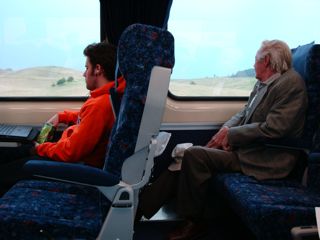
passengers.jpgAs the price of petrol climbs my theoretical enthusiasm for public transport increases.
This weekend the family made the trip to Coffs Harbour. Normally we would either drive or catch a plane but along with my fun-loving sister and brother-in-law, we decided to catch a CountryLink train from Sydney Central.

We decided to pay a little extra and go "first class". The best thing about the trip was meeting other passengers. Along the way we had some great conversations and heard some truly amazing stories that I won't betray here.

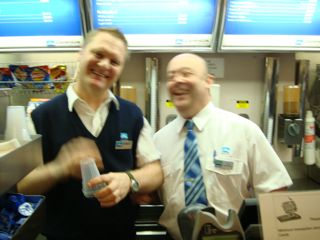
The staff were really nice and seemed to be even having some fun.staff.jpg

The seats were rather hard and next time I'd consider taking an inflatable cushion of some sort. The trains themselves are very modern and even had a payphone on board (mobile reception was decidedly patchy along the way).

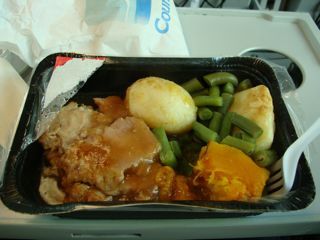
The wine was pretty good (served after noon) but I'd have to say that the food was hearty but not exciting. Here's the roast pork.

lunch.jpg

Sydney to Coffs Harbour took nine hours whereas the trip by plane is about two all up. I found myself strangely tired from a day of sitting in a chair, but definitely enriched by the experience.

Monday, June 30, 2008

Killarney water rocket with video camera on board


Great innovation this past weekend.

Here it is again, but with the footage shot from the rocket in slow motion.


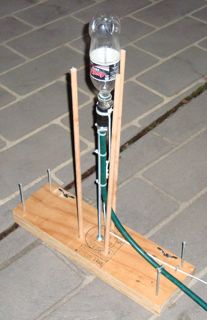
RocketLauncher.jpgNew technology is on the way.... Rocketeer Holland came up with a brilliant plan, to use water hoses and quick release joiners to launch with.
I've only seen this at night and unfortunately won't be able to try it out until next week due to an exciting train trip this weekend (reports to follow).

Friday, June 20, 2008

iPhone Australia countdown

iPhone.png

Vodafone

The Vodafone store near North Sydney station told me today that all they know is that iPhones will be available on July 11 and that there will be new data plans announced soon.

I pre-registered and just received the following email:

"Here at Vodafone, we’re eagerly counting down the days until the launch of the new iPhone 3G - and we bet you are too! We are keen to make sure that we can give you the very best deals on your new iPhone 3G and we are putting the finishing touches to these offers.

So, what next?

Since you have taken the time to pre-register, you are now at the front of the line. We will be rolling out these exciting offers very soon, so make sure to keep an eye on your inbox to stay ahead of the game.

Stocks will be limited so you will need to be quick.

Regards

The Vodafone Direct Deals Team"

Well, I'm standing by...

Optus


Optus was taking $50 deposits for existing customers and $100 deposits for customers proposing to "churn" from another carrier. Shouldn't that be the other way around?

They have now ceased taking deposits, presumably if you've paid a deposit you'd expect to get your hands on the device on July 11. I guess they don't have enough stock coming in to meet that expectation.

They've now sent out the following email to people who've registered:

"Thanks for your interest in the iPhone 3G with Optus.

Apple has released details of the new iPhone, and it's exciting! With fast 3G wireless technology, maps with GPS and the new App store, you have even more features at your fingertips.

Check out the full features and tech specs today.

We'll be back in touch in the coming weeks to give you more information on Optus' great coverage, great content, great service - and most importantly, the Optus iPhone plans. All reasons why your iPhone 3G will be happy with Optus.

Stay tuned!"

Telstra


They've come to the party, although they'll pay the penalty for being late. When the iPhone launched in the US it's estimated that sales in the first weekend were at least 700,000 units, with 200,000 on the first night. Now, Australia has a much smaller population but we are known as "early adopters" so it's likely that there will be a big pent-up demand.

If the opening of the Sydney Apple store is anything to go by, I can see overnight queueing for iPhones on July 10/11.

Telstra will miss out on this surge and further are likely to suffer the loss of customers who churn over to Optus or Vodafone just to get an iPhone without delay.

Let's not forget that Telstra's operations chief Greg Winn famously predicted that the iPhone would meet stiff competition from the incumbent mobile phone makers and he advised Apple to "stick to it's knitting".

More than a year has passed and while we are starting to see phones with large screens, I don't think anything so far has come close.

Perhaps Mr Winn should stick to his knitting and get Telstra operations working competitively? (Go to a Telstra shop around lunch time and try to get anything done...)

Update

It's December 2012 and Vodafone's Search Engine Optimisation Manager contacted me asking me to fix a link to their iPhone page. Of course this article is now very old so I've removed the link. Thanks for your interest.

Thursday, June 19, 2008

Sydney Apple store opening

SydneyAppleStore.jpgChris, Coops and I wandered into the city to see if anyone had turned up to the opening of the new Sydney Apple store.

It was dark and raining but the queue stretched for several city blocks. Hard to estimate the numbers but it seemed like they would run out of the 2,000 T-Shirts that were up for grabs.

You've certainly got to hand it to Apple for generating a buzz. Passers by were asking what on earth all those people were lining up to buy.

What a pity they don't have any iPhones just yet.

Sunday, June 15, 2008

Building a software defined radio

softrockfront.jpgI'm building the new Softrock "Xtall+Lite" v8.3 from Tony Parks KB9YIG.

He definitely needs to come up with a snappier name!

All seems well on the receiver front although it doesn't seem very sensitive and I suspect my front end isn't resonant in the right place. Shown above is the 40/80m front end.

Construction went well and all seems to check out ok. This board has a few surface mount components that take me a bit of concentration. The little DIP switches set the oscillator frequency.

First I had a go with Linrad on a Linux box but I seem to have sound troubles, so over to the Mac. My frustration is trying to get some SDR software running on the Mac. I spent several hours trying to get UWSDR to build on Leopard, after fixing all the little type casting complaints it wouldn't link with libfftw (missing symbols) so I'm stuck for now.
softrockback.jpg

In other news, I finally heard some PSK31 stations on 80m, VK2BOJ and VK2DD were heard on about 3.660Mhz with excellent signals. We were on our way out the door but I transmitted a few Hz away and they noticed and said hello. I only had time to say I had to go but this is a good sign.

It puzzles me why people give reports such as "599" when using PSK31, surely "S9 and -23db IMD" would be a more useful measure.

Update: I've just been pointed to some SDR software for the Mac by Sebastian DO8SEM here. Looks very promising although still under development. Currently, I'm not hearing too much but it has great promise.

Here it is on 80m. The audio seems rather distorted to me but it certainly works and I'm happily listening to SSB conversations.

SDRTransceiver.png

Tuning shortwave with a "waterfall" display is certainly the best way to operate.

Update 2:I figured out why my softrock was so deaf, the tuned RF front end is supposed to provide anti-phase signals at the input but in my case I had the phase of one side reversed. Works much better now.

Sunday, June 08, 2008

Water rocketry in Killarney Heights

The Killarney Heights space program continues, but this time it's sustainable. These water and air pressure rockets work surprisingly well and can be used multiple times. The air is pressurised with a car tire pump.


Thanks Pete and kids for a fine afternoon out. Shot with a little Canon still camera.

Had a contact with a $5 80m DSB radio

80mDSB.jpgStephen, VK2BLQ, has been selling off his old projects and I picked up an 80m double sideband radio he built for $5.

The only modification I've made is to re-wire the microphone socket to suit the mic I have.

I ran into local ham, Rob, VK2ZNZ in the supermarket today and asked if he would listen out for a weak signal on 80m. We liaised by phone and without trouble he was able to find me and we had a fine chat with the radio. His only complaint was a slow drift in frequency but the audio was good both ways.

This design is one that was published in Silicon Chip in November 1994 and available as a Jaycar kit. A pity they don't offer anything like that now. It's 1.5W PEP out and Rob said I was a little noisy but perfect copy.

Thanks Stephen for the fine radio to play with. Thanks Rob for helping me out.

Friday, June 06, 2008

Looking forward to WWDC 08

This year I'm not attending Apple's WWDC in person. I try to go every few years as it's a very energising experience.

Like many, I'm looking forward to the announcement of a 3G iPhone that I can buy here in Australia, but I'm also wondering what goodies we might see on the MacOS X and developer front. "Snow Leopard" sounds like an incremental update to Leopard, (which seems to be a very stable OS to me), but it would have to have some major changes under the hood. What comes to mind is:

  • Switching to a more modern, faster kernel, such as L4.
  • Make other languages, hopefully python, a first class AppleScripting language
  • Dropping support for PowerPC and no doubt cleaning out the code somewhat
  • Home directory in the cloud, or at least properly on a flash key drive
  • Build in the best of Wine, to make it at least easy to port Windows software to the Mac
  • A framework for making application uninstallers
  • ZFS or something to update HFS+


I'm also looking forward to an updated copy of "Cocoa Programming for MacOS X".

Tuesday, June 03, 2008

Mobile phone operating systems list

I'm preparing a chat about smart phones and trying to get a rundown of the current mobile phone operating systems. Here's what I know, any further tips would be greatly appreciated.


  • Symbian Series 40 - Older Nokia, Foma, Motorolla, Panasonic, Sendo, Siemens, Sony Ericsson and UIQ

  • Symbian Series 60 - in Nokia smart phones and many others including FOMA, LG, Nokia, Samsung, Sony Ericsson and UIQ

  • Windows Mobile - in Samsung, Palm Treo W, HTC, Motorola, Psion, i-Mate, Intermec,

  • RIM Blackberry - What OS is this underneath?

  • Apple iPhone OS - iPhone

  • PalmOS

  • Linux - Motorola, Grundig, HTC, NEC, Panasonic, Samsung, big list here

  • Google Android - Not out yet, coming to HTC at least


It looks like Symbian is currently dominant but clearly it's ageing which is presumably why Nokia bought Troltech. One year after launch, Apple has done well to get to 7% of market share.

Funny how it's hard to figure out the OS on many low end phones. I've used a Linux phone but couldn't tell really.

Had a chat about this on ABC Radio National this morning with Mark Bannerman.

Sunday, June 01, 2008

Sailing weekend in Melbourne

Photo 4.jpgCurrently on "Mark Twain" a lovely S&S 37. We're spending the weekend sailing around Melbourne.

Sailing is something that really brings me back to nature, it's great to be moving fast under just the power of the wind.

For someone like me, who spends so much time sitting in a chair in front of a computer, it's very refreshing to be in an environment like this.

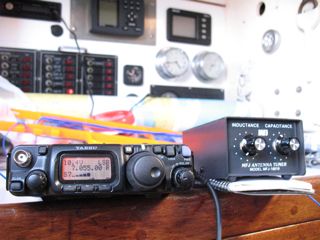
While on board, we ran a wire up the mast which I tuned up as a vertical on 40m. I can personally recommend the little MFJ-16010 antenna tuner for these types of jobs and the in-built SWR meter in the FT-817 works well enough to tune with.ft817.jpg

The club we're moored at, Williamstown, has wifi that gives free access to Google and that's all. As I blog and do email with google everything just works for me.

skipper.jpg
The skipper.

crew.jpg
The crew.

My role was mostly as ballast.

Later..

Stayed over night at Queenscliff, lovely place people leave their houses open and their WiFi open, thanks to Annie and Mr D. Link.

Wednesday, May 28, 2008

Finally robotic beings rule the world

robotSafety.jpgTook some time out today to visit National Manufacturing Week here in Sydney at Darling Harbour.

What a fantastic show!

The best bits for me were the surface mount assembly machines, the printed circuit fabricator that uses a flat drill bit and stepper motors (for under $10k take home), and of course the robots.

There were huge metal benders, cutters - both laser and plasma, lathes and even some fine industrial footware.


Here's one of the robots in action, I like the warning label that is shown above.

I've put a gallery here.

Thursday, May 22, 2008

Social networking and the future of customer care

Had a chat on ABC Radio National with the very hip Steve Cannane this morning about how social networking is starting to be used for pro-active customer care. Check it out here.

iPhone in Australia with dual sims?

My Vodafone contract has expired and naturally I'm waiting for the iPhone to come to Australia before signing up again.

Just had a call from Vodafone asking me to start a new contract. Told the guy I was waiting for the iPhone and he said he was too.

He said a few other interesting things, all just from this outbound sales rep..

  • Vodafone will have about one month of exclusivity in Australia
  • New iPhones will have slots for dual sims, one for data and the other for calls
  • Launch in Australia is mid June


As I said, just claims by an outbound sales rep.

Friday, May 16, 2008

Web controlled Icom radio using python cgi

Modern radios have serial remote control interfaces but they're a little difficult to use. There is a wonderful library called hamlib but for some reason I can't get it to build at the moment on my Mac.

A remote control radio is a wonderful thing, I wish there were more around. You can listen to your own signal from far away to see how it really sounds and if the remote receiver is in a quiet location with a decent antenna it might be much better than listening from your home QTH.

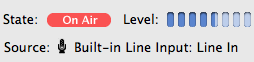
Picture 3.pngI've set up a simple web page controlled remote receiver. The audio is streamed using Nicecast which is a great implementation of a streaming mp3 server that can be received using lots of different software on all platforms. One neat feature is that it automatically configures the port forward on my router.

Initially I used an external USB audio input device but after about 18 hours the sound deteriorated. I think there's a bug in the Mac's USB audio chain somewhere.

For the web interface I chose a very simple cgi using python.

Unfortunately I can't really offer this up to the world as I pay for upload on my internet connection and I'm already on target to run out this month.

I hope others can build on this and set up some more remote receivers around the place.

Here's the little python cgi:


#!/usr/bin/env python
# By VK2TPM Peter Marks http://marxy.org
# You are free to use this for any purpose.
#
# Thanks to df4or.de for notes on CI-V here:
# http://www.plicht.de/ekki/civ/civ-p31.html
#
# The BCD utilities come from
# Rigserve by Martin Ewing
# http://sourceforge.net/projects/rigserve
#


import serial
import time
import cgi
import sys
import time
import string
sys.stderr = sys.stdout

SERIAL_DEV = "/dev/cu.PL2303-000013FD"
SERIAL_BAUD = 4800
INTRO = "\xfe"
TO_ADDR = "\x70"
FROM_ADDR = "\xe0"
SET_OPERATING_FREQ = "\00"
SET_OPERATING_MODE = "\x06"
READ_OPERATING_FREQ = "\x03"
READ_OPERATING_MODE = "\x04"
EOM = "\xfd"

STREAM_URL = "http://XXXXXXXXXXXXX/listen.m3u"
SCRIPT = "/cgi-bin/radio.py"

def main():
log = open("log.txt", "w")
log.write("started %s\n" % time.ctime())
ser = serial.Serial(SERIAL_DEV, SERIAL_BAUD, timeout=1)
form = cgi.FieldStorage()
if form.has_key('frequency'):
freq = form.getvalue("frequency")
log.write("freq = %s\n" % freq)

setFrequency(ser, float(freq) * 1000)
if form.has_key('mode'):
mode = form.getvalue("mode")
log.write("mode = %s\n" % mode)
setMode(ser, mode)
else:
log.write("no form submit\n")
freq = getFrequency(ser)
mode = getMode(ser)
if mode == "LSB":
mode1 = "SELECTED"
mode2 = ""
mode3 = ""
elif mode == "USB":
mode1 = ""
mode2 = "SELECTED"
mode3 = ""
elif mode == "AM":
mode1 = ""
mode2 = ""
mode3 = "SELECTED"

htmlTemplate = """<html><head>
<title>VK2TPM</title>
<style>body,td,a,p{font-family:arial,sans-serif}</style>
</head><body>
<h1>VK2TPM Web controlled radio</h1>
<form action="$script">
<table>
<tr><td>Frequency:</td><td><input name="frequency" value="$freq">Hz
<a href="$script?frequency=$freqDown&Submit=Submit">-5</a>
<a href="$script?frequency=$freqUp&Submit=Submit">+5</a> </td></tr>
<tr><td>Mode:</td><td><SELECT NAME="mode">
<OPTION VALUE="LSB" $lsbSelected>LSB
<OPTION VALUE="USB" $usbSelected>USB
<OPTION VALUE="AM" $amSelected>AM
</SELECT></td></tr>
</table>
<input name="Submit" type=submit value="Submit"> <a href="$script">Refresh</a>
</form>
<a href="$script?frequency=3700&mode=LSB">3700 LSB</a> |
<a href="$script?frequency=3670&mode=AM">3670 AM</a> |
<a href="$script?frequency=3600&mode=LSB">3600 SSB</a> |
<a href="$script?frequency=576&mode=AM">576 AM</a> |
<a href="$script?frequency=11750&mode=AM">11750 AM</a> | <br />
<a href="$script?frequency=5643&mode=AM">5643 AM</a> |
<a href="$script?frequency=8867&mode=AM">8867 AM</a> |
<a href="$script?frequency=4426&mode=USB">4426 USB</a> |
<a href="$script?frequency=8176&mode=USB">8176 USB</a> | <br />
<p>Click to listen to the stream <a href="$streamUrl">here</a>.</p>
This receiver is connected to a 40/80m trap dipole so is best around 3500 and 7000.<br />
The stream is buffered by a few seconds so don't panic after you change something.<br />
After some tidying up, I'll publish the source on the <a href="http://marxy.org">blog</a>
</body></html>
"""
template = string.Template(htmlTemplate)
html = template.substitute({ "freq": str(freq),
"freqDown": str(freq - 5),
"freqUp": str(freq + 5),
"script": SCRIPT,
"streamUrl": STREAM_URL,
"lsbSelected": mode1,
"usbSelected": mode2,
"amSelected": mode3})

print "Content-type: text/html\n\n"
print html
ser.close()
log.close()

def test():
print "started"
ser = serial.Serial(SERIAL_DEV, SERIAL_BAUD, timeout=1)
print getFrequency(ser)
print getMode(ser)
setFrequency(ser, 3670 * 1000) # Hz
ser.close()

def setFrequency(ser, freq):
fs = "%010d" % int(freq)
print fs

out = bcd4(int(fs[8]),int(fs[9]),int(fs[6]),int(fs[7]))
out += bcd4(int(fs[4]),int(fs[5]),int(fs[2]),int(fs[3]))
out += bcd2(int(fs[0]),int(fs[1]))
print out

sendStr = INTRO + TO_ADDR + FROM_ADDR + SET_OPERATING_FREQ
for byte in out:
sendStr += chr(byte)
sendStr += EOM
ser.write(sendStr)

echo = ser.read(len(sendStr))
print "got reply of %d chars" % len(echo)

def getFrequency(ser):
sendStr = INTRO + TO_ADDR + FROM_ADDR + READ_OPERATING_FREQ + EOM
ser.write(sendStr)

echo = ser.read(len(sendStr))
print "got reply of %d chars" % len(echo)

if not expectChar(ser.read(), INTRO): return
if not expectChar(ser.read(), FROM_ADDR): return
if not expectChar(ser.read(), TO_ADDR): return

byte = "0"
result = ""
while byte != EOM:
byte = ser.read()
print "%02x" % ord(byte),
result += byte

print "got EOM byte"
frequency = 0.0
if len(result) > 0:
f=0
for k in [10,11,8,9,6,7,4,5,2,3]:
f=10*f + nib(result,k)
frequency = (float(f) / 1000)
return frequency

def getMode(ser):
sendStr = INTRO + TO_ADDR + FROM_ADDR + READ_OPERATING_MODE + EOM
ser.write(sendStr)

echo = ser.read(len(sendStr))
print "got reply of %d chars" % len(echo)

if not expectChar(ser.read(), INTRO): return
if not expectChar(ser.read(), FROM_ADDR): return
if not expectChar(ser.read(), TO_ADDR): return

byte = "0"
result = ""
while byte != EOM:
byte = ser.read()
print "%02x" % ord(byte),
result += byte

print "got EOM byte"
mode = "XXX"
if result[1] == "\x00":
mode = "LSB"
elif result[1] == "\x01":
mode = "USB"
elif result[1] == "\x02":
mode = "AM"
elif result[1] == "\x03":
mode = "CW"
elif result[1] == "\x04":
mode = "RTTY"
elif result[1] == "\x05":
mode = "FM"
elif result[1] == "\x06":
mode = "Wide FM"
elif result[1] == "\x07":
mode = "CW-R"
elif result[1] == "\x08":
mode = "RTTY-R"
elif result[1] == "\x11":
mode = "S-AM"
return mode

def setMode(ser, mode):

sendStr = INTRO + TO_ADDR + FROM_ADDR + SET_OPERATING_MODE
if mode == "LSB":
sendStr += "\x00"
elif mode == "USB":
sendStr += "\x01"
elif mode == "AM":
sendStr += "\x02"
sendStr += EOM
ser.write(sendStr)

echo = ser.read(len(sendStr))
print "got reply of %d chars" % len(echo)

# non-reversed
def bcd4(d1,d2,d3,d4): return (16*d1+d2, 16*d3+d4)
# pack 2 BCD digits
def bcd2(d1,d2): return ( (16*d1+d2), )

# get a 4-bit nibble (digit) from a nibble string
def nib(s,i):
k = ord(s[i/2])
if i%2 == 0: k = k >> 4
return k & 0xf

def expectChar(byte, expected):
"""Return true if we got what we expected"""
if byte == expected:
print "good %02x" % (ord(expected)),
return True
else:
print "wanted %02x unexpected %02x" % (ord(expected), ord(byte)),
return False

main()

Measuring small inductors with a bridge

meter2.jpgYou might gather from this blog that I'm most comfortable with digital things - computers, software and even embedded microcontrollers seem very predictable to me. However, I'm very interested in learning the dark arts of radio frequency construction.
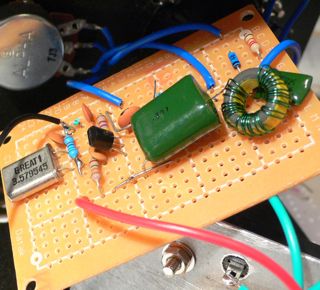
There's a long term project on the bench here, a double sideband transmitter for 14Mhz. Everything was going quite well until I got to building a tuned circuit. Of all the components, small inductors are the most mysterious to me.

I mentioned my frustration to John Ha1e, VK2ASU, at a recent meeting of the NSW home brew group and he kindly offered to help me out.

John showed me how he measured small inductors, such as ones wound on drinking straws, using an inductance bridge. There are a number of circuits around the net, I built the excellent simple one by Drew Diamond, VK3XU from his first volume of "Radio projects for the amateur". A design based on his circuit is published here I just discovered.

Yes, it really dips on small inductors like the one shown above. In this picture it's not showing the dip as it would be boring to show a meter on zero! I have yet to calibrate this instrument but I think it can measure from about 1uH up.

meter1.jpg


As with all of my home brew, they look pretty messy when you open the case - but that's where the beauty is for me.

It's amazing how valuable it is to actually watch someone winding and measuring small tuned circuits, but after watching John at work I gained the confidence that these things do actually follow the laws of physics and now feel I'm on my way again.

Thankyou VK2ASU and VK3XU.

Update: It looks like I can measure from about 1uH to 10uH on this device. I went out this morning and purchased a collection of 10% inductors. There's something funny about the colour codes on inductors, the colour seems rather different to those on resistors for some reason.

Monday, May 12, 2008

A Chat podcast 23

Get the podcast in iTunes, or here.

  • Neil Young and the Java?

  • Alternative firmware for Canon point and shoot cameras

  • OLPC in Australia

  • Home broadband upgrade


Thanks Ben for production. Sorry my earlier quick show notes post looked bad.

Sunday, May 11, 2008

Controlling an AD9851 with an Atmel AtTiny85 (or other)

avrdds.jpgFollowing on from my last post, I got something similar working with an ATTiny85. This sample code does a slow sweep from 10Mhz up a bit. It's just a demo, the bit I've been looking for myself and couldn't find was how to just say sendFrequency().

I have lots of ideas for applications of these things, including:


  • General purpose VFO with keypad and knob

  • Sweep test generator, paired with a digital rf signal measurer for computer plotting filters etc

  • Automated antenna analyser with a digital SWR measuring thingy


This code is written in C and uses avrlibc. I'm working on a Mac but it will work the same on Linux or that other OS that was quite popular.


/*
Control an AD9851 DDS with an ATMega85
*/

#include <avr/io.h>
// Sets up the default speed for delay.h
#define F_CPU 800000UL
#include <util/delay.h>
#include <math.h> // for pow()

// Pins used to talk to the DDS chip
#define LOAD 4
#define CLOCK 3
#define DATA 0
#define LED 1

#define DDS_CLOCK 180000000UL

#define OUTPORT PORTB
#define OUTPORTDIRECTION DDRB

void sendFrequency(unsigned long frequency);
void byte_out(unsigned char byte);
void outOne();
void outZero();
void bitSetHi(volatile uint8_t *port, int bit);
void bitSetLo(volatile uint8_t *port, int bit);

int main (void)
{
OUTPORTDIRECTION = _BV(LOAD) | _BV(CLOCK) | _BV(DATA) | _BV(LED);
unsigned long freq;

// flash an led to show we're alive
int i;
for(i = 0; i < 10; i++)
{
bitSetHi(&OUTPORT, LED);
_delay_ms(100);
bitSetLo(&OUTPORT, LED);
_delay_ms(100);
}
while (1)
{
// Do a frequency sweep in Hz
for(freq = 10000000; freq < 10001000; freq++)
{
sendFrequency(freq);
_delay_ms(1);
}
}
return 0;
}

void bitSetHi(volatile uint8_t *port, int bit)
{
*port |= ( 1<<bit );
}

void bitSetLo(volatile uint8_t *port, int bit)
{
*port &= ~( 1<<bit );
}

void sendFrequency(unsigned long frequency)
{
unsigned long tuning_word = (frequency * pow(2, 32)) / DDS_CLOCK;
bitSetLo(&OUTPORT, LOAD); // take load pin low
int i;

for(i = 0; i < 32; i++)
{
if ((tuning_word & 1) == 1)
outOne();
else
outZero();
tuning_word = tuning_word >> 1;
}
byte_out(0x09);

bitSetHi(&OUTPORT, LOAD); // Take load pin high again
}

void byte_out(unsigned char byte)
{
int i;

for (i = 0; i < 8; i++)
{
if ((byte & 1) == 1)
outOne();
else
outZero();
byte = byte >> 1;
}
}

void outOne()
{
bitSetLo(&OUTPORT, CLOCK);
_delay_ms(1);
bitSetHi(&OUTPORT, DATA);
_delay_ms(1);
bitSetHi(&OUTPORT, CLOCK);
_delay_ms(1);
bitSetLo(&OUTPORT, DATA);
_delay_ms(1);
}

void outZero()
{
bitSetLo(&OUTPORT, CLOCK);
_delay_ms(1);
bitSetLo(&OUTPORT, DATA);
_delay_ms(1);
bitSetHi(&OUTPORT, CLOCK);
_delay_ms(1);
}


The AMQRP board has it's own regulator and has a 5V output so I'm powering the ATTiny85 from that power rather than a separate input. Here's a nifty spot reference. Simple enough even for me to build.

spotGen.jpg

Saturday, May 10, 2008

Controlling an AD9851 DDS with an Arduino

ad9851.jpgBeen playing with the AD9851 DDS for a while now using other people's software mostly written in assembly language that I find rather hard to get my head around. Finally tonight, with the help of several others who have published their work on the internet I have got some simple code to drive this chip the way I want.
This can tell it the frequency the generate in Hz and it just works.

This minimal example does a small sweep from 10Mhz so it's easy to listen to on a radio.

While I prefer to use the atmel chips "naked" I do find the Arduino board a very convenient way to muck around and get things going in an interactive environment. This code doesn't rely on any magic Arduino libraries so it should be easy to port, I'll post a straight ATMEGA version soon.

The code presented here shows some things I've struggled to figure out: how to calculate the tuning word from the frequency and how to send the serial commands to the chip. I hope this helps someone else.


// Control a AD9851 DDS based on the good work of others including:
// Mike Bowthorpe, http://www.ladyada.net/rant/2007/02/cotw-ltc6903/ and
// http://www.geocities.com/leon_heller/dds.html
// This code by Peter Marks http://marxy.org

#define DDS_CLOCK 180000000

byte LOAD = 8;
byte CLOCK = 9;
byte DATA = 10;
byte LED = 13;

void setup()
{
pinMode (DATA, OUTPUT); // sets pin 10 as OUPUT
pinMode (CLOCK, OUTPUT); // sets pin 9 as OUTPUT
pinMode (LOAD, OUTPUT); // sets pin 8 as OUTPUT
pinMode (LED, OUTPUT);
}

void loop()
{
// Do a frequency sweep in Hz
for(unsigned long freq = 10000000; freq < 10001000; freq++)
{
sendFrequency(freq);
delay(2);
}
}

void sendFrequency(unsigned long frequency)
{
unsigned long tuning_word = (frequency * pow(2, 32)) / DDS_CLOCK;
digitalWrite (LOAD, LOW); // take load pin low

for(int i = 0; i < 32; i++)
{
if ((tuning_word & 1) == 1)
outOne();
else
outZero();
tuning_word = tuning_word >> 1;
}
byte_out(0x09);

digitalWrite (LOAD, HIGH); // Take load pin high again
}

void byte_out(unsigned char byte)
{
int i;

for (i = 0; i < 8; i++)
{
if ((byte & 1) == 1)
outOne();
else
outZero();
byte = byte >> 1;
}
}

void outOne()
{
digitalWrite(CLOCK, LOW);
digitalWrite(DATA, HIGH);
digitalWrite(CLOCK, HIGH);
digitalWrite(DATA, LOW);
}

void outZero()
{
digitalWrite(CLOCK, LOW);
digitalWrite(DATA, LOW);
digitalWrite(CLOCK, HIGH);
}


The board I'm using is the excellent carrier from AmQRP.

Friday, May 09, 2008

Switched home broadband to Telstra

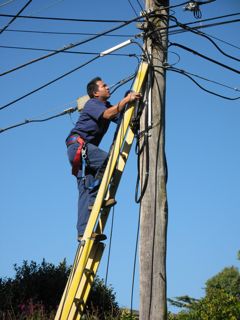
cableGuy.jpgWe've had Optus cable internet here at the house for many years. It's been a reliable service but over time annoyances build up in a relationship like this so I decided to upgrade and switch to Telstra Bigpond on a service they claim can deliver up to 30Mbps down and 1Mbps up.

Optus gave me 8Mbps down and 256kbps up. The slow upload did cause me some grief sending mail and uploading.

These days Telstra sends out contractors to do any "hard" work and in this case it was Silcar Communications. The guys did a great job and didn't mind me taking a few pictures as the job progressed.

They had to run another cable from the pole as I refused to let them cut over the Optus cable.

I'm pretty happy with the performance so far, of course it will be interested to see how it degrades in busy times. Here's my test results from ozspeedtest.

Broadband Speed Test Results

Test run on 09/05/2008 @ 02:38 PM

Mirror: Telstra Bigpond
Data: 9 MB
Test Time: 3.28 secs

Your line speed is 23.02 Mbps (23024 kbps).
Your download speed is 2.81 MB/s (2878 KB/s).

I'm seeing some pings under 10ms to Australian sites and I really do get 1Mbps upload which is great.

I refused the netgear wireless router they offered and just took a motorola cable modem and I chose to use my Airport Extreme which seems to be working nicely.

It's always amusing to see how these folks respond to a house without windows. They are drilled in the art of telling windows users to reboot to make things work. I said, this is a Mac, you don't need to reboot.

So, why did I switch from Optus:


  • They decided to charge me $2 per month because I wouldn't agree to direct debit. I always pay promptly by bpay and I'd be happy to have electronic invoicing, but no dice.

  • A sales person came to the door trying to sell me a worse deal than I was currently on, much less data, a little more speed and more money.

  • When my modem died in a storm, I purchased a replacement on ebay (from another optus customer), despite this they insisted on sending out a tech to read them the Mac address - something I can certainly do, and charged me the same amount as a replacement modem.


Oh and don't try writing to them about anything, when I did I just got back a form letter FAQ. I don't think they even read letters from customers. Oh well, bye bye Optus. Let me know when you're rolling out fiber.

Update: Cancelling Optus was a good experience. When you ring to cancel you get the 'A' team, the retention people. He said, "you should have rung us first, we could have given you $30 a month for 6 months". I explained that I had rung, and written, and had not been satisfied.

Anyhow he was able to cancel me right away and refund my latest payment. "Speed isn't everything" he said. You're right there, I thought...

Update 2: We are now without a home phone. The plan was also to churn our home phone over to Telstra today as well. The tech was due to come in "the morning", at 2pm they rang to say that they couldn't come and needed to re-shedule. I suggested next week.

Our home phone has been disconnected by Optus, not sure if it's related to the internet switch-over or the churn of the line to Telstra. Very annoying. Currently talking to Optus via Skype.

Ok, Optus has turned it back on. Strange that a churning phone can be disconnected before being connected to the new carrier. I guess I'm being punished for being pesky.

Sunday, May 04, 2008

Rough guide to surface mount soldering

smd.jpgI share an interest in good quality headphone audio with many including Alastair who purchased the board and parts for the Alien DAC. Not being too confident with the soldering iron he made a deal, he bought two sets, one for him and one for me, if I'd help him construct his one.

Surface mount components are either tiny themselves, like the resistors and capacitors, or if large, they have pins that are very close together and hard to avoid having the solder bridge between them. The move to computer manufacturing with surface mount components is unfortunate for us home constructors. Some parts are only available in surface mount packaging and I fear for the future of this fine past time.

I got both boards going and thought I'd share my tips on construction, which you can see from the image are not too good, but serviceable.

For the chips with many pins, hold down the chip with the point of angle ended needle nosed pliers (the weight of the tool will hold it in place - hands shake too much), tack solder one corner pin and one on the opposite corner, then remove the pliers. Just flow solder across all the pins on each side, then go back with fine solder wick and suck back all the excess solder.

For resistors and capacitors again use the point of angle ended needle nosed pliers to hold them in place while soldering one end.

I think I'll put my new audio output device in a nice box along side a powered amplifier as covered in the past. Thanks Alastiar for the bag of bits!