It was my pleasure again this year to visit the National Manufacturing Week show at Sydney Olympic Park. Here are a few video impressions:
The mood amongst manufacturers I chatted with was pretty negative. The combination of our high dollar, competition from Asia, and the uncertainty of the looming carbon tax is not enough to counteract growing opportunities to supply the booming mining sector.
Defence was once seen as a marvellous new market for manufacturers but cuts in recent years, (and no doubt in tonight's federal budget), have hurt this sector. One speaker commented that it's not wise to bet your business on government work as government is "not rational".
The car industry continues to shrink and car parts suppliers will be rationalised. The move towards global car platforms will either provide opportunities for us to supply globally or conversely cut us out of even local supply.
Mining continues to grow and requires 15% per year more manufacturing supplies of which we get an additional 5%.
Wages in China are starting to rise, and it's not just at Foxconn, so there is hope that we can compete provided that we invest in new technology and automation.
Computer controlled milling and cutting is everywhere and general purpose robots are so cheap that they can pay for themselves in a year even doing things like packing biscuits.
Additive Manufacturing (3D printing) is getting cheap, with one machine on sale for $1,600 that seemed useful for prototyping at least.
One positive of the carbon tax is that in a carbon constrained and priced world, transport will be more expensive and this will favour local manufacturing.
While there are some local success stories including Resmed, Cochlear, and AussieBum, the majority of product design is done outside Australia and until that changes we will find it hard to compete.
The Epson robot guy I spoke to (there's a bit in the video above) said that they've just had their best year on record selling robots in the US. If we could come up with ways to apply robots to health care we'd be on a winner.
A $30 DVB-T USB stick just arrived from China and coupled with HDSDR and helpful instructions I'm starting to tune around and hear signals. The first thing I tried was 123MHz AM, air band.
Still lots to learn but this is an encouraging start. These dongles can tune over a wide range, some from 64MHz to 1.7GHz.
Here's a stronger FM signal.
Which DVT-T Stick?
The one I bought was advertised as being compatible. It's hard to figure out from the generic names which is which. This one is simply called "DVB-T STICK" on the packaging. Here is the seller's ad:
So, it's actually getting easier in that more of the dependencies are already installed by default. The only tricky bit was figuring out where the portaudio libs live now.
Note that while you can do a "make install" to copy over the /usr/local, it won't run from there because it can't find wspr.py so I just cd to the wspr build directory and run it there with ./wspr
Update
Ross, T16AA, noted that if you are building for 64 bit linux the portaudio libraries are in a slightly different location so the configure line will be:
Regular readers will know that I'm a huge fan of ABC Radio National and it's a privilege to contribute technology commentary to RN Breakfast in recent years and lately Marc Fennell's (probably ironically) titled radio program titled "Download this show".
Marc is a multi-talented producer, author, editor, and presenter on both TV and audio.
This week we talk about exercise apps (some with zombies), cloud disks, and the price of software in Australia. You can hear "Download this show" on RN on Sunday at 9:30pm or download the show now via the podcast feed.
I'm looking forward to National Manufacturing week and will be attending on Tuesday and probably talking about it on RN Breakfast on Wednesday.
Just had good reports for my first contact with a new rig in the shack. The Icom IC-725 was spotted on eBay last week and I was the only bidder at $220 which I think is a pretty good deal.
The transceiver has a few minor issues: half the dial light is out, it's a little off frequency and there's a bit of corrosion here and there.
After a little cleaning up I got on air on the Kandos net, VK2ARK, hosted by Tom, at 4pm eastern time. It's a friendly and lively net and they've been kind enough to respond to my calls on a QRP rig in the past. I got good reports including one from Mildura almost 1,000km away.
The IC-725 seems like a good entry level older rig. Although it doesn't have any bells and whistles like DSP or different filters, the AGC has two time constant settings (much better than the still in production IC-718 that has only super-fast AGC).
Update
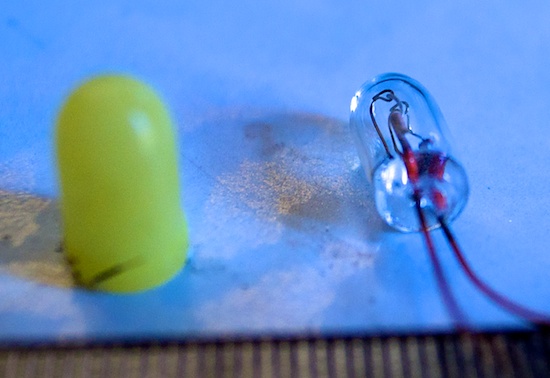
I've opened it up and moved it pretty much on to frequency (by ear using the 3.699 VK2WI beacon). The dead dial lamp has been removed - it's a tiny 12V incandescent lamp. The hole is too small for any of the LEDs I have laying about.
The lamp is inside a yellow rubber holder. Those ruler gradations are half millimeters, it's pretty small.
WSPR is a wonderful tool for comparing HF antennas. I "spot" and get "spotted" all around the globe running just 2W into my outdoor wire dipole on 20m. A few stations are often very strong and I wondered if I could be active with just an indoor end fed wire.
About 10m of wire running around the book shelves tunes up nicely with the ZM-2 Z-match tuner. A 1.5m counterpoise runs around the floor.
Despite all sorts of local electrical noise in the room from fluorescent lights and computers I'm hearing Ross, VK1UN (in Victoria) pretty well.
VK4BV and VK1UN are both decoding me 700km away in opposite directions north and south.
Note that previously VK4BV had me at +10db SNR and now I'm -9 so that's much worse but due to the huge dynamic range WSPR can handle it's great to get a reading at all.
Later it's getting better:
WSPR provides a good platform for evaluating indoor antenna options.
In spare time I've been working on my entry for the ARNSW home brew group challenge project which is to build a low power AM transmitter for 7.125MHz.
There have been a couple of false starts here. First I ambitiously tried to make a pulse width modulated transmitter but couldn't get it working. Next I tried high level AM modulation using an audio transformer but I think it saturates and I could get only very small modulation with it.
Now I'm trying low level modulation of the IRF510 power stage. This looks distorted but seems to be working pretty well.
The AF board uses a pre-amp with AGC picked up from a recent trash and treasure at Dural (thanks John VK2ASU). For the power stage is a module from Jaycar - I know, a bit slack on my behalf, but an audio power amp is the least interesting bit for me.
The RF board starts with parallel 7.122 crystals pulled as close to 7.125 as I can get, a buffer stage, a driver, an IRF510 final and a low pass filter.
Along the way, the bias on the IRF510 got out of control making a big bang and releasing its smoke. I now use a current meter at all times so I can spot thermal runaway before catastrophe strikes.
Happily they are cheap.
Lots of work still to do and I'm very much looking forward to having a contact with this tangled mess.
Now that Rasberry Pi has passed electrical compliance certification I went to take a look and see if I could order one. Previously I've only been able to register interest.
Turns out Element14 will take orders with of up to 1 per person. The supplier lead time is listed at 143 days.
The other bad news is that to get one of these in Australia adds a $12.95 shipping charge to the $38 price of the board taking it to $56.05 once GST is added. Not so cheap, but not so bad for a unix capable single board computer.
Latest improvements are thicker spot polylines for stronger reports and if you roll over a trace it pops up details of that spot. Any feedback most welcome.
Great excitement as the Elecraft KX3s are starting to ship. The first one, ordered on December 27, has left the building.
I got my order confirmation early on December 28 but from what I can tell from the newsgroup, that means I might have thousands of orders in front of mine.
By all accounts this rig seems like a very modern, power efficient, technically advanced HF transceiver that is set to replace the FT-817 around here.
Elecraft has slipped a bit but their communication has been first class and customers like me feel informed and respectful of the quality job they have done bringing a complex new product to market under the bright lights of the internet.
At the meeting on Sunday at Dural, I proposed a construction challenge for the Home Brew Group: To build an AM transmitter for 40m, specifically 7.125MHz.
As in past years, these challenges are not a competition, although we do get together to compare what everyone came up with.
My reasons for suggesting this project are:
7.125 is very active with AM activity here in NSW
AM sounds lovely on air
There are quite a few ways to generate AM
Crystals are available for 7.122 from Expanded Spectrum Systems for $2.55 ($2.15 in lots of 10). I used a technique suggested by Peter, VK3YE, to pull the crystal to 7.124 - which is near enough for AM.
Note that I couldn't get Peter's design to oscillate (I had substituted a 2N2222a I had at hand) but values from this page worked fine.
Ways to make AM
Series modulation, either with a modulation transformer or heising modulation which passes the audio through an RF choke.
Make DSB and re-insert the carrier - there's a bit on this in EMRFD.
Cameron McKay, VK2CKP, was kind enough to give an excellent presentation at today's ARNSW Home Brew Group meeting at Dural NSW. I've broken it in to two parts and posted them on YouTube.
I like the AppleTV. It's tiny, runs cool, has AirPlay and the remote is very simple. As soon as the HD version was announced I ordered online. Weeks later it had not arrived. I followed the status on TNT Express.
The "Card Left Not Home" is untrue. I was here and there was no card left.
When I rang to ask to see the "Proof of Delivery Image" they admitted that it was not any kind of proof of delivery signature.
Turns out when Apple has a major bump in shipping TNT outsource deliveries and they lose real tracking.
In the end they admitted that my package had been lost. Apple was advised. Rather than risk another lost shipment I cancelled the order, was credited, and I dropped down to the local Domayne and bought one off the shelf.
The user interface is 1080p and looks great. Although it came out before this new hardware, the updated software seems a bit of a step backwards to me. I find it hard to see which tile is currently highlighted, the indication is a thin blue glow line.
Last night we hired a movie in HD. Normally when we hire a movie they are ready to play within a few seconds, this one took over an hour. The status showing how long until it can play seems worse than it was in the old version and the estimated time jumped up and down alarmingly.
Compared to other TV boxes we have here, a Boxee, a WD TV Live, and a few no-brand gadgets, the AppleTV is certainly the best but not up to the standard I expect from Apple.
The hardware is great, I just hope the software gets some love soon.
It should get easier to receive high quality short wave digital radio mondiale from April 1, 2012.
"RA will commence a DRM schedule from its main Pacific station at Shepparton, Victoria, from 1 April 2012. Average power is 40 kW from a Continental 418G transmitter. Reception reports welcome especially notifying interference to the RA transmissions.
Broadcasts to central Pacific may also be audible in North America; broadcasts to the south-west Pacific and PNG
may also be audible in eastern Australia. Broadcasts to south-east Asia may be audible in Europe."
It's great to see DRM starting to get some traction. The combination of All India Radio, Radio New Zealand International and Radio Australia means that there will be plenty to tune in to. The AIR DRM schedule is here.
Now we need a new generation of low cost, low power consumption receivers to make it take off.
Update
Bad news I'm afraid. It looks like management have decided not to go ahead with the DRM transmissions from Shepparton at this stage. Very sad.
The WSPRnet map is great but it hasn't been updated to Google Maps v3 so I've started working on my own version here.
Currently I'm scraping the spots from the WSPRnet database display page every ten minutes but I'd love to work with whoever is responsible to make this a bit more efficient.
I've done more work on the map and now it emulates the official map in that you can click on a marker to see who they're hearing and who's hearing them.
There's been a lot of talk about the inadequacy of 16/44.1 compressed tracks recently. The thing that makes a big difference is the bit rate of the compressed files and one of the side-effects of the iCloud music storage system is that it matches your low bit rate tracks and lets you "upgrade" them to 256kbps.
Good instructions on how to go about the upgrade are here. Basically you sign up to iCloud match (just do it in iTunes), submit your collection, then delete all the matched tracks with a bit rate under 256kbps. Finally you re-download them.
I was pleasantly surprised by the number of matches I got. The vast majority of my music is ripped from CDs I own but there are a few others in there that were happily matched.
So now the big download is taking place here. Looks like it will take a day or so to complete. I'm getting 900 KB/sec from iCloud at times which is pretty snappy.
The new collection will be quite a lot larger than before but with the price of disks these days I don't see it as an issue.
Apple's recent announcement about "Mastered for iTunes" and the future prospect of upgrading to uncompressed tracks shows the way forward.
All this is more reason why we need faster broadband now and in the future when we want to listen to our collection streamed live from the cloud.
Update
Over night my library finished re-downloading all the matched tracks. My iTunes folder was 85GB before, now it's 98GB.
My iPhone 4 is starting to lose battery capacity. Apple says that after 400 cycles the battery loses 20%. I charge each night and recently I've been getting warnings in the early evening. There are kits on eBay that give you a battery and the tools you need. I purchased one for $8.95 with free postage. It came next day.
It's curious that the QR code is defaced. I wonder why. The screen suction cup wasn't needed and I soon had the battery replaced.
It was nice to remove a bit of pocket fluff that had crept in too.
Instructions on how to replace your battery are widely available on YouTube. I watched this one.
It remains to be seen what effect this has (the battery came virtually discharged). It was an easy and cheap process.
Update
I'm very happy with the new battery. At the end of of a day of normal use I was getting the 20% warning, today (after a full charge over night) I'm still at 89%. It's like having a new phone again for $9.
Tuning a radio by pressing keys or even mouse movement doesn't quite have the familiar feel of an actual knob. Griffin makes a nice knob called the PowerMate and I've now hooked one up to PowerSDR and it works well. Here's a demo.
While setting it up I learned of a great collection of keyboard shortcuts available in PowerSDR. I set the knob to send 100kHz up and down keys but in time I'll probably add accelerator modifiers for quicker tuning when needed.
There is a delay in the decode audio so you can't really spin the dial the way you would on an analog radio but perhaps a faster computer and lower latency audio driver will improve this.
We're having widespread rain in NSW at the moment, so much so that the Warragamba is overflowing for the first time since 1998. It's interesting how much havoc widespread sustained rain causes compared to a local intense storm.
We live near the Terry Hills BOM Radar which is great because I can watch the radar to choose when to go for a walk or when to bring in the washing.
The animation above is captured from the BOM site with a cron job that runs every 5 minutes and runs this script:
Here's some video impressions of the Wyong field day:
The numbers were clearly up this year, probably a combination of good weather, well organised parking and the success of last year.
I bought a mysterious 250W HF linear amplifier for $25, enjoyed the usual displays from the Home Brew group, Historical Radio Society and the various vendors.
Thanks to the organisers for another fine day out.
Our old HP Laserjet 1022n has run for many years but since about the time of Leopard a bug appeared in the driver, that still hasn't been fixed, where it will not print every other page sometimes. This drives me nuts.
For $80, at Officeworks, I purchased an HP Laserjet P1102w and after some messing about it's working really well.
First, there is a firmware update that you must install via USB. Second, the wireless setup, which you need to do via a web page configuration while connected on USB is a little non-obvious - particularly the bit where you click a double arrow button move your wireless network over to the left from the scan list.
An HP employee has put a video on Youtube demonstrating this.
Once on Wifi there is a blue wireless light that should be steady.
Now the printer works great on Lion and finds it's own driver. On Leopard I had to install the driver. Best of all I can print from iOS.
As with many printers these days, a toner cartridge costs more than the printer itself.
Important tip - use a static IP address
The printer goes to sleep quite quickly, which is good, but we've had a frequent problem of computers not being able to connect to the printer. What happens is that the printer's DHCP lease expires and presumably because it's asleep, the computers can't find it until you wake it up.
The fix is to allocate a fixed IP address for the printer. Much better now.
I've enjoyed the Ensemble RXTX kit build but I'm having a devil of a time with audio under Windows XP. There's not a lot of ham radio software for MacOS but there is an SDR program called "DSP Radio" from Sebastian Mrozek, who has been very helpful in getting me past some problems I ran into.
The instructions with the software are a little brief and so I wanted to capture my working configuration here for future reference.
I'm using a MacBook Air with an Edirol USB audio device for sending and receiving I/Q signals from the Ensemble RXTX. USB control is via TODO which links to DSP Radio.
Plug in the external audio device. Then run the Apple "Audio MIDI Setup" utility (in the utilities folder). Create a new Aggregate Device and add the external USB device and your built-in audio (for your headphones and microphone).
Make sure to set all the devices to the same sample rate.
Set the external USB audio device as the clock source in the popup.
Turn on the Drift Correction checkboxes (called Resample under 10.6) for the built-in microphone and built-in output.
Open the Audio devices window in DSP Radio.
Select the Aggregate Device as both Input and Output.
Open the Configuration window in DSP Radio. (If there is an existing audio configuration there, just leave it and make a new one, then go back later and delete it). Add a new audio configuration.
First make a receive (Rx) configuration. Unfortunately the name of the devices within the aggregate are simply numbered: Input 0, input 1, input 2, input 3; so you need to play around to figure out which is which. I did this by choosing inputs and whistling until I saw my trace on the waterfall - that meant I'd found the microphone.
In my case I/Q from the radio was Input 0 and Input 1 but it may come up differently for you. Play with the Output popups until you get audio through your speaker. For me it was Output 2 and Output 3. Don't worry that the heading says "Output I and Q", that's for transmit. In the receive context it's just audio out to your speaker.
Note that the audio level was very low for me and I had to increase output gain to hear radio signals.
Here's a screen shot with everything working. The second audio configuration line is for transmit.
Transmit configuration is similar. Make a new configuration. Select Tx. Choose the inputs from the microphone channels in your aggregate device. Choose the Output I & Q for the external USB outputs to the radio.
Frequency & TX control via USB
Andrew Nilsson has contributed SoftRock-USB-Controller-v1.2.zip which talks to the Ensemble RXTX and also links to DSP Radio so that changing the frequency in DSP radio updates the Ensemble. (The file is hosted in a Yahoo group under VK6JBL - you have to join the group to access it unfortunately).
The transmit button in DSP Radio also sets transmit in the radio. Great stuff.
First QSO using PowerSDR under Windows 7
Most of my problems have been sound related under Windows XP so I switched to a laptop running Windows 7 and had much more success. Here's my first contact with VK2HLG - thanks Dave for taking the call.
Sorry about the low receive audio on this one, I'll try to get a better recording next time.
I'm pleased to report that the build of the Ensemble RXTX kit is complete and I've hacked it into a box.
While there is a purpose built box available, I found something off the shelf that is the perfect width although deeper than really required.
Maybe I could fit rechargeable batteries in there?
I built to cover 20, 30 and 40m and reception is working really well. There is lots of software around but my favourite at the moment is PowerSDR IQ. Note that you need to set the audio jumpers to straight through for this software as it has no reverse I/Q setting.
So far I haven't got transmitting going, partially due to the mystery, to me, of how to control it over USB. As you can see I'm fitting a hardware transmit switch for cases where the software doesn't support TX control over USB.
If I inject a tone into the audio input socket and enable transmit in the test utility I can see that it puts out just under 1W, but for some reason the Transmit button in Rocky 3.7 is dim for me:
Update: Duh, OK, figured this out. Rocky only transmits in CW mode.
I would like to thanks WB5RVZ for the fantastic build notes. These really helped me through the process and covered great detail where it is needed.
A few of the transformers were pretty tight by the time I put the bifilar and secondary windings in them but otherwise all went pretty smoothly. I didn't solder any surface mount devices in backwards on this occasion!
My kit was short 1 10K resister - no big deal (or most likely I've put one in the wrong place...). As the construction notes say: Even Leonardo DaVinci would have used an ohmmeter on these had he had one! Those reds and browns are really close.
We mostly use Apple Macs here (except for a Windows XP netbook for some ham radio software). We love Apple's iWork suite but my wife is required to work on documents in Microsoft Word.
She runs Microsoft Office for Mac 2011 on Lion. We have the latest updates of both but her day to day experience is very poor.
The documents she works on are large, hundreds of pages, with track changes enabled and showing lots of history.
Every day, every few hours, Word hangs in some way. Sometimes it shows a black window or a blank dialog box. Mostly we can't quit the program nicely - we must force quit to get out of it.
Word does recover the file without losing too much but it can be distressing for her when deadlines are approaching.
Microsoft do acknowledge quite a few "known issues" but no crashes in Word (only Excel).
This morning, just before heading out the door, we were unable to copy a PowerPoint presentation to a USB key. I know from past experience that Office holds files open even though the window is closed for some reason (no idea if this is still the case but it used to be). We tried to quit all the Office apps, they did appear to exit but when we tried a restart it was prevented by Word.
This software has been around for a long time. People rely on it. I'm embarrassed on behalf of the industry that a user can have such a bad experience every day. LibreOffice is looking very tempting again.
I'm all for going paperless and have switched to paperless notifications of most things, (although I do find myself printing a lot out to hand to my accountant at the end of the year which rather makes me feel like a distributed printing service).
A few Westfield shares means that I get notifications such as the one shown here that just came in.
I noticed that it took rather a long time for my email client to download the email and the "hero" image of "Westfield Sydney City - Feb 12" rendered progressively.
It turns out that the image they embedded in the email, from an email & SMS marketing service called Vision6, is a 6MB image which measures 3495 x 2713 pixels!
It's a lovely image but really, this is abuse of my inbox. Please don't do that.
On the bench at the moment is the Ensemble RXTX SDR. I've built a Softrock receiver in the past but never tried transmitting so this should be fun. I'm building it to cover 20m, 30m and 40m which seems a pretty useful range.
It's a bit hard to order a Softrock, the site often says "check back soon". I happened to be reading the reddit amateur radio site when someone noticed stock so I got in.
There's still a bit to go but I'm now up to the point where I can try the receiver.
(That photo is from before I was ready to try the receiver). The hairy thing for me with these kits is the soldering of tiny surface mount components but I find that I'm getting better (although probably using too much solder) and also the components seem very robust.
Not too bad eh? (Believe me, it's really tiny).
This model has an Atmel processor which does USB so that the computer can control the frequency and transmit line.
My build has not been all smooth sailing. On receive it was super deaf - turned out I'd wound the wrong T5 and it was attenuating the receiver so much that it made almost no difference when the antenna was connected such that I thought something was unconnected.
There's not many stations on but here's a video of a little reception that sounds pretty good, until my WSPR station transmits and blots everything!
Here's a bit more reception:
The Kodak Zi8 does a pretty good job on these clips I think.
Since doing some research on audio quality this week for a RN breakfast panel responding to Neil Young's comments I've been hunting for ways to experience the best quality audio I can get out of my Mac.
I don't have a SACD player but I found some rips in the form of .dff files that contain 1 bit encoded streams at 2.8 MHz. To play these on a Mac you can AudioGate from KORG. It's free but they either want you to have some of their hardware or alternatively use your Twitter account to tweet a little marketing. This seems like a fair deal to me.
The software is written in some kind of cross platform library so it looks pretty weird on the Mac but it works and sounds good. Oddly it claims to be clipping pretty frequently but maybe the track is normalised to use the full dynamic range.
I'm outputting to an Edirol at the highest bit samples and rate I can do.
The software will convert to formats including FLAC:
but as I mentioned they force you to tweet some marketing. Haven't seen this before.