Wednesday, February 08, 2012

HF Loop by Ross 5Z4/VK1UN - T51/VK1UN

Old mate Ross, VK1UN, is currently stationed in Somalia and Mogadishu where he runs WSPR.

In calls via Viber he described an HF loop built from heliax and hose clamps that he's been building and I asked him to send me some photos.

He writes:

"I've been corresponding with Myles VK6ZRY a lot as he has been using a magloop for quite some time now, another notable maploop users on WSPR is Peter DL6NL who has used a loop now for about 2-3 years, maybe earlier (let me check my email). yes, I have email re his loop going back to March 2009, indeed he sent me a photo of it suspended in the horizontal mode over a table inside. Peter typically runs about 200mW on various bands.

I really would like to have a mag loop running on 160m so that I can use WSPR on 160m without having to put up 150m of wire, which is not practical in Mogadishu but a 3m diameter loop supported on plastic water pipe, would be. 

Also the magloop is very narrow in bandwidth and also very sharp in the plane of the loop, one can null out noise sources very easily. 

"I'm beaming to….." takes on a whole new meaning with a magloop, indeed it is bi-directional and, if supported close to the ground, the direction of best radiation is up at, perhaps, 45 degrees from the horizon. Loop currents at resonance are quite high -30 amps in a 3m diam loop on 160m and the voltage at the capacitor can be 5 KV or so and that's why I was seeking a decent vacuum variable, both high voltage and high current. This means I can run up to 75W on a 3m loop with a 4KV capacitor as 100W would mean 5.048KV at the capacitor, still I do not expect to use 75W WSPR too often. 50W, yes! Mind you, a quick calculation for one of three magloop calculating programs shows that even 75W would be 4.372KV at the capacitor! 

There are a few programs that will calculate loop performance and needed capacitance as well as voltage current and a number of other parameters from circumference, diameter of element, frequency and power, these are very useful modelling programs that will calculate for circulator, octagonal and square configurations. Loopcalc, RJELoop and magloop4 are three that I use.

The main issue in Mogadishu will be salt corrosion on the copper tube and capacitor, so I am using plastic coated Heliax which gives slightly different readings from the programs, I guess due to the dielectric effect on the plastic covering, of course that will provide corrosion protection, I have just bought a plastic lunch box/refrigerator box to put the vacuum variable and ends of the loop in to protect from the salt air. The antenna will only be about 300m from the water's edge and in the evenings there is a nice sea-breeze, cooling down everything but bringing lots of salt to corrode!

I have a Flex-1500 but unfortunately the Atom N570 powered netbook has just not got enough oomph to successfully run WSPR, PowerSDR, USB transfer AND decode the spots. Even just running the netbook and an analogue transceiver I do not get anywhere near the number of spots I get if I use the MacBook and the OS X compiled WSPR. To successfully run PowerSDR, WSPR, get USB working properly AND decode, I would probably need a quad core or even a Core i7 and 2-4GB of ram. I just wish PowerSDR was also written for OS X".

Great work Ross! That's a very nice vacuum variable capacitor you have there. I like the fire extinguisher close by.

Tuesday, February 07, 2012

MorseDec morse decoder for iOS

Here's a demo of a morse decoder that works pretty well. MorseDec.


A new version, 1.2, came out today that fixed a bug in the spectrum display. Here's it decoding the VK2WI morse beacon on 3.7MHz. This is simple acoustic coupling to the iPhone's microphone. It's 2:30 in the afternoon and there's a bit of fading so I think it's doing a pretty good job.

Getting to Neil Young's audio quality

Musician Neil Young's interview with Walk Mossberg at the recent All things D: Dive Into Media conference last week is worth a look.

Young says that in the studio he's pretty happy with masters recorded at "24/192" which is presumably 24 bit at 192kHz sample rate (lossless compression). He bemoans the fact that most listeners currently get "just 5%" of the music data in the form of MP3 compressed audio.

I think that's overstating it a little, while the file size might be 5%, the genius of lossy compression is that it doesn't sound 95% worse. Despite apparently having been working with the late Steve Jobs on bringing better quality to portable players, Young never mentions better codecs such as AAC which Apple standardised on, Apple Lossless or the freely available FLAC.

My setup here has a number of external USB audio devices and to find out what their capabilities are you use the "Audio MIDI Setup" app found in the Utilities folder. My day to day headphone driver is a Corda "Move":


Like the Mac's internal audio, it's capable of 16/48, but interestingly it was defaulted to 16/44.1. This probably makes sense as pretty much all my music is from CDs which are sampled at 16/44.1kHz. I have some uncompressed tracks, you can see them in iTunes by getting info:


Again the sample rate is 44.1kHz and the sample size is 16 bit. I would assume that matching the output DAC to the sample rate of the recording would avoid resampling errors and extra CPU effort.

Would a move to 24/192 make a big difference?

Sampling at 44.1kHz means that the theoretical highest frequency that can be reproduced is 22kHz but a tone at that frequency would end up being a square wave that would be low passed filtered back to a sine wave - no doubt bearing little resemblance to the original waveform except in frequency. While I certainly can't hear beyond about 15kHz these days, I'm confident that others, particularly teenagers, can. Going to 192kHz seems a big jump. Perhaps 96kHz would be a good next step.

24 bits instead of 16 doesn't seem like a huge leap and given that storage and bandwidth go up by a third every few months I can't see any reason not to go to 24 bit.

Compressed bit rate

The other part of the equation is the bit rate that lossy compression must fit the audio in to.

Apple made the move to 16/44.1 AAC at 128kbps in the iTunes store without being pushed a few years ago and one of the benefits of their cloud music system is that they give you a better version of your tracks if required. (AAC is better than MP3 and a bit rate of 128kbps AAC is generally agreed to be equivalent to 196kbps MP3).

My guess is that further increasing the compressed bit rate would give a greater improvement to the perceived audio than increasing sampling or sample size bits. Of course no lossy compression is where we need to get in the end.

High resolution source audio

Increasing the sample rate or sample size beyond the original that most of us deal with every day - Audio CDs, will not improve the audio. Short of original recordings, the only other widely available source of high quality audio are "Super Audio CD" (SACD). These are recorded at a sampling rate of 2.8224 MHz  and encoded as direct stream digital which is hard to directly compare with 16/44.1 but given the claimed high frequency response limit of 100kHz, seems more than twice as good, and arguably good enough for Neil Young. (It would be interesting to quiz him about this).

I found some 24/96 audio and was able to play it with VLC (although my USB DAC will only sample up to 48kHz):


Turns out I have an audio device capable of playing this without loss. It's an Edirol UA-25EX. Once the driver was installed it can do what we want:


It sounds pretty good, particularly the cymbal sounds I think, but to be honest at my age it's probably lost on me.

Pay for quality option

Another interesting thread in the interview was that "piracy is the new radio". He's talking about customer learning about new music by first getting a copy from someone and then going on to buy the tracks.

We already pay a little extra for an HD version of a movie, (and I always do pay the extra personally), it makes sense to offer more options including very cheap versions for small screens.

In the case of music, where it is often being consumed in noisy environments or simply as low level background, it might be good to have very low priced - (or even free) to a low bit rate, possibly compressed and equalised to suit the listening environment. There would be the opportunity to "upgrade" to a high resolution version.

Young's comment about it taking 30 minutes to download a decent quality version won't prevent piracy of these versions as it's clear that consumers currently download HD movies without much sweat and speed will relentlessly increase.

What really makes the difference to audio listening quality?

Before all of these upgrades, the first thing to upgrade is speakers/headphones and amplifier. I recently purchased a pair of Sony MDR-7506 headphones and have been very happy with them. Day to day I use a little headphone amplifier and have built several Chu Moy amplifiers that really sound great.

Young is kind of right but doesn't realise that our existing hardware is already capable of increased quality in the form of lossless support and slightly higher bit rates. I'd like to see sliding price scales for better quality digital audio so that those who want it can get it.

Discussion on RN Breakfast

We had a panel discussion on RN breakfast this morning. Got a big listener response which was great. Here's co-panelist, Robbie Buck, standing by for air on the "brefast" show:


We had a bit of fun and played a vinyl record and then an MP3 for the listeners, many of them on AM radios. Lots of emails from people preferring the vinyl version.

iTunes store accepts higher resolution audio

I've just read in “Music as the Artist and Sound Engineer Intended,” that iTunes has asked publishers to submit high-resolution 24-bit/96kHz files, and not original CD masters to create the 256kbps files which are sold as iTunes Plus tracks.

Great stuff!

Sunday, February 05, 2012

Ham radio day in Killarney Heights

The weather in Sydney has flipped back to sunny again. On the bench in the shack is an Ensemble RXTX software defined transceiver. Progress is slow but steady. After the WIA Sunday broadcast we had callbacks on 80m and there was some gear changing hands between Robert VK2ZNZ and Mal VK2BMS so I offered to be the taxi.


First we visited Mal's place to pick up some very well made gear. I learned that they would wind RF inductors with hot wire on to porcelain forms so that the wire would cool and contract and therefore hold tight.


Mal has a fine shack that looks out over a fantastic antenna tower in the back yard. He certainly puts a thumping signal in to my place just across the water.

Next we visited Rob's place.


We listened to the radio for a while.


And played a record. Surprisingly loud.

Mal and I headed off to Pet Barn to pick up supplies during their 20% off sale. We were joined there by NSW Premier Barry O'Farrell.

Thursday, February 02, 2012

Ear piercing through cartilage ends in hospital

My daughter decided to get some new ear piercings a few weeks back. One went through cartilage near the top of her ear.

The ear went red and swelled up so much that the stud disappeared into the wound. Our GP had a go at getting it out but in the end sent us on to hospital emergency, which after the minor surgery, admitted her for forty eight hours.

Mona Vale Hospital did a great job, and it's much quieter than Royal North Shore (where I took my broken toe a few years back).

We've had a very good run with the kids and illness or injury. My daughter hasn't been to hospital since birth and there was some messing with computers to figure out that she had no entry in their database.

If your kids want piercings that go through cartilage you can tell them from us that getting them out after an infection is a very painful operation. Infected cartilage is less serious than a bone infection but still quite serious.

Sunday, January 29, 2012

Grand central dispatch plus blocks = bliss

I've been doing some iOS programming recently and needed to load a UITableView with images from a web site.

You don't want to load images synchronously as the view scrolls or it kills the user interface response so that needs to be done in another thread. There is some nice code around to do that but after watching the Stanford lecture on the topic I'm totally turned on to the GCD block pattern where a lump of code is written in line but gets run in another thread.

Here's a snippet from my - (UITableViewCell *)tableView:(UITableView *)tableView 
         cellForRowAtIndexPath:(NSIndexPath *)indexPath

// Load the image with an async block executed in another thread
dispatch_queue_t downloadQueue = dispatch_queue_create("image downloader", NULL);
dispatch_async(downloadQueue, ^{
 NSData *imageData = [NSData dataWithContentsOfURL:[NSURL URLWithString:imageUrl]];
 UIImage *image = [UIImage imageWithData:imageData];
 // this has to be back on the main thread
 dispatch_async(dispatch_get_main_queue(), ^{
  cell.imageView.image = image;
 });
});
dispatch_release(downloadQueue);

The effect is that you scroll the table view and the images load later. The code looks pretty ugly (to my eye) but it's much simpler than any alternative and great to have it right there in line rather than off in another mystery object.

Wednesday, January 25, 2012

Six point plan to halt movie piracy

Bouncing off the Megauploads story, I had an opportunity to reflect on RNBreakfast on why there is a widespread problem with people obtaining illegal copies of (in particular) movies.

I think the problem stems from the big studios failing to keep pace with the technology habits of the general public, this has turned Mr and Mrs Average  into a pirate, not because they want to be, but because they can't get what they want.

Here's what I think studios should do to give people what they want and start receiving the money which is currently flowing to Megauploads and friends:

  • Make new content available everywhere in the world at the same time.
  • It should be easy to purchase, without needing to join an ongoing service.
  • The price should be fair so that risky pirate alternatives don't seem worth the effort.
  • Price should slide according to quality - phone size to 4k TV video, extra for 3D, extra for multi-channel sound, extra for extra features.
  • DRM should be permissive and allow a user to move the purchase around their devices.
  • Upgrades should be available - if I rent the phone version I should be able to upgrade to HD later.
Finally, all of the fights over territory and fragmentation of titles across stores should just be solved. I should be able to rent any movie, or TV show, or music, or book, or whatever that has ever been made on any of my devices.

Audio from this morning here.

Tuesday, January 24, 2012

Coffs Harbour Radio Expo, a bit smaller this year

For many years we've headed north to Coffs Harbour at this time of year for the radio expo. Alas, this year it wasn't on - but we decided to go anyway.


It's a lovely place, we often discuss the idea of moving there to escape Sydney. There was a confluence of radio though as I'd just sold an IC-718 on eBay and the buyer was Scott, VK2AET, who lives not far north so we met up and had our own little radio expo in a cafe.


Scott's a great guy and recently lost a lot of gear in a lightning strike to his house - hence the interest in the Icom radio. We had a very interesting chat and I hope to catch up on air in the near future.


Despite the deteriorating weather, we had a great time including a chance to view the film Hugo which I highly recommend, particularly to film buffs.

Wednesday, January 11, 2012

Ericsson phone catalog

Rob, VK2ZNZ, showed me a marvellous catalog of old Ericsson telephone handsets. These are drawings but many look photo-realistic and show great skill by the artists.

Ericsson Type AC 110 "Magneto table telephone"

Ericsson Type AC 210 "Magneto table telephone"

Ericsson Type AB 140-145 "Magneto wall telephone"

Ericsson Type AC 130-140 "Magneto table telephones"

Ericsson Type AC 1000 "Extension table telephone without generator or bell"

Ericsson Type BC 1300-1301

Ericsson Type BC 2050 "Battery ringing table telephone"

Ericsson Type CL 510

Ericsson Type AC 100

Rob has some of these phones and you can truly say they were built to last. I called him on skype and he answered on a magneto table telephone.

Kodak Zi8 pocket HD video camera to watch out for

Dave, VK3ASE, tipped me off to this one. There's a, now obsolete, video camera from Kodak (soon to be obsolete too), called the Zi8. It has two things I look for - high quality video and an audio input port. Here's some test footage, but I recommend you go to YouTube and switch to HD to watch it here.


Highlights are burnt out and it really needs a tripod to get good quality. It's much better than my existing Canon video camera and very compact.

Here is an example of the 15cm close up mode:


Incidentally, I'm selling this IC718 on ebay at the moment.

I paid a little over $80 for the Zi8, they're a bit hard to find but they are out there.

Here's a picture from Kodak's site.


Native recording format is .MOV containing H.264 video with AAC Audio so it's perfect for my uses and uploading to YouTube.

Sunday, January 08, 2012

Charming sketches from travelling friend

Old friend Jennifer Lewis has just returned to Australia after working in London and Indonesia. She's been doodling in a sketchbook too good effect.


Check out her blog with scans of her sketches as she's not getting much traffic so far. Great stuff!

Friday, January 06, 2012

SyPy in the pub with Malcolm Tredinnick

An informative, entertaining, tasty, thirst-quenching meeting of the Sydney Python group was held last night in a pub in the Sydney CBD (instead of at Google for a change).


The new venue had has pros and cons. On the plus side, we could order Thai food which was delivered to us when ready; it's a nice central location, just near Town Hall; and the house beer was just $3.60 a scooner. The down sides were some street noise and a bit of a flow of patrons through the presentation looking for dunnies.

Malcolm, a long time Django contributor, ran through the top security risks and talked about how Django protected us from ourselves in general. I've had the experience of one of my apps being formally externally security audited. Being a Django app it came up pretty well except for a few things that I had introduced.

Malcolm pointed out that Django's attention to security ironically makes us more likely to be kidnapped and "rubber hosed" by attackers!

It was great to get together and as always the chats with others in attendance were interesting and valuable. Thanks to the organisers, particularly Dylan.

Tuesday, January 03, 2012

A perfect day: work, social and soldersmoke

The weather has turned in Sydney and we have very pleasant sunny days with a refreshing wind.

Today I woke early and went for a brisk walk listening to a podcast. In the morning I worked, doing a geospatial project converting a Django project from Google Maps 2 to 3 as well as working to handle complex polygons efficiently (tens of thousands of points) with holes in them.

Lunch with Jonathan, then some more work followed by some quality shed time.

A kit arrived from QRP Kits, it's a DC40B CW transceiver. I'm still struggling to learn CW and I thought that having a CW only transceiver might help with my motivation. Instructions are good and it was lovely working in the shed with a breeze through the window blowing the solder smoke.

Over the past week there have been numerous visitors to the shed. Dave, VK3ASE, George, Bob, Dave VK2HLG, and Indy (ham call coming soon).

I'm on 20m WSPR and band conditions are really good. I'm running just 1W (the minimum my rig will go down to) and getting spotted right around the globe including by K1JT himself.


My reception seems quite low in noise and I'm also hearing lots of stations.

Thursday, December 29, 2011

Xmas present to self: Sony MDR-7506 Headphones

In this age of tiny computer speakers, or worse - laptop speakers, it's easy to forget just how good music can sound in a decent set of headphones.

I must be a bit of an addict as over the years the headphone collection has grown to more than ten pairs. While you generally get what you pay for, it's not always the case.

There's a bit of a balance to be struck between comfort and quality. When walking (where I listen to podcasts) I use either a little Bose on-ear pair or the Apple in-ear headphones - although I don't like the noise I hear as the cord moves around.

At my computer I've ended up using a Sennheiser HD 212Pro which I find very comfortable and pleasant despite a pronounced bass boom.

On the podcast front, I was a dedicated listener to Leo Laporte's TWIT network but the ads have grown to be so long as to sometimes go for five minutes or more. I'm also finding the density of useful information and unique insight has dropped. They do a great job and it must be hard to keep up the pace.

This year, 2011, I've discovered Dan Benjamin's 5by5 podcasts. I'm addicted to Hypercritical with John Siracusa and Talk Show with John Gruber. Host Dan Benjamin is a great host and sensitive interviewer, further he clearly cares about audio quality. Dan sounds great and chastises guests when their audio breaks up (I'm looking at you Gruber).

Dan has kindly published details of the equipment he uses and when he raved about the Sony MDR-7506 for just US$85 I thought I'd track down a pair. Foolishly, my first thought is I'd visit the local Sony Centre, imagining it would be like an Apple Store with every thing they make. The Sony store looks like an Apple store without any customers. They told me that the 7506 is obsolete and sold me the nearest thing: MDR-ZX500. While comfortable, they are disappointing lacking sparkle and I was soon back to the 212Pros.

In a Twitter exchange, Dan urged me to get the originals and today they arrived.

I really like the MDR-7506 headphones, wide response, smooth low end, sparkling high end response. They are comfortable and the curly cord is convenient (I often run over the long Sennheiser cord with my chair).

Here in Australia I ended up paying AU$167 (including fast shipping) via eBay seller onlyonline.

Tuesday, December 27, 2011

Shed visit from VK3ASE

Dave came to check out the shed. Unfortunately during coffee he was struck by a car...

Seems OK now.

Incidentally, WSPR on 20m is the busiest I've seen it:


Monday, December 26, 2011

Apple Lion Internet recovery a good thing

It used to be that I was in a tiny minority who used a Mac. I've always regarded this as a competitive advantage - I got on with my work while others fought with viruses, weird behaviour and a generally hostile environment.

Something's changed and a few years ago fellow programmers all switched to Macs, now this has broadened to the extended family too.

One potential drawback is that I'm the tech support "go to" guy.

A sister-in-law, who's never used a Mac, recently went wild and purchased a second hand 17 inch Macbook Pro. She used it for a day and then dropped it which killed the hard drive. Very upsetting.

She left it with me on Xmas day and I've just had the pleasant experience of using Apple's Lion Internet recovery feature.

Lion has a recovery partition on the boot drive which lets a tech person do a disk utility Repair or even a clean install. In this case the drive was damaged and so by booting holding down Command-R and choosing a Wifi network, the machine downloads this software from Apple.

In the future, when most machines out in daily use have this feature, it will be fantastic for front line support people - in the past we've had to build up a collection of software CDs for every different model.

I replaced the damaged drive with an old drive I had lying around. Turned out it contained Ubuntu which booted up and looked great. After re-formatting the drive, the install takes about half an hour.

Friday, December 23, 2011

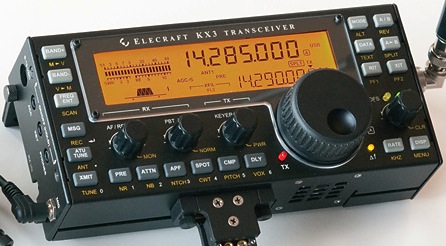
Elecraft KX3 is coming

A new ham radio is about to become available and like too many others, I'm waiting to find out the price and place my order. The Elecraft KX3 looks like a worthy successor to the popular Yaesu FT-817 for portable low power operation.


This radio covers 160-6 meters, power 10W, weighs 0.7kg, and can draw as little as 150mA on receive.

Elecraft have said that they plan to start taking orders in December with delivery in February. As I write, December is running out rapidly.

There is an active Google group with over a thousand members who are currently all asking if there's any updates yet. Actually, the conversation turned amusing yesterday with people joking that they'd received theirs yesterday and others offering second hand units for sale. Elecraft's Wayne Burdick N6KR is chipping in every now and then to politely answer every question but the big one.

I can't remember seeing so much excitement before the release of a ham radio product before. Merry Xmas Elecraft, now finish it off and we can all take a break.

Elecraft are so quaint. I love how they've configured their Apache web server so we can view directories.

Update

Just placed my order on 28-December.


Huge archive of scanned 73 Magazine

Stephen, VK2BLQ, sent around an email pointing to a great archive of scanned issues of a popular ham radio magazine from my childhood, "73 Amateur Radio".

They come up in a rather strange order, like all the Decembers together, but they are high resolution scans saved as PDFs so perfect for reading on an iPad for inspiration.

It's a great way to see the march of technology from 1961 through to 2003.

Early editions are valve technology, later there are hybrid rigs with solid state drive to a valve final. Gradually digital frequency displays creep in and there's a marvellous time when having an LED is a feature worth advertising.

There's lots of ads featuring girls with big hair caressing equipment.

This collection, for me, represents what may be a golden age, before everything in electronics just turns into computer chips surrounded by surface mount components.

A few of the home brew group seemed interested in grabbing the set for later viewing so I wrote a little python script to download them from archive.org to share around. (I think I'm being throttled but it's going pretty well).


#!/usr/bin/python
"""
Download pdfs of 73 magazine.


Items at: http://www.archive.org/download/73-magazine-1968-09/09_September_1968.pdf
"""
import os
import urllib2


MONTHS = ('January', 'February', 'March', 'April', 'May', 'June',
          'July', 'August', 'September', 'October', 'November', 'December')


START_YEAR = 1961
END_YEAR = 2003
OUTPUT_DIR = "73 Magazine"
MISSING = ('73 Magazine/73-Magazine-1975_11.pdf',
'73 Magazine/73-Magazine-1975_12.pdf',)


def main():
    if not os.path.exists(OUTPUT_DIR):
        os.mkdir(OUTPUT_DIR)


    for year in range(START_YEAR, END_YEAR + 1):
        for month in range(1,13):
            monthName = MONTHS[month - 1]
            fileName = "%s/73-Magazine-%d_%d.pdf" % (OUTPUT_DIR, year, month)
            if not os.path.exists(fileName) and fileName not in MISSING:
                editionString = "%d-%02d/%02d_%s_%d" % (year, month, month, monthName, year)
                url = "http://www.archive.org/download/73-magazine-%s.pdf" % editionString
                print("Downloading: %s..." % url)
                print("To: %s" % fileName)
                pdfData = urllib2.urlopen(url).read()
                outFile = open(fileName, "wb")
                outFile.write(pdfData)
                outFile.close()
            else:
                print("Skipping: %s" % fileName)


if __name__ == "__main__":
    main()

If you stop the script and re-start it, it will not re-download any that it has. Otherwise it's pretty basic stuff.

Thanks archive.org! Look out for the ladies with tech:


iMac mysteriously shutting down

My wife's 24 inch iMac recently started exhibiting an annoying fault - it would, seemingly at random, just switch off.

Not a crash, not a shutdown, it just powered off.

My first thought was some sort of thermal problem tripping the power supply but oddly it did not seem related to the machine being busy or having been on for a long time.

I ran the Apple Hardware Test software which on very recent machines is built right in (you boot while holding the D key). On this machine it was on the second install CD, you insert the CD, reboot and hold the D key to get it.

Hardware test is a blast from past and uses the old System 7 GUI. I ran all the tests in the most thorough version, which takes hours, and everything came up clean.

The most reliable way to trigger a power off was rapidly launching a bunch of apps so that lots of icons were bouncing together. Very mysterious.

In the end the quickest way to trigger an instant power off was to run the iTunes visualizer. There's the clue - the graphics card.

The local Apple store took a few days and $600 to replace the graphics card and now we're good to go. I've never bought AppleCare, my Apple equipment has been fantastically reliable and the most likely problem - hard drive failure, I can fix myself. AppleCare on this machine would have been $268 per year so it would have broken even on this fault.

Wednesday, November 30, 2011

Australian PV Solar Energy Exhibition

Today I visited the Australian PV Solar Energy Exhibition at Darling Harbour in Sydney.

There were a lot of Chinese PV Solar cell manufacturers on hand and it seems like wholesale prices are diving to an incredible 77 cents per watt (we pay around $5 per watt retail so there's a good margin somewhere).

Interestingly, polycrystalline panels seem to be almost as efficient as monocrystalline and the extra area due to them being rectangular may be the reason.

The gentlemen at Alco Battery Sales were very kind and patiently answered a bunch of questions I had.

Something seems to have gone wrong with the show's timeline and apparently about two-thirds of the Chinese exhibitors didn't get time to clear customs to allow them to attend so it was much smaller than planned.

Several of the manufacturers commented that the withdrawal of the NSW solar rebate scheme had impacted them in a very negative way along with the instability in Europe. Happily, Germany, which has the largest solar program remains strong.

The standout in the show for me was the LED lighting, which I believe will take off in the next twelve months.


Above is a demo showing an incandescent 40W bulb producing the same output as an LED replacement using less than a tenth of the power. LED lights last much longer and in summer there are also savings in the need for air-conditioning.

Awaiting approval are 240V bulb drop-in replacements, 12V AC halogen replacements and 240V fluorescent tube replacements (you remove and bypass the starter).

Monday, November 28, 2011

A talk about setting up a small solar power system

At Sunday's Amateur Radio NSW Home Brew Group meeting I gave a talk about what I've learned about low voltage solar electricity systems.


My thanks to Peter, VK2EMU, for the opportunity to speak and to John, VK2ASU, for shooting the video.

If you find this interesting and want to know more there is a book "Small Solar" available for less than $3 from Amazon for the Kindle and in the Apple iBookstore for iPad.

Sunday, November 27, 2011

Back on WSPR on 20m but not on Windows

I have an MSI U-200 netbook that dual-boots Windows XP and Linux. For a long time I used Ubuntu but when I upgraded to 11.04 wireless networking wouldn't work and being unable to figure out the magic incantation decided to try Fedora.

There's no built WSPR for Fedora that I could find so I've been running it under Windows XP. Lots of people were spotting me (running under 5W from an ft-817) but I got no decodes of other stations at all. This morning I checked out the WSPR source and built it. All of a sudden I'm receiving lots of stations.


Ubuntu has been good to me but I found the switch to Unity a little premature and, quite frankly, Gnome 3 has all the good bits as far as I can tell and seems a lot more complete. It's weird that a desktop could ship without a simple way for a user to add a launcher to the dock (or whatever it's called).

Can't explain why I get no decodes on Windows. Perhaps the sound card is not right?

Thursday, November 24, 2011

Learning iOS 5 programming with Paul Hegarty

When I need to do a bit of Cocoa programming I normally turn to the excellent books from Big Nerd Ranch. iOS 5 and Xcode 4.2 has changed normal practice quite substantially and I was struggling along trying to re-interpret the old code in the new environment.

A couple of days ago the latest videos of the Stanford computer science class covering iPad and iPhone App development turned up in iTunesU.

This course presented by Paul Hegarty is fantastic. It's a best case example of good teaching by a master of what he is presenting. Even the questions from the class are spot on.

I've just got to lecture 4 which took place the day after Steve Jobs died. Paul gives a nice tribute and talks about the years when he worked at NeXT and how Jobs valued the aesthetics of things so much that FMRI scans of iPhone users match up with them feeling love (rather than the expected addiction).

He ends each lecture with "if you have any questions... I'm here."

Update

I'm still ploughing through these lectures and continue to be super-impressed with Paul Hegarty's teaching style and overall knowledge. It's wonderful that Stanford feels comfortable to release lectures of such quality for free to the public - great stuff, a credit to everyone involved!

Humbly, I'd like to propose some constructive feedback:

  • The slides are sometimes very wordy - fine when it's code, but often just descriptions that could be shortened.
  • Sometimes it's hard to read the code shown in Xcode, it ends up being rather soft, perhaps there is a more video friendly font?
And, an Apple TV complaint. The damn thing over-scans and I can't find a way to turn it off. So I lose the menu bar on my TV. I know it's there in the movie if I look in iTunes but you can't see it on the TV. The overscan is not in my TV.

Thanks Paul Hegarty, you are doing great work - thanks for sharing.

To be specific, here's a wordy slide example:


Update

Eight months after this post, I have two apps in the store by me and am now a full time iOS developer for a major media company which publishes a large number of apps. I'm loving my work and continue to learn more each day about iOS programming.

Tuesday, November 22, 2011

HP Laserjet 1022n prints every second page

A note to myself really. We have an old but reliable HP Laserjet 1022n laser printer but ever since Snow Leopard it has been printing every second page, with a blank page in between. I used a generic CUPS driver but the quality is very poor.

I've found a solution for me, that might work for others. If you set the printer's resolution to 600dpi it seems to print all pages and the quality is good. Here's how the setting looks in the print dialog box:


I've saved this as a preset so it comes up by default every time and has worked for me for several months now. This problem has many threads in Apple's support forums and HP's boards so I'm not alone. Hope it helps someone else.

Sunday, November 20, 2011

QRP Portable at Fisherman's Paradise

Just returned from a weekend away, four hours south of Sydney at Fisherman's Paradise. Here's my QRP portable station:


My antenna was a random wire, about 6m long, thrown to a tree from the balcony.

The ZM-2ATU antenna tuner does a fine job with a random wire and a counterpoise and never fails to tune up easily.

Fine copy on the WIA Sunday broadcast on 80m, 40m but best on 30m. I called back on 30m and while the VK2WI station couldn't make me out a few other stations relayed my presence. VK2BGU, VK2BGL, VK2JE and VK2HL were all very strong to me.

Local birdlife came to listen in and stayed for some snacks:


After lunch we went for a walk among the mosquitoes and looked at the local boats.


Back in Sydney and a big week ahead.

Thursday, November 10, 2011

Insulated the metal shed roof for summer

The shed has been marvellous so far, but as foretold by mates Gerald and Ralph, the weak spot will be heat from the sun beating on the corrugated metal roof.


Indeed, when the sun is on the roof, it's like a radiator inside. I purchased R3 poly bats, which I had to split in half so they're around R1.5. Backed and held in place with masonite board. It now looks like this inside:


It's a pretty rough job but the effect is a huge improvement in comfort when the sun is beating down. Foolishly I went along with the offered skylight and of course this isn't desirable in full sun so I've placed the 65W solar panel over it and it covers it pretty well.


I could go on and insulate the walls but wood is a pretty good insulator already so I think the most important job has been done.