Sunday, March 29, 2020

ARNSW Home Brew Group meeting via video conference

With our normal Dural meeting off this month due to the COVID-19 pandemic, we moved online and had a group meeting using Skype. It went pretty well.


Thanks to everyone who participated and we'd love to do this again in the future.


Perhaps, as we meet physically every two months, we could alternate with an online meeting?


Next Skype meeting is planned for noon on Sunday 26th of April 2020.

Tuesday, March 17, 2020

ARNSW Home Brew group & Trash and Treasure meetings suspended due to COVID-19

Today I heard from Mark Blackmore and Peter O'Connell that physical meetings at Dural NSW of the Amateur Radio NSW Home Brew Group and the Trash and Treasure events are to be suspended. Mark suspects that this may be right up until September, but it depends on how things pan out.

This is very wise as the age profile of the attendees includes some people of an age that getting the novel coronavirus could be devastating.

I am recovering from a quite unpleasant bout of flu. As I wasn't eligible for a test I have no idea if it is the flu. The symptoms all line up - headache, sore throat, temperature, dry cough. For me, it wasn't serious enough to warrant a doctor and symptomatic medication was enough, although it was rough particularly at night. It's taken about ten days so far and I'm feeling better each day.

Social contact via Ham Radio seems like an excellent option at times like this. As Bill, N2CQR, points out in the latest edition of the Soldersmoke podcast there is no evidence, at this stage, that the virus can be transmitted via amateur radio, although there is some concern about 80m.

Sunday, March 15, 2020

Radio Australia Shortwave broadcast antennas in use again!

This weekend there is a special event under the callsign VI3RA where amateurs are able to use the amazing antenna array that used to be used for Radio Australia at Shepparton.

I listened in on 40m using the VK2OB KiwiSDR at the CSIRO Australia Telescope Compact Array at Narrabri NSW. As expected, the signal was excellent.

Of course I really wish we were still broadcasting on shortwave to Australia, the Pacific and Asia from this or another facility but sadly that is not the case.

Here's a short recording.


These Web SDRs really are a fantastic development.

Friday, March 13, 2020

Ham Radio on a Chromebook?

Chromebooks are generally low cost, low spec laptops that run a simpler operating system than Windows, Macs or Linux machines. As there’s less going on, the battery life can be excellent, sometimes ten hours or more. The Chrome browser runs really well and if you live in the cloud, and do everything through a web browser, a Chromebook is a great choice.

Chrome OS is very secure and updates itself regularly. The Google suite, which includes all of the office apps you might want, can be set to cache a copy of docs locally so you can work on them offline.

Under the hood, Chrome OS is a locked down version of Linux. There have been ways in the past to turn off this security so that other Linux apps could be installed but that was risky. In 2019, Google announced proper Linux support for Chrome OS.

To maintain the secure environment, the official Linux environment runs in a virtual machine. There’s a handy way to copy files over to your Linux home directory right in the Files app but the Linux environment can’t access the Chrome OS files unless you explicitly choose “share with Linux” in the Files app.

What you get is a terminal and a pretty standard Debian 9 world with a few things installed such as git, vim and ssh. Using apt you can install many popular ham radio packages such as fldigi and wsjt-x. Here is fldigi running next to an Android app on Chrome OS:


The virtual Linux environment has access to networking, USB ports and the ability to draw windows on screen and it seems to run quite well. The bad news, at the time of writing, is that sound doesn’t seem to work. I can see likely looking sound devices listed in the PortAudio device popups but no sound seems to come in or get out.

There’s a ticket open about audio capture, it appears to be an issue that the Linux VM needs a way to be given permission to access audio devices on Chrome OS. Work needs to be done both by Google on Chrome OS and by the Linux kernel maintainers on Linux.

Note that running the Linux virtual machine is said to cut battery life by about two hours.

Modern Chromebooks can also install and run many Android apps by simply using the Google Play store. Android apps seem to run in a phone sized window and work pretty well. The first ham radio app I went looking for was SDR Touch but unfortunately it’s not listed. My guess is that the special access it needs to talk to an RTL-SDR is not possible on the Chrome OS platform.

Chrome OS Observations


The micro SD card seems like a good way to expand the small built-in storage (64GB in my case). I inserted a card with music on it but when the Chromebook wakes from sleep it complained that I hadn’t unmounted the card before ejecting it. Battery power had drained much more than usual during this sleep as well, perhaps it was waking to check the card or something?

I find the icon for settings, a cog, is visually similar to the icon for screen brightness, a sun circle. Several times I’ve clicked the brightness hoping to get to settings.

The “shelf”, which is like the dock on macOS, can be used to launch applications including those in the Google suite. It took me a while to figure out how to put website launch buttons there. The trick is to go to the site, click the three vertical dot menu top right, open “more tools…”, choose “create shortcut…” and then make a shortcut to the site. These shortcuts appear on the “desktop” which can be accessed from the search key. Show the desktop and drag the icon to the shelf. This should be easier.

Lenovo Chromebook S340-14


I purchased this 14 inch Chromebook for $397. The main reason, apart from learning about Chrome OS, is to use it for reading mail and news in the morning while having breakfast. The morning routine is exclusively looking at web sites in a web browser so a web only machine is a perfect choice.

This Chromebook has a high resolution screen for the money. 1920x1080 with a matt surface. It’s said to be 220 nits in brightness but I find the contrast quite low. Many Chromebooks, and in fact surprisingly many low cost Windows laptops have screens that are just 768 lines high and this is not enough for viewing web sites that increasingly overlay the page with annoying requests to agree to cookies, sign up for newsletters, or have you watch floating videos.

The chiclet keyboard is good and the trackpad works very well - not to Apple standard - but responsive.

This laptop has USB-C ports on both sides, something I wish Apple would do on all laptops, so you can charge from either side with minimum cord crossing. It comes with a 45W USB-C charger but charges just fine from various USB-C chargers I have around the house. Other ports are two USB-A ports, headset, microSD slot.

CPU is Intel Celeron N4000 (2C / 2T, 1.1 / 2.6GHz, 4MB). 4GB RAM and 64GB eMMC storage. If you use Google’s cloud storage, this is perfectly fine. The camera is pretty bad. Sound from the speaker is tinny.

Running Chrome OS means that the laptop boots quickly, wakes instantly, and runs the Chrome browser better, I think, than any other platform.

Battery life is good. In my use as a breakfast news consumer, I charge it every few days (perhaps 4) and don’t feel panic as the battery level drops. It does seem to run down rapidly towards the end though.

I'm a big fan of USB-C, I know it's not cool to say so. Plugging a 4k monitor in via a USB-C cable worked perfectly and a second desktop appeared with plenty of space. It defaulted to tiny text but that's easily changed in device settings.


As expected, this single cable not only passes video and audio but also charges the laptop.

Conclusions


If you’re looking for a low cost laptop for browsing the web, particularly if you use Google’s mail and other cloud tools, a Chromebook is a great choice. I would recommend one to a non tech savvy user just as I would suggest an iPad.

The recent feature of being able to run Linux apps is interesting and means that as a unix user I can install power tools like Visual Studio Code, python, even graphical Linux apps.

Ham Radio on a Chromebook?


At the time of writing, the main missing piece for Ham Radio applications is access to sound. Devices are listed and I’m sure one day soon this will be solved. So, ham radio on a Chromebook? No. Not quite yet.

This conclusion is in line with Betteridge's Law.

Monday, March 09, 2020

Enjoyed the 48th Model Railway Exhibition at Forestville

One thing I'll definitely miss as we move away from this area is the annual model rail exhibition that is just up the road. Here's a few impressions:


WifiTrax is a good idea but it didn't work very well in a busy environment with lots of hot spots.


Hearty congratulations to the North Shore Radio Modellers Association Inc. who run this fantastic event.

Tiny toaster ovens are the best ovens

As part of the downsizing project here we threw out or sold a lot of things. Our old toaster oven had been damaged by me cleaning it with oven cleaner. Big mistake on aluminium walls!

I really missed the toaster oven. The small internal volume means that it gets up to temperature in seconds and the heat is very even.

After struggling with the big oven in the kitchen for a few months I decided to lash out and purchase a replacement. The Sunbeam 9 litre shown here at Myer was available at The Good Guys for $59 so that's where I purchased it.

The signature dish in one of these is a ham, cheese and tomato toastie, but tonight we had little quiches. Very nice.


Thursday, March 05, 2020

How to see LoRa on an RTL-SDR waterfall

I've tried to see the LoRa chirps in the past but they were always too quick. John, VK2ASU, has figured out how to slow down the chirps and spread the spectrum enough to see this:


Here's the settings used:

LoRa.setSpreadingFactor(20);
LoRa.setSignalBandwidth(62.5E3);

Thanks John!

Decoding a Digitech Wireless LCD Thermometer

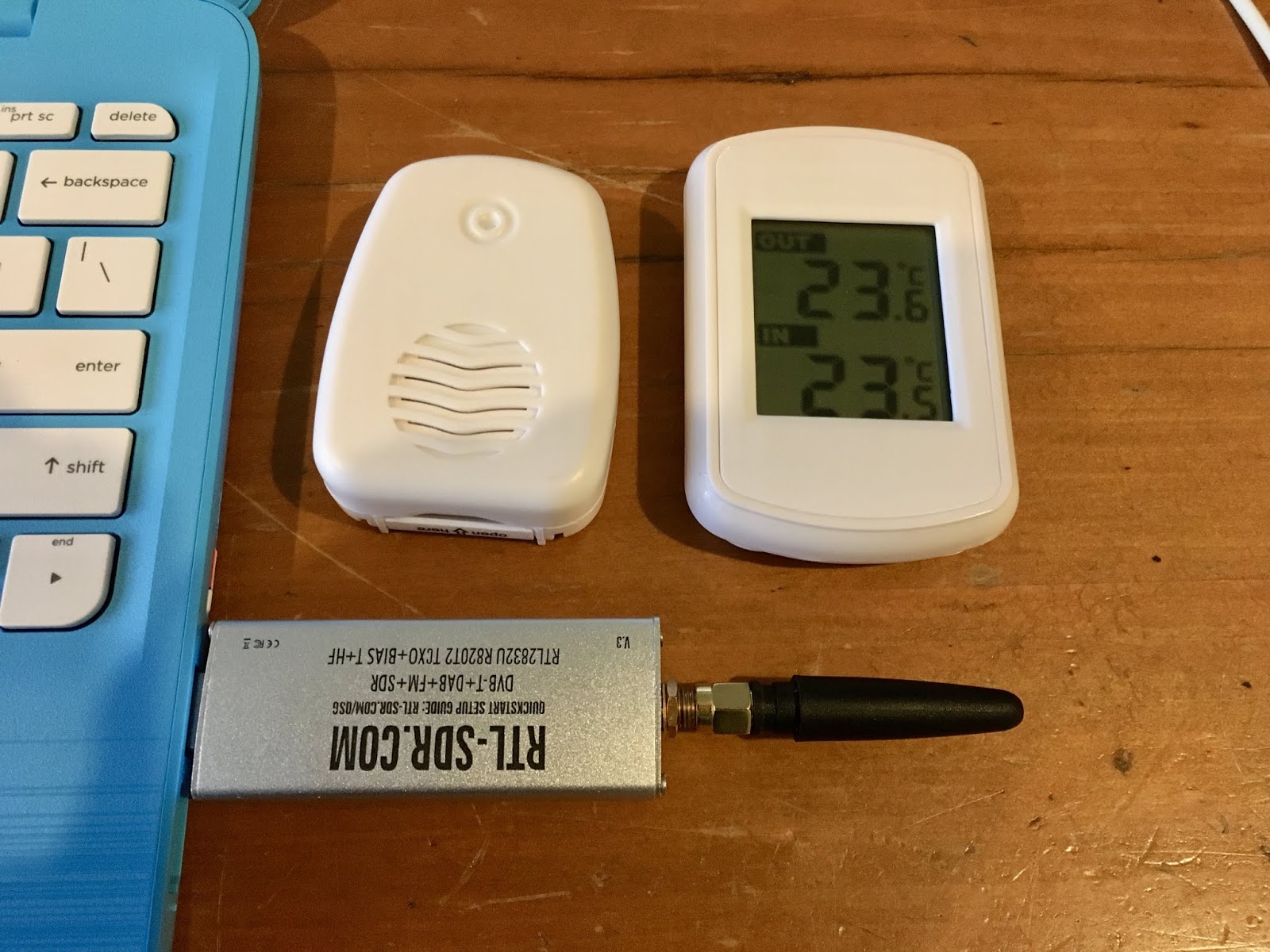
Just picked up a AU$20 indoor/outdoor wireless thermometer from Jaycar. It mentions on the back that it uses 433.9MHz so I connected an RTL-SDR and ran the omni decoding rtl_433 command line tool. Simply installed using apt on Ubuntu.


The remote FT-004-b temperature sensor sends a reading once every 60 seconds. There's a little LED that blinks just before it sends. Here's the setup.


rtl_433 can output decoded data in a variety of formats: kv|json|csv|mqtt|influx|syslog,  so this could be handy for logging temperatures. rtl_433 can decode about 150 different devices and there is documentation on how to add more.

It supports the following modulation types:

OOK_MC_ZEROBIT :  Manchester Code with fixed leading zero bit
OOK_PCM :         Pulse Code Modulation (RZ or NRZ)
OOK_PPM :         Pulse Position Modulation
OOK_PWM :         Pulse Width Modulation
OOK_DMC :         Differential Manchester Code
OOK_PIWM_RAW :    Raw Pulse Interval and Width Modulation
OOK_PIWM_DC :     Differential Pulse Interval and Width Modulation
OOK_MC_OSV1 :     Manchester Code for OSv1 devices
FSK_PCM :         FSK Pulse Code Modulation
FSK_PWM :         FSK Pulse Width Modulation
FSK_MC_ZEROBIT :  Manchester Code with fixed leading zero bit


Thanks to John, VK2ASU, for the nifty 433MHz SMA antenna.

Tuesday, March 03, 2020

WSPR Watch app comes to macOS

Some years ago I created an iOS app called WSPR Watch that queries the WSPRnet.org website and displays spots. As WSPRnet is free, my app is free (unlike at least one other).

Last year Apple released the ability to easily port iPad apps to macOS and so with just a few changes I was easily able to produce a macOS version.

Here's how it looks showing spots received by Phil, VK7JJ, who has particularly low noise reception in Tasmania.


The app has been approved by Apple is now available in the macOS App Store. Because of the Catalyst porting system it is only visible to people running macOS 10.15 Catalina.

I hope you like it.

Sydney house sold

The process of selling our home in Sydney is over. We accepted a reasonable offer a few days before the auction. While there's a chance of a bidding war pushing the price up at the auction, there's also the risk of only low or no bids so it seemed wise to take the offer.

We selected a well known real estate agent and basically took all of their advice except that we didn't bother with advertising in the newspaper. I figure that the buyers would be a young family who would most likely only look online.

After downsizing and storing lots of possessions in Victoria (where we are moving), the house was "styled" which means lots of cushions, throws, big lamps and vases. (See photo above). Looking at other houses on the market it seems they all look the same which I guess helps when comparing.

Having the house open for inspection is an intrusive affair. Visitors seem to open everything, including draws in furniture which is not part of the property. We got very good at cleaning the place but I'm happy that's over.

Now that the "styling" has been taken away, I've thrown a wire out and am listening on 20m for WSPR signals again.

It's a long settlement so we're here until May. Next step is to find a rental in Melbourne and then start looking for a new home.

Tuesday, February 25, 2020

Wyong Field Day 2020

The Amateur Radio field day at Wyong this year seemed relatively quiet but had some very interesting gear on display.

All sorts of old gear was on display under the awning.


Commercial displays were in a large tent.


Tecsun Radio, who are mostly known for selling shortwave receivers, now have an amateur transceiver, the XIEGU G90, in their range.


The Amateur Radio NSW Home Brew Group had a wonderful display and here's John, VK2ASU, ready to explain the gear.


Recently, John and I, have been experimenting with LoRa transceivers and John showed a short message transceiver system.


Tuesday, January 14, 2020

Downsizing and moving

A few observations.

There is some sort of bag collecting addiction at work here. It became clear when all bags were removed from cupboards and placed on the bed, Kondo style.

After decades at this address in Sydney, we are downsizing, selling and then moving to Melbourne.

It’s been great, but the kids have both grown up and have ended up in Melbourne, so it makes sense that we go there too. I grew up in Melbourne so it will be great to re-connect with old friends there.

We’ve been rattling around in a house much too big for the two of us but of course, having lots of space makes it too easy to accumulate stuff.

Getting rid of things takes work and often costs. I’ve been selling some items on eBay but unless they’re going to fetch over $200 it’s not worth the time and frustration of dealing with buyers and shipping.

I sold an Apple laptop which I had been using as a test machine. The buyer, clearly a dealer, made low-ball offers but eventually won the auction. When he received the laptop, he wrote and said that he’d run the diagnostics and the RAM was bad so he wanted a reduction in price. I was suspicious and simply offered to fully re-fund if he returned it. When it came back, I ran the diagnostic and the RAM is fine. My conclusion is that this is a scam by the buyer to get a better price. This cost me two lots of postage and some mental anxiety.

The local tip won’t take paint. Council collection won’t take building materials or anything smaller than a bread box. Gas bottles can be left at the Swap n Go point at petrol stations. Books go to the local Vincent de Paul shop - who seem happy to have them. The skip bin is filling and happily a bloke turned up in a truck looking for metal.

It’s a weird feeling watching someone go through discarded possessions looking for things he can flip for metal or other value.

Going through all of my possessions, deciding what to keep and what to throw out, is strangely exhausting. Many items trigger memories of one kind or another. I’ve been taking photos of treasured mementos. At this stage of my life, a photo is enough.

There’s a sadness too, finding projects optimistically started but never finished. Clearly the joy for me is in the construction rather than the use of things. Many electronic projects have been left at a point that they just showed that the design was viable. I guess the challenge went out of it right then.

I will miss the big dipole cut for 40m we had here. Hung from a gum tree at the back of the block it had wonderfully low noise. I'll miss the shed, but the van is a decent alternative.

Having let go of most of my possessions I do feel lighter. If I haven’t touched something for years it’s clear I don’t need it. Right now, buying anything seems very un-attractive, I hope this feeling continues.

So many bags! Every size, every configuration. What madness is this?

Monday, December 30, 2019

Arduino Pro-Mini with 900MHz LoRa on board for environmental monitoring

Recently I started playing with LoRa modules for sending telemetry around. Last time I purchased a 433Mhz module and wired it up to an Arduino Nano Pro board but now I've found a board that has both the Arduino and the radio module on the same board. This is the 900Mhz version.


I'm using a temperature, humidity and air pressure sensor that is designed for the M5Stack system, but is easy to use on its own. The transmit side samples the environment and sends a packet with plain text containing the measurements.


One problem I ran in to was that the transmit side would re-boot when transmitting - the USB power isn't enough to handle the current on transmit. The solution is to lower the transmit power or attach a LiPo battery to the board. I turned the power down to 2dBm (from the default of 17).

Even on this very low power the packets can be reliably be received around my home block.


Here it is in action.


The code is simple and as always, my apologies for how it gets mangled by Blogger.

#include "DHT12.h"
//#include //The DHT12 uses I2C comunication.
#include "Adafruit_Sensor.h"
#include "Adafruit_BMP280.h"
#include "SPI.h"
#include "LoRa.h"

DHT12 dht12; //Preset scale CELSIUS and ID 0x5c.
Adafruit_BMP280 bme;

void setup() {
  // initialize both serial ports:
  Serial.begin(9600);
  Wire.begin();
 
  while (!Serial) {
    ; // wait for serial port to connect. Needed for native USB port only
  }

  Serial.println("Setting up LoRa...");
    if (!LoRa.begin(915E6)) {
      Serial.println("Starting LoRa failed!");
      while (1);
    }
    LoRa.setTxPower(2);
    Serial.println("LoRa ok.");
 
    Serial.println(F("ENV Unit(DHT12 and BMP280) test..."));

    while (!bme.begin(0x76)){
      Serial.println("Could not find a valid BMP280 sensor, check wiring!");
    }
    Serial.println("Env sensor ok");
}

void loop() {
    float tmp = dht12.readTemperature();
    float hum = dht12.readHumidity();
    float pressure = bme.readPressure();

    Serial.println("Starting LoRa packet");
    LoRa.beginPacket();
    LoRa.print("Temperature: ");
    LoRa.println(tmp);
    LoRa.print("Humidity:");
    LoRa.println(hum);
    LoRa.print("Pressure:");
    LoRa.println(pressure);
    LoRa.endPacket();
 
    Serial.print("Temperature:");
    Serial.println(tmp);
    Serial.print("Humidity:");
    Serial.println(hum);
    Serial.print("Pressure:");
    Serial.println(pressure);
    Serial.println();
    delay(1000);
}

Australian bush fires mapped

As you might have read, (particularly for international readers), the bush fires this summer in Australia are unprecedented. At the time of writing, more than 1,000 homes have been lost.

Waking in the morning either smelling wood smoke, or seeing the sun obscured by smoke makes me head to one of the maps showing where the fires are.

The most popular source is the Rural Fire Service's Fires Near Me site and app which looks like this.


There are other sites with good information such as the ArcGIS fire map which shows hot spots. This is interesting because the CSIRO is using infra-red data from satellites to map hotspots (which may or may not be from fires).


GeoScience Australia also has Sentinel Hotspots map.


To see smoke, we can use the Bureau of Meteorology's Sat-View site. This works even better if you play the animation.


Another good one is zoom earth.


When the smoke is really bad it turns up on the BOM rain radar site.


Here's some tourists taking a selfie in front of the Sydney Opera House.

(It's there very faintly).

Saturday, December 14, 2019

Australia - still calling 80 years later

This morning on ABC Radio National, Geraldine Doogue's Saturday Extra featured a fascinating panel discussion about what became Radio Australia - which recently celebrated its 80th birthday.


Photo by Mary Anne Waldren.

The panel includes:

Jemima Garrett, journalist and co-founder of Supporters of Australian Broadcasting in Asia and the Pacific

Ian McIntosh, veteran broadcast journalist, news executive and media consultant

David Hua, head of International Strategy at the ABC

Herve Lemahieu, Director of the Asian Power and Diplomacy Programme, Lowy Institute.

Kean Wong, Journalist and author (calling in from Malaysia)

You can listen here.

Sunday, December 08, 2019

WSPR Watch is back

There's a new version in the App Store that corrects the problem we've been having. I'm now working on improvements to the handling of data from PSKReporter and the Reverse Beacon Network.

WSPRnet has been a bit unreliable lately but the latest version of WSPRwatch will now correctly show if the network request times out. I set the timeout to 30 seconds.

Thanks to everyone who wrote in via the app with feedback and suggestions.


Friday, December 06, 2019

WSPR Watch is down

My free iOS app, WSPR Watch, is a convenient way to display data from WSPRnet.org and a few other ham radio sites. The app stopped working last night probably because something changed in the way the site works. I emulate a browser and for some reason this has stopped working.

I'm sorry about this, it was always on the cards. I'm working on a fix and will get it out as soon as I figure out this little puzzle.

Sunday, December 01, 2019

ABC celebrates 80 years of international broadcasting

80 years of international broadcasting by the ABC was celebrated this week at the headquarters in Ultimo, Sydney.

David Hua, ABC Head, International Strategy introduced the event.

Geraldine Doogue was the MC for the evening. She described the International division as “Taking Australian culture beyond its shores”. Doogue described ABC International as the very best of the ABC and said that the people who work in it have a sense of pride in Australia and work out how to present it to the world.

Ita Buttrose, ABC chair, said “The birth of Australia’s international broadcasting service came at a time of global upheaval, uncertainty and disruption. Australia seemed far removed from the epicentre of conflict in Europe, but the technology of cable and wireless brought the war in to living rooms across the country.”

As Ms Buttrose noted in her recent speech at the Lowy Institute, radio technology also gave Australia the opportunity to speak directly, for the first time, to its near neighbours, countering the propaganda and fake news of the day.

Buttrose referred to the book “This is the ABC”, a history by Ken Inglis, where the author noted that following World War II, when it looked like the ABC’s international service would be drastically cut, the government was warned that if Australia gave up its international frequencies, someone else, perhaps the Russians, would move right in. That was enough to change the Government’s mind and in the post war period, Radio Australia flourished as an integral part of the ABC and served as a vital and effective diplomatic tool.

“Just like the early days of international broadcasting, a disruptive world order, rapid technological change, the growing influence of super powers in our region, and the use of media as a geopolitical tool; are all still very familiar to us today.”

The ABC International service of today is quite different to its past. (Hint: much smaller, and lacking shortwave -editor). Some changes are a natural evolution due to technology and audience demographics, but the current form has primarily been brought about by necessity.

However, Ms Buttrose is optimistic about the future. “In recent weeks, both Prime Minister Morrison, and the Minister for the Pacific and international development, Alex Hawke, have spoken of the importance of marshalling resources to engage with and influence the region and the wider international community”.

“The Minister for Foreign Affairs, Marise Payne, has encouraged Australian communities and institutions to take Australian values to the world in the interests of promoting peaceful, open and inclusive international relations”.

Ita Buttrose went on to say “I believe the ABC has a fundamental role to play in achieving these objectives. We are Australia’s trusted voice in Asia and the Pacific. We have a proud record of achievement, telling Australian stories, reporting fairly and fearlessly, presenting Australian culture and education, and delivering valuable information in times of crisis, and we’ve done this for eighty years”.

“Crucially, our point of difference from state broadcasters and other international media is that the ABC has an independence from Government and the longevity to secure a foundation of mutual trust and respect. An unmatched expertise and understanding. We talk with, not to, our neighbours”.

Buttrose argued that if Australia is to step up in the region, the ABC is an existing platform from which to step up.

David Anderson, ABC Managing Director, has recently shown a commitment to international broadcasting by launching an international version of the iview video on demand platform last month.

“ABC’s international services are a national asset and they have been for a vast majority of the ABC’s history. They’ve been connecting with Australians overseas, sharing Australian stories with the world, and letting our neighbours in the Indo-Pacific region know that Australia is a trusted friend. We’ve done that over multiple generations”.

Anderson commented that the international TV service, “ABC Australia”, is available in 80 territories across the Indo-Pacific region. ABC Radio Australia is available via FM relays right across the Pacific. Digital stories published in four languages reach people all over the world through web sites, social media and apps.

“The importance and relevance of international media is as important now as it was on the 20th of December 1939 when Sir Robert Gordon Menzies’ voice echoed across the ionosphere. The more things change, the more they stay the same. Misinformation and fake news are a threat to the rules-based order that we have across the globe”.

Pressure on the ABC and public broadcasting continues.

“Let’s not forget our foreign correspondents who report to and from the region: from the legendary Sean Dorney, Jemima Garrett, Natalie Whiting, Melissa Clarke, and Liam Fox”.

Anderson said “I believe, with the right commitment the ABC can offer even more to the region than what we do now. The question shouldn’t be whether we can afford to have an international media service, but whether we can afford not to”.

My thanks to the organisers for inviting me.

Update

See also "Australia Calling: A look at 80 years of Radio Australia and ABC international broadcasting".

There is a documentary about the history of Australia's international broadcasting. There's even a story about the making of the documentary.

Wednesday, November 27, 2019

Beware of macOS malware

I've always felt pretty safe from malware by running macOS but recently three people I know have found that they have unwanted software on their Macs. In each case, they were tricked into installing software that claimed to be an update to Adobe Flash. I saw this scam recently and I think it was launched from an ad on the page. Here's a screen shot:


checkupdate.mainsourceofupgrade.best yeah right, that sounds legit.

This works I think because we've all been well trained to keep Flash up to date.

The most obvious symptom of the infections I've seen is that your default search engine is changed from Google to Bing. I've no idea why that might be done but perhaps the browser extensions it installs is able to intercept your searches to Bing to better target ads at you.

To check for, or get rid of, this unwanted software, I recommend Malwarebytes which will let you do a scan for free and only asks for money if you want it to remain and keep scanning. This seems very fair to me.

I ran it on my machine and am clean, my neighbour had 17 bad things.


If you choose not to purchase then you can remove it via the Uninstall item in the Help menu.


The malware I've personally seen is "Adware" which seems to install browser plugins to show you more or different ads. It's annoying but the terrifying thing is that once on your computer who knows what it might get a look at.

Apple's macOS is getting more secure with more limits on what applications, including browsers, can access and I support this, despite occasional pain with apps that have to ask for lots of permissions.

Be very skeptical of popups on web sites, or even emails, that ask you to authenticate to install anything.