Showing posts with label ham radio. Show all posts

Monday, July 13, 2020

Great book: "Radio Girl: The story of the extraordinary Mrs Mac"

I'm currently enjoying "Radio Girl: The story of the extraordinary Mrs Mac, pioneering engineer and wartime legend" by David Duffy. It's a terrific story of early radio in Australia and the remarkable career of Mrs Mac, the first, and at the time, only female electrical engineer in the country.

Mine is the Kindle edition but it's also available in Paperback.

Peter, VK3RV, (fellow FreeDV enthusiast) mentioned the book when we spoke recently. Thanks for the tip!

Sunday, August 10, 2008

Back on 20m, doing PSK31 and Bitx20

Picture 2.pngMy primary antenna for the past few months has been an 80m dipole. It works pretty well and I hear lots of regular groups chatting but I really miss my PSK31 contacts.
There is a digital mode range on 80m (3.620 - 3.640) and I've been calling CQ there for some time but have only had one PSK31 contact on 80m and that was a conversation I stumbled across on 3.66Mhz.

The other reason to abandon 80m for now is that I've just constructed a bitx20 transceiver and am trying to get it going.

As you can see from the waterfall on the right, there's lots of PSK31 activity on 20m and I'm seeing US stations pretty well here at 3 in the afternoon.

Sunday, April 27, 2008

Clothesline style antenna hoist for experiments

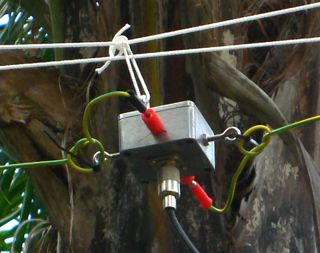
AntennaHoist.jpgI'm experimenting with antennas again and wanted a way to string up a dipole so that I could easily pull it down and make adjustments.
My best antenna is a dipole tuned for PSK31 on 14.070Mhz that is over the roof of the house but while playing with a simple wire dipole between some trees next to the house I noticed it it appeared to pick up less electrical hash and it got me wondering if I should try suspending the dipole out beside the house where I currently have an end fed long wire (that picks up tons of noise).

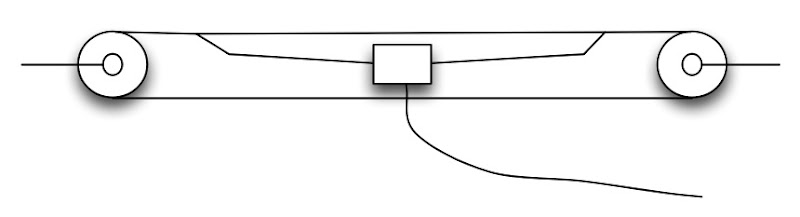
This is a very simple idea, I'm positive others have used it too. I bought 30m of 3mm venetian blind cord and two little pulleys. (I already have a pulley up a tree from previous squid pole activities that was used to hold up the far end).

antenna hoist diagram.jpg
It's too early to tell if having the dipole away from the house is better than having it up higher but over the house but it's great to be able to drag it out and back in again for tuning. (I've got this dipole perfectly tuned on my second clipping).

Yes, I will need some weather proofing before leaving the balun out too long.

Saturday, December 15, 2007

80m loop antenna experiment failure

Just a brief post about some experimentation that has failed.

I've been trying to build a loop antenna for 80m (3.5Mhz) to reduce local electrical noise.

The idea was a 2m diameter square loop built from 1m lengths of electrical conduit. First I built with 1 turn and a 300pF polyvaricon capacitor and it resonated nicely at about 20Mhz. Next went to 3 turns and it seemed to resonate around 9Mhz, then 4 turns and I can't get this thing to resonate at all.

No idea what I'm doing wrong or why this won't work. The family is a little bemused about the structure in the back yard - I tried to pass it off as my version of a Xmas decoration.

I did learn a bit about conduit - there are two main kinds around, electrical and water. Water pipe is designed to carry water under mains pressure so it's much stronger.

Update: Check out Alan's excellent response. I will get back to this project soon.

Sunday, October 21, 2007

Dxpedition with OziPole at Sydney's North Head

Alan VK2ZAY and I went bush this morning in search of a low noise HF location where we could play with antennas, balans, tuners and annoying flies.

I recently built the excellent Ozipole kit and this was a good opportunity to try it out, primarily on 7Mhz.

I've been searching for a location close to Sydney but as far as possible from power lines and houses and Fairfax Walk at North Head seems perfect.


View Larger Map

As expected, this was a superbly low noise location, and as it was the Scout Jamboree of the Air today there were tons of stations about. Unfortunately VK2WI was on low power on 40m and pretty hard to hear.

We played with several antennas and generally had a pleasant time. Notes for the next outing:
  • Take a table of some sort
  • Shade if possible
  • Find a way to carry the gear, (the battery is rather heavy)
  • Something to repel flies
It was wonderful to hear stations perfectly clearly at less than S1, at my home they need to be overwhelmingly strong to be heard. I'll go back to this location - any other suggestions around Sydney would be most welcome.

Thanks Alan for the fine company. He has blogged about this outing here, which refers back to this post so I hope the internet doesn't get runaway feedback and explode.

Update: Turned on 80m this morning at home at 6am and there is no noise. Here's a sample. So the band noise at my QTH must be from an appliance or power supply or something. I need to go hunting for it and I'm also reading up on receiving loop antennas that might let me null out the signal.

Friday, October 05, 2007

HF QRP pleasure with an FT-817

I've just spent a few very pleasant days south of Sydney at Gerroa.

We hired a house on a hill looking out over the beach and I took a Yaesu FT-817 and a slightly modified MFJ random wire tuner along for fun (all I did was add banana sockets for attaching a wire to it).

I strung out about 20m of wire from the balcony to a piece of wood in the yard and it tuned up nicely on 80m, 40m, and 20m. Had a few contacts running just 2.5W (on the in-built rechargeable batteries).

80m is blotted with interference at home. At this location it was magnificently quiet until about 5:30pm when bad televisions get turned on. I really want to find a location with no noisy power lines or TV sets to disturb by HF listening.

Only a few contacts, mostly listening. Just before we packed up I tuned around on 2m and found a very active local community.

Spent the time reading the ARRL Handbook, 2007 and a book by Melvyn Bragg, both really dense and fascinating.

On our last morning, went for a walk with my wife who slipped on a ramp and broke her leg. So quick, so easy. My thanks go out to the good folks of Gerroa who helped us to a car, a doctor and a hospital.

It's amazing how easily we can be injured. Such fragile creatures.

Sunday, July 08, 2007

Antenna hoist installed

It's great to be back home after a few weeks away. Apart from cleaning up the pool (which had gone green), doing my washing, and trying to sync up with local time, I've been trying as always to improve my HF antennas.

Hanging an 80m dipole on a suburban house is no easy task, my goal is an inverted V from the tree at the front of the house to the tree at the back of the block with the feed point above the roof of the (two story) house. 

Shown here is a vertical pole with a pulley at the top that raises up the balun feed point. This arrangement is still not idea, it doesn't clear the peak of the roof and those palm trees you can see in the image are a real problem on our block - they invariably grow and catch on wires I string up.

Just before I went away, "Experimental Methods in RF Design" by Wes Hayward and others, arrived. What a fantastic book! For anyone interested in designing and building RF projects, this is a must get book, clearly it has influenced many other designers.

Sunday, May 13, 2007

Built a roll-up 2m j-pole antenna

I saw Dom Bragge's posting about a 2m J-Pole antenna made out of 300 ohm TV ribbon and thought I'd give it a go.

Although the design specifies 51 inches in length, Dom notes that other builders have found this resonates too high in frequency and they suggest you start at 52 inches. I did that but found that the lowest SWR was at 148Mhz so even that's too short.

Perhaps 300 ohm twinlead material is different to the original designer.

I do have one contribution to make on this topic, it's really hard to strip the insulation from this twinlead. The insulation seems very strongly bonded to the conductors and they always rip out for me. The solution is to melt your way through with a soldering iron.

Some toxic vapour comes off but it seems pretty easy to tin the wires after the plastic melts away. Shown above is the bottom of the antenna where the co-ax connects and the shorting bar at the base. The melting works quite nicely as you can see.

Thanks to Dom for the pointer to this simple and highly portable VHF antenna design.

Sunday, May 06, 2007

Antenna activity

To maximise my procrastination on the morse code front, I've spent the weekend improving the antenna situation here. There are two HF antennas, a 40/80m trap dipole, and a recently improved (by lifting it high into a tree with a squid pole) long wire.

The long wire was used with an excellent Emtron matcher but with just a wire counterpoise in place of a real earth. I had a lot of RF in the room so I've now run that wire down to an attachment on a copper water pipe in the yard pretty close to the house. See picture above.

The dipole was in a sharp V shape from the middle of the house to two trees in the back yard, but with the help of the squid pole and a daughter, I've swung one arm right around, over the house and hung it from a tree in front of the house. So now the dipole is nicely in line and up pretty high.

The feed point is on a TV gutter mount on the second floor, the arm that goes over the roof just grazes the peak of the roof and the ends are both about 3m up. Pretty much as good as I can manage without a tower.

Disappointingly, a comparison with the long wire shows that the long wire antenna performs much better. The coax feed line to the dipole is RG58 but it's crummy stuff with aluminium foil mixed with only a few strands of copper in the shield. Next step is to upgrade that coax.