Sadly, it looks like wsprnet.org is down and has been for an hour or more at the time of writing.
I notice that it has been struggling a bit lately, in particular since the WSPR story made the front page of QST.
Hopefully it isn't too serious. I certainly miss it.
Update
It's back up.
Monday, November 29, 2010


Sunday, November 28, 2010
WSPR analysis with gnuplot
Just posting this for my own reference really. I find that spreadsheets don't really cope with lots of data to plot so gnuplot is the way to go, but it's a little hard to figure out.
I want to plot Ross VK1UN's reception of my WSPR signal using the data on the site. Here's the output I want (pretty much).

To get this, I go to the wsprnet.org site, run a report of my transmissions and vk1un's receptions of me. Then I copy the table data from the web browser and paste it into a text file called "wspr.txt", then I run this python script to clean it up ready for gnuplot.
Then I run the following gnuplot commands to draw the graph above.
One thing that eludes me is how to get the date xlabel to change once a day. Any tips most welcome.
By the way the plot shows two days on the half wave dipole followed by one day on the half size G5RV. Not much between them. (Well, not enough data to tell).
Here's VK6ZRY's reception reports:

I want to plot Ross VK1UN's reception of my WSPR signal using the data on the site. Here's the output I want (pretty much).
To get this, I go to the wsprnet.org site, run a report of my transmissions and vk1un's receptions of me. Then I copy the table data from the web browser and paste it into a text file called "wspr.txt", then I run this python script to clean it up ready for gnuplot.
import csv

INFILE = "wspr.txt"
OUTFILE = "data.txt"

infile = csv.reader(open(INFILE, "r"),
            delimiter = "\t")
outfile = csv.writer(open(OUTFILE, "w"))
for row in infile:
    timestamp = row[0].strip()
    call = row[1].strip()
    sn = row[3].strip()
    receiver = row[7].strip()
    #print("'%s': '%s'" % (timestamp, sn))
    outrow = (timestamp, sn)
    outfile.writerow(outrow)
Then I run the following gnuplot commands to draw the graph above.
set terminal png size 405, 320
set title "40m WSPR VK2TPM - VK1UN"
set output "WSPR.png"
set xlabel "DATE"
set ylabel "S/N"
set xdata time
set timefmt "%Y-%m-%d %H:%M"
set xtics format "%d"
set datafile separator ","
plot "data.txt" using 1:2 title 'S/N' with points
One thing that eludes me is how to get the date xlabel to change once a day. Any tips most welcome.
By the way the plot shows two days on the half wave dipole followed by one day on the half size G5RV. Not much between them. (Well, not enough data to tell).
Here's VK6ZRY's reception reports:
Saturday, November 27, 2010
Electronic technical books will win quickly
I've been lying in the hammock reading my ARRL Handbook and noticed the CD Rom in the back. It turns out they give you a complete copy of the book in PDF format.
Dragged it over to iTunes and found that it is very readable on the iPad. One problem, dear ARRL publishers, is that the files are simply called 01.pdf, 02.pdf and so on, with no metadata. Happily, iTunes can edit the metadata quite easily (although it seems to feel that it's editing music files).

Reading such a big heavy book on the iPad is much nicer than trying to hold the big heavy book up, plus you get search (well, within each chapter).
PDF is OK but the text can be a little small, it would be great to have an ePub version. Quite frankly, I never want the physical book again. It won't be long before most technical book buyers feel the same way I think.
Dragged it over to iTunes and found that it is very readable on the iPad. One problem, dear ARRL publishers, is that the files are simply called 01.pdf, 02.pdf and so on, with no metadata. Happily, iTunes can edit the metadata quite easily (although it seems to feel that it's editing music files).
Reading such a big heavy book on the iPad is much nicer than trying to hold the big heavy book up, plus you get search (well, within each chapter).
PDF is OK but the text can be a little small, it would be great to have an ePub version. Quite frankly, I never want the physical book again. It won't be long before most technical book buyers feel the same way I think.
Wednesday, November 24, 2010
Google search results with page preview
I just got this Google preview display next to my search results.

It pops up quickly as you roll over the result line. Not all sites have previews but lots do.

(click to enlarge).
It pops up quickly as you roll over the result line. Not all sites have previews but lots do.
Sunday, November 21, 2010
CZH-05B 500mW FM transmitter
I like to listen to the VK2WI Sunday broadcast. It's part of my weekly routine. This week I was able to listen to it lying in a hammock thanks to a new arrival, a small FM transmitter purchased on eBay.

It's synthesised for frequency stability. At 500mW it saturates the house but doesn't go much past the neighbours. On the back there is a BNC connector and it comes with a little antenna. No doubt an external antenna would extend the range.
Internally, construction is of a very high standard:

It came with an over the top switched giant power supply. There is some hum evident in the signal but no doubt that could be improved with a regulated supply.
Over the years I've built many little FM transmitters but they always drift to some extent. It's nice to have something stable like this.
I think there could be a market for a radio station that broadcasts selected podcasts, my latest discovery is The Changelog. Now I can just make my own.
It's synthesised for frequency stability. At 500mW it saturates the house but doesn't go much past the neighbours. On the back there is a BNC connector and it comes with a little antenna. No doubt an external antenna would extend the range.
Internally, construction is of a very high standard:
It came with an over the top switched giant power supply. There is some hum evident in the signal but no doubt that could be improved with a regulated supply.
Over the years I've built many little FM transmitters but they always drift to some extent. It's nice to have something stable like this.
I think there could be a market for a radio station that broadcasts selected podcasts, my latest discovery is The Changelog. Now I can just make my own.
Saturday, November 20, 2010
Sony Reader PRS-350 review
 Sony kindly sent me a loan PRS-350 for review this week.
The PRS-350 is a small e-ink book reader, less than the size of a novel (5"), but with a "paper white" touch screen. The display is 800 x 600 pixels and capable of reasonable grey scale display and of course works nicely in daylight. It has 2GB of built in storage.
The review unit I received was pretty grotty from previous users but cleaned up well with a damp cloth. I guess that's the drawback of any touch screen - including the iPad.
Around the rim, the device has slide power switch to wake it up, a stylus top right, one of the various micro-USB connectors (the same as the HTC phone I use which is handy but not the standard one used on many devices, and a reset hole.
On the front there are buttons for previous and next page, home, text size and options. I'd be inclined to make the next and previous page more prominent as they'll be used hundreds of times more than the others.
When you first plug it in to your computer, two storage devices are mounted, one with applications that download the software installer (a good idea - rather than directly installing an old version of the software),

another with a mysterious directory with "database", "Digital Editions" and some pdfs with the user manual and instructions on how to get content.

Unfortunately you don't seem to be able to simply drag content to the reader so software needs to be installed.

The installer wants to reboot the machine, I'm on a Mac here, and that always worries me as it indicates it's going to install something that runs in the background. Sure enough, after reboot, even when not plugged in there is a program running called "Reader Library Launcher". There is no uninstaller.
The "Reader Library" software shows your library on the computer, a status display of any transfers, your local disk and an ebook store:

Clicking one of those links simply opens your web browser at their store, so it's not an immersive experience like Kindle or iTunes. The instructions on the Borders store for "Reader Users" are a bit scary:

I mostly purchase books from O'Reilly in ePub format and for some reason you can't just drag them in to the application, you need to "Import" them.
For me, ePub has emerged as the winning book format, with its ability to reflow the text around graphics and the open nature of the file format (a zipped xml file) it's what I look for in a book reader.
The Sony PRS-350 does a good job with my test epub file, dithering the colour images down and showing the text styles nicely. The touch screen means that links work the way you expect without having to move through a page link by link.
It's great having search but the keyboard is a little cramped and the slow updating of the e-ink display makes this kind of user interaction a little clunky.
Summary
The device is good, it handles even large ePub books well and does a good job with fonts and images. The software is not so good, the integration with stores is poor and even books you own can't be just dragged to the window or the device.
The touch screen, even on a matt display works well and I can see why an iPad owner would want one for times when they want to read in daylight.
RRP is AU$229 which seems fair but not quite in "impulse purchase" range.
Thursday, November 18, 2010
G5RV compared with dipole using WSPR
It's hard to measure one antenna against another on HF due to the huge variations in conditions even minute by minute.
Recently I bought a half size G5RV multi-band (compromise) antenna and while it's incredibly convenient my feeling is that while reception is as good, people just don't hear me as well.
To test this, I used WSPR on 40m to record the S/N that people hear me with running 1W.
This graph plots 1 nightly cycle of transmission on the G5RV followed by two on the old 40m wire dipole.

Higher up the chart is better and there are outliers, but the average of reception seems markedly better on the simple dipole on average.
More samples need to be taken and my analysis needs to be better thought through.
Recently I bought a half size G5RV multi-band (compromise) antenna and while it's incredibly convenient my feeling is that while reception is as good, people just don't hear me as well.
To test this, I used WSPR on 40m to record the S/N that people hear me with running 1W.
This graph plots 1 nightly cycle of transmission on the G5RV followed by two on the old 40m wire dipole.
Higher up the chart is better and there are outliers, but the average of reception seems markedly better on the simple dipole on average.
More samples need to be taken and my analysis needs to be better thought through.
Sunday, November 14, 2010
QSL Cards arrived - a blast from the past
I've never played the QSL card game, where you send a card off to people you talk to on Amateur radio to confirm the contact. Recently an envelope arrived stuffed with QSL cards people had sent me in recent years.

Back:

Thanks Dmitry, UA0LQI (I think) in the Russian Far East. I remember when I was a kid listening to short wave I sent off to Radio Moscow and received a lovely QSL card back from them - my parents were appalled and thought I'd be tagged as a Communist for life!

Thanks Pierre F5GPE in Grenoble, France.

A charming design from VE3HMK.
These contacts are all from a period when I was pretty active on 20m PSK31.
Thanks to the VK2QSL Bureau, greatly appreciated.
Back:
Thanks Dmitry, UA0LQI (I think) in the Russian Far East. I remember when I was a kid listening to short wave I sent off to Radio Moscow and received a lovely QSL card back from them - my parents were appalled and thought I'd be tagged as a Communist for life!
Thanks Pierre F5GPE in Grenoble, France.
A charming design from VE3HMK.
These contacts are all from a period when I was pretty active on 20m PSK31.
Thanks to the VK2QSL Bureau, greatly appreciated.
Monday, November 08, 2010
Half size G5RV arrived
A half size commercial G5RV just arrived from ebay seller capitalstoresaustralia. It seems well constructed, certainly better wire than the zip cord I normally use.

It hangs pretty well in the space I have between the tree and the house where my 40m dipole went. On the MiniVNA you can see the SWR plot:

SWR seems good on 40m and 20m and fair on 10m. I can't see how you'd use it on 15m.
Perfect day for hanging antennas:

Happily it's south of me, however there is tons of static crashes so it's a bit hard to evaluate the antenna at the moment. I'm running WSPR on 20m and so far reception is excellent.
I paid AU$61.21 all up which seems a bit much for some bits of wire but overall I'm happy with what I got.
Update
Well, that didn't last long. It's very windy here tonight and the antenna is down. It broke at the junction between one wire leg and the central connector. To be fair, it's pretty interesting weather here at the moment:

It hangs pretty well in the space I have between the tree and the house where my 40m dipole went. On the MiniVNA you can see the SWR plot:
SWR seems good on 40m and 20m and fair on 10m. I can't see how you'd use it on 15m.
Perfect day for hanging antennas:
Happily it's south of me, however there is tons of static crashes so it's a bit hard to evaluate the antenna at the moment. I'm running WSPR on 20m and so far reception is excellent.
I paid AU$61.21 all up which seems a bit much for some bits of wire but overall I'm happy with what I got.
Update
Well, that didn't last long. It's very windy here tonight and the antenna is down. It broke at the junction between one wire leg and the central connector. To be fair, it's pretty interesting weather here at the moment:

Sunday, November 07, 2010
Tet-Emtron wire dipole centre pieces
I picked up a few of these excellent plastic wire dipole centre pieces from Tet-Emtron at the last Gosford field day and I'm now starting to figure out a good way to use them.

Wing nuts are the answer.

I've been using perspex sampler squares but these are really well thought out and constructed. I've now cut and tuned wire dipoles for 40m, 30m, and 20m and with my pulley and cleat system it's pretty quick to change them over.
Wing nuts are the answer.
I've been using perspex sampler squares but these are really well thought out and constructed. I've now cut and tuned wire dipoles for 40m, 30m, and 20m and with my pulley and cleat system it's pretty quick to change them over.
Best time for an HF contact using WSPR Data
I'm hoping to have a contact with old friend VK3ZZC and to figure out the best time to suggest a sked I look to the WSPR data between my station and Ross VK1UN/1 (who's actually located in Melbourne at the moment).
I grabbed the historical data of Ross receiving me from the WSPR spot database and plotted it in local time.

Although Ross spots me all through the 24 hours, the best times are 5am and 7 to 8pm.
It would be nice if it was a little easier to grab the data for this kind of plot, but it's a very useful resource.
I grabbed the historical data of Ross receiving me from the WSPR spot database and plotted it in local time.
Although Ross spots me all through the 24 hours, the best times are 5am and 7 to 8pm.
It would be nice if it was a little easier to grab the data for this kind of plot, but it's a very useful resource.
Saturday, October 30, 2010
Dual-band "fan dipole" for 40 and 30m
I've been having great success with 40m WSPR with my 1W going right around the world (at certain times of the day) but much of the WSPR activity is on 30m.
Today I ran a second wire dipole cut for 30m below the main dipole suspended with strings cut for 30m and connected to the same coax.

It worked out pretty well and I'm keen to see how it goes over night. That plot is from a MiniVNA which makes it very easy to get everything adjusted.
There's a half G5RV on it's way and I'm looking forward to getting more bands but it's unlikely that I'll see the exceptionally low SWR I get with my simple wire dipoles.
Looks like it's working nicely:

As the "grey zone" approaches it gets better:

A nice balance of hearing and being heard. I'm running 1W here and have just been spotted by W1BW 16,209Km away. (The earth's circumference is 40,000Km, so I'm on the way to the other side).

I'm using a new centre connection with screws so I can switch wires more easily.

Today I ran a second wire dipole cut for 30m below the main dipole suspended with strings cut for 30m and connected to the same coax.
It worked out pretty well and I'm keen to see how it goes over night. That plot is from a MiniVNA which makes it very easy to get everything adjusted.
There's a half G5RV on it's way and I'm looking forward to getting more bands but it's unlikely that I'll see the exceptionally low SWR I get with my simple wire dipoles.
Looks like it's working nicely:
As the "grey zone" approaches it gets better:
A nice balance of hearing and being heard. I'm running 1W here and have just been spotted by W1BW 16,209Km away. (The earth's circumference is 40,000Km, so I'm on the way to the other side).
I'm using a new centre connection with screws so I can switch wires more easily.
Sunday, October 24, 2010
Visit boat supplier for wire dipole supplies
A new wire dipole for 40m has gone up at chez marxy.

As it's suspended by the wire itself I decided not to use a balun in order to avoid the weight. The coax to wire joins are attached to a perspex sample square the local perspex supplier appears to happily give away. It's soldered and the whole lot is smeared with silicone bathroom sealant.

The wire is held at the ends with 3mm braided cord from the boating supply shop. They sell 100m for $30 and I find cord made for yachts survives the weather better than venetian blind cord.
At each end I have a pulley mounted on the house and tree.

Finally, for ease of fix and release, I've mounted cleats suitable for 3mm cord.

All this makes it very quick and easy to raise and lower the dipole.
This (no balun) wire dipole seems to be working extremely well, at least according to my wspr spots. I called back on 40m after the VK2WI broadcast this morning and they clearly heard me better than I could hear them. Despite the lack of balun I'm not getting RF in the shack.
I notice that the resonant dip is very sharp but I got it resonant at 7.1Mhz without too much trouble.
All the bits and pieces from a boat supply shop are tested on ships at sea and seem far superior to the stuff I get at the local hardware store. The tension on an antenna is much less than what a sail causes and the ability to survive salt air means that it will last in my yard.
Monday, October 18, 2010
HF Radio lives, and is fast, at least for the military
Thanks Nigel for pointing this out. They say the've made HF communications so easy to use that no specialist knowledge is required. No mention of antennas though.
Sunday, October 17, 2010
Higher quality aerial imagery at nearmap.com
This was mentioned on the VK2WI Sunday broadcast. They have aerial imagery that is higher quality than what you get on maps.google.com and it's updated every few months by the look of it.
Here's a sample near Circular Quay.

If you go to nearmaps.com it's worth trying different dates as the quality varies and sometimes exposure is out.
Here's a sample near Circular Quay.
If you go to nearmaps.com it's worth trying different dates as the quality varies and sometimes exposure is out.
Saturday, October 16, 2010
Shelves in the shack, thanks SolderSmoke
On a walk this morning I listened to a brand new SolderSmoke podcast, back after taking a break while Bill's family moved back to the US.
My workbench was such a mess that it's been hard to get in there and melt solder. Basically, I need to dispose of some junk or add some shelves.

I took the easy option and put in some nice new shelves.

It's really not cramped, it's cosy.
We've had big wind here in Sydney and one leg of my 40m wire dipole has fallen off so my next priority is to fix that.
It was great to hear the podcast again, and Bill, I think your audio on the old laptop running Ubuntu is the best its ever been. I wish you'd put out a podcast every day.
My workbench was such a mess that it's been hard to get in there and melt solder. Basically, I need to dispose of some junk or add some shelves.
I took the easy option and put in some nice new shelves.
It's really not cramped, it's cosy.
We've had big wind here in Sydney and one leg of my 40m wire dipole has fallen off so my next priority is to fix that.
It was great to hear the podcast again, and Bill, I think your audio on the old laptop running Ubuntu is the best its ever been. I wish you'd put out a podcast every day.
Thursday, October 14, 2010
Ubuntu desktop 10.10 no ntp by default?
I've been running my WSPR station on a new Ubuntu Desktop 10.10 install on an MSI laptop and for mysterious reasons hadn't been spotting anyone or being spotted. I could see strong traces though.
Happily, this is now fixed quite markedly:

My thanks go out to Nick, VK2DX who wrote to point out that my clock was off.
It turns out that this Ubuntu install does not include the NTP daemon.

I think this may cause problems for other software as well.
Happily, this is now fixed quite markedly:
My thanks go out to Nick, VK2DX who wrote to point out that my clock was off.
It turns out that this Ubuntu install does not include the NTP daemon.

I think this may cause problems for other software as well.
Sunday, October 10, 2010
Is Pygame faster than PIL? How about pyglet?
In my work I draw a lot of polygons on PNG images.

Currently I use Python Image Library (PIL) for all my drawing and I'm pretty happy with the performance. Intriguingly, I read here that "Pygame is three or four times faster than PIL" and that got me interested.
I guess it makes sense that a library designed for games would be better optimised than alternatives. I created this simple test to render a random polygon and measure the speed.
Here's pygame's version:
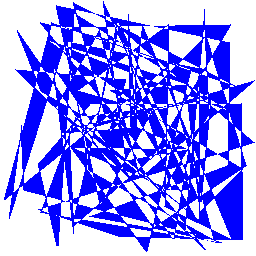
Interestingly in this test, PIL is twice as fast as pygame, here's a typical result:
PIL took 0.015594959259 seconds
pygame took 0.0300869941711 seconds
My guess is that as the author of the gheat code found the reverse that pygame is better at image compositing which is used more for games than for just drawing polygons.
There's another python image library out there, pyglet, but so far I haven't figured out how to do a simple drawing on a new image and save to a PNG file without it wanting an X server. I get "pyglet.window.NoSuchDisplayException: Cannot connect to ""." Any pointers would be appreciated..
Currently I use Python Image Library (PIL) for all my drawing and I'm pretty happy with the performance. Intriguingly, I read here that "Pygame is three or four times faster than PIL" and that got me interested.
I guess it makes sense that a library designed for games would be better optimised than alternatives. I created this simple test to render a random polygon and measure the speed.
import time
import random
import os
from PIL import Image, ImageDraw
import pygame


def PolygonPILTester(polygon):
    width = 256
    height = 256
    img = Image.new("RGBA", (width, height), (255, 255, 255, 0)) # rgba
    draw = ImageDraw.Draw(img)
    draw.polygon(polygon, fill="blue")
    f = open("pil.png", "wb")
    img.save(f, "PNG")
    f.close()

def PolygonPyGameTester(polygon):
    width = 256
    height = 256
    os.environ['SDL_VIDEODRIVER'] = 'dummy'
    pygame.display.init()
    pygame.display.set_mode((1,1), 0, 32)
    surf = pygame.Surface((256, 256), pygame.SRCALPHA)
    pygame.draw.polygon(surf, pygame.Color("blue"), polygon)
    pygame.image.save(surf, 'pygame.png')


if __name__ == "__main__":
    polygon = []
    for i in range(100):
    polygon.append((random.randint(1,255), random.randint(1,255)))

    start = time.time()
    PolygonPILTester(polygon)
    end = time.time()
    print("PIL took %s seconds" % (end - start))

    start = time.time()
    PolygonPyGameTester(polygon)
    end = time.time()
    print("pygame took %s seconds" % (end - start))
Here's pygame's version:
Interestingly in this test, PIL is twice as fast as pygame, here's a typical result:
PIL took 0.015594959259 seconds
pygame took 0.0300869941711 seconds
My guess is that as the author of the gheat code found the reverse that pygame is better at image compositing which is used more for games than for just drawing polygons.
There's another python image library out there, pyglet, but so far I haven't figured out how to do a simple drawing on a new image and save to a PNG file without it wanting an X server. I get "pyglet.window.NoSuchDisplayException: Cannot connect to ""." Any pointers would be appreciated..
Friday, October 08, 2010
Mac Ports geodjango libgeotiff breakage
At some point in the last few weeks I did a Mac Ports update and gdal, which I use in Django broke.
Here's the exception (which gets silently captured and turned into HAS_GDAL = False):
So something is linked to s version 1 of libgeotiff and it's been upgraded to 2. Here's what I have installed:
My workaround for the moment is:
which seems to work but is obviously risky.
This post is really just a note to myself.
Here's the exception (which gets silently captured and turned into HAS_GDAL = False):
>>> from django.contrib.gis.gdal.driver import Driver
Traceback (most recent call last):
  File "", line 1, in
  File "/opt/local/Library/Frameworks/Python.framework/Versions/2.6/lib/python2.6/site-packages/django/contrib/gis/gdal/driver.py", line 5, in
    from django.contrib.gis.gdal.prototypes import ds as capi
  File "/opt/local/Library/Frameworks/Python.framework/Versions/2.6/lib/python2.6/site-packages/django/contrib/gis/gdal/prototypes/ds.py", line 8, in
    from django.contrib.gis.gdal.libgdal import lgdal
  File "/opt/local/Library/Frameworks/Python.framework/Versions/2.6/lib/python2.6/site-packages/django/contrib/gis/gdal/libgdal.py", line 37, in
    lgdal = CDLL(lib_path)
  File "/opt/local/Library/Frameworks/Python.framework/Versions/2.6/lib/python2.6/ctypes/__init__.py", line 353, in __init__
    self._handle = _dlopen(self._name, mode)
OSError: dlopen(/opt/local/lib/libgdal.dylib, 6): Library not loaded: /opt/local/lib/libgeotiff.1.2.5.dylib
  Referenced from: /opt/local/lib/libgdal.dylib
  Reason: image not found
So something is linked to s version 1 of libgeotiff and it's been upgraded to 2. Here's what I have installed:
sh-3.2# ls /opt/local/lib/libgeotiff*
/opt/local/lib/libgeotiff.2.0.0.dylib
/opt/local/lib/libgeotiff.dylib
/opt/local/lib/libgeotiff.2.dylib
/opt/local/lib/libgeotiff.la
/opt/local/lib/libgeotiff.a
My workaround for the moment is:
ln -s /opt/local/lib/libgeotiff.dylib /opt/local/lib/libgeotiff.1.2.5.dylib
which seems to work but is obviously risky.
This post is really just a note to myself.
Subscribe to:
Posts (Atom)