While my iOS phone is undoubtedly the computing device used most often in my day, when I want to do some serious computing work I use macOS and Linux. There is some software that still only runs on Windows so I have a Windows 10 computer. Windows can be annoying but it's superficially looking much nicer these days, but from time to time cracks appear.
I use "natural scrolling" where the direction of the trackpad or mouse wheel moves the content as if you were scrolling on a touch screen. On Windows 10 I have a Logitech wheel mouse and I wanted to make it work the same as every other mouse here.
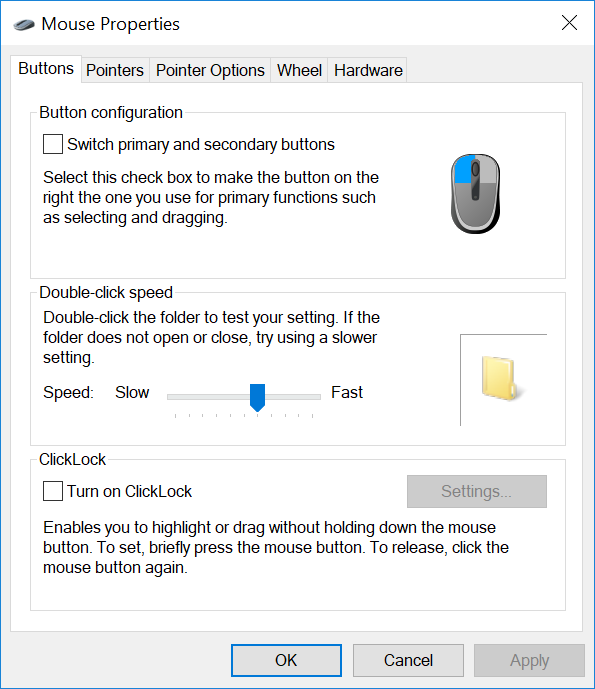
First I go to the Mouse settings which looks like this:
Nowhere in there is scroll direction so I click "Additional mouse options" and I'm thrown back into a Windows 95 settings user interface:
Wow! they haven't got around to updating the settings to the new look. This must make it hard for touch screen users. I looked all around here and there is still no way to switch the direction of the scroll wheel.
I found the answer here. Unbelievably, one must get the HID device path, open the registry editor and set 1 as the value of the "FlipFlopWheel" property (after navigating five levels deep in the hierarchy).
A lot of older Windows software runs well under Wine on Linux. That may be the ultimate answer.
LTSpice seems to run just fine on Linux under Wine.
Wednesday, August 08, 2018
Sunday, August 05, 2018
Another van trip north
I've just returned from a few nights away in northern NSW. On this occasion the driving was shared with another ABC alumni, Peter Cave.
We're not sure if the van is driving better or if it's just that we've got better with the worn gears, but it seems smoother. It's still using a bit of oil and coolant for some reason but is otherwise reliable.
Along the way we dropped in at the Williamtown Fighter World which I can recommend as an excellent display of military planes near the base. From time to time jets fly over and it can be quite a display.
Here's Peter with a type of fighter that once took a shot at him:
There are two large sheds full of planes, trainers, and even some missiles.
And who could resist the attractive observation deck so beautifully promoted in the flyer:
While exiting through the gift shop, I bought this excellent key ring tag for the van:
After Williamtown, we dropped in on another ABC alumni, the venerable Tim Bowden, who was in fine form.
Tim is an experienced camper who has advised me on various aspects of the van. He was more than happy to try it out.
The stay at Dorrigo was again relaxing and entertaining. It's a place that has very high rainfall but at the moment even it looks a bit dry. I'm sure the federal minister for climate change is working on the big dry and planning for our carbon reduction as a top priority of government...
Friday, July 27, 2018
Built a QCX 20m kit
Inspired by the fascinating talk by Hans Summers I mentioned recently, I ordered a QCX transceiver kit with filter for 20m. Hans criticised the continued use of the obsolete NE602 based QRP transceiver design in the light of more modern and better performing quadrature detectors based on clever programming of the Si5351 clock generator.
QRP Labs, Hans' company has published an excellent paper that accompanies that talk. For US$49 you get amazing value.
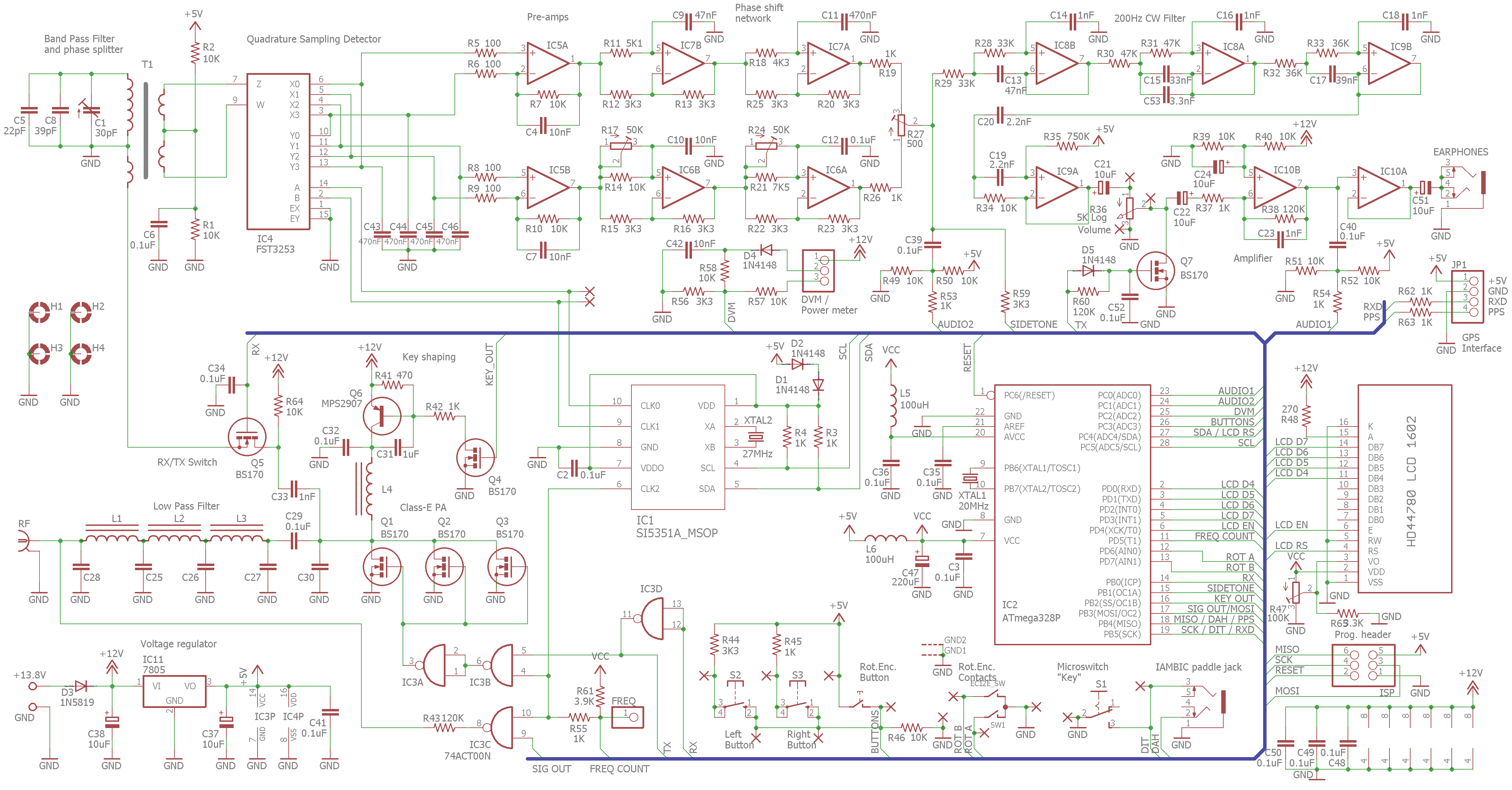
The quadrature sampling detector is shown here (reproduced from the paper which is well worth a thorough read). Here's the full circuit.
The board has the surface mount ICs already soldered as you see above and the components are neatly bagged up.
My kit was missing the plastic screws which is no big deal.
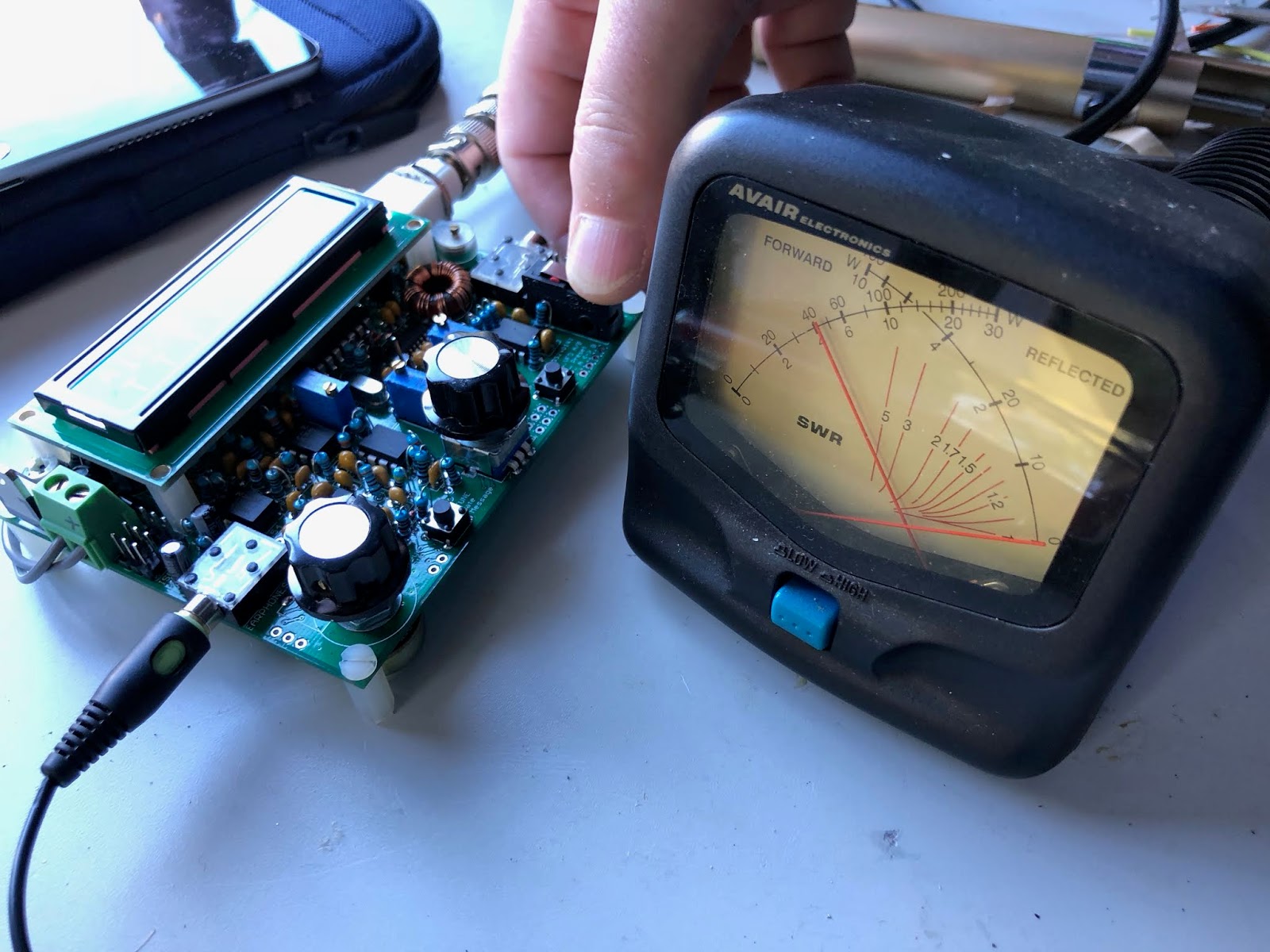
My board was revision 4 and unfortunately the assembly manual hasn't been updated yet. The instructions are very clear and detailed. I mis-installed a few resistors, completely my fault, but easy to do. Colour codes are hard to read sometimes.
The most challenging part of the build is the T1 Toroid transformer with 4 windings but Hans has included a diagram from a third party that makes it quite clear.
The software is fantastic with a menu driven system that includes built-in alignment circuitry that is magical! With no antenna connected, test signals are generated and measured with multi-range bar graphs so that the front end band pass filter can be peaked, I-Q balanced, and 90-degree phase shift can be adjusted for high and low frequencies. (Note that these last three interact so you have to rock between them to optimise).
I'm getting about 4W out on 20m with a 13.8V supply.
The RF out stage is three BS170 FETs running in class E and it's amazing to see a few small transistors producing this power without excessive heating.
I enjoyed building this kit, it's great value, but care is needed as it's quite difficult to remove components from the dense board.
Today was the ARNSW home brew group meeting. I passed the QCX around along with the circuit diagram which attracted quite a bit of interest.
Tuning around 20m this afternoon I found the CW decoder works amazingly well. This is a 200Hz bandwidth CW receiver but I'm able to listen to SSB, although it's rather too narrow. I hope QRP-Labs does go on to make an SSB unit based on a similar design.
Thursday, July 19, 2018
A visit to the home of FreeDV and codec2
Arriving in Adelaide after the spectacular Great Ocean Road, David, VK5DGR, was kind enough to invite me to stay with him. I knew I was in the right place when the squid pole supporting a corner dipole came in to view.
I was very keen to see where the "magic" happens concerning the development of the world class low bit rate voice codec2 and FreeDV. While David insists that much of it is done on a couch with an old ThinkPad he does have a nice bedroom setup with some test gear.
Two members of the influential Amateur Radio Experimenters group, Mark, VK5QI and Matt, VK5ZM came for dinner and we had an entertaining chat about balloon telemetry and tracking. Mark brought along one of the radio transmitters harvested from those launched by the BOM.
These folks are known internationally for their work launching balloons and tracking them. It was great to meet. David, has contributed an improvement to the radio modem software that is used to transmit telemetry.
At the moment, David is working on a new mode called 2200 for FreeDV with better quality (and a higher bit rate than 700D) and I was pressed into service doing a field test where we left a test transmission running and drove several kilometres away to receive off air and measure real world errors. We met up with Peter, VK5APR at the park. I haven't seen an Alexloop up close before and was impressed with how well it worked.
The tests went well and it was interesting to see how the spectrum looked flatter on my KX3 than it did on an FT817 (where is slopes down to the right).
David has a much better and more technical blog post on the development and field testing.
Vanlife on the Great Ocean Road
The main attraction of my current trip has been the drive along the Great Ocean Road from about Geelong over towards Adelaide.
The road is spectacular with lovely spots to stop and walk to see views like the one above. There are lots of tourists and apparently they need to be reminded of the road rules quite often.
The van is running well again but I heard a strange clunking sound which I thought was something falling in the back but turned out to be the right front indicator.
I have repaired this with duct tape but will get it fixed on my return. I can see it's been glued up by past owners.
The road is spectacular with lovely spots to stop and walk to see views like the one above. There are lots of tourists and apparently they need to be reminded of the road rules quite often.
I have repaired this with duct tape but will get it fixed on my return. I can see it's been glued up by past owners.
Van tour of ham shacks
In my current van expedition I've been dropping in to a few ham radio friends. On my way south I visited Peter, VK3RV, who I met on the Sunday FreeDV callback. He has a terrific signal from his QTH in Sunbury in to my location in Sydney. He's on a property and has a nice HF antenna setup.
Thanks Peter for the hospitality and fascinating chat.
While there we had a contact with New Zealand using the amazing FreeDV 700D mode.
Thanks Peter for the hospitality and fascinating chat.
Monday, July 09, 2018
Van broke down
It's an old van and so far I've replaced the differential, rear bearings, battery and tyres. Yesterday I was rather lost on muddy logging roads with no mobile reception and I noticed that sometimes the van didn't start first time when I turned the key.
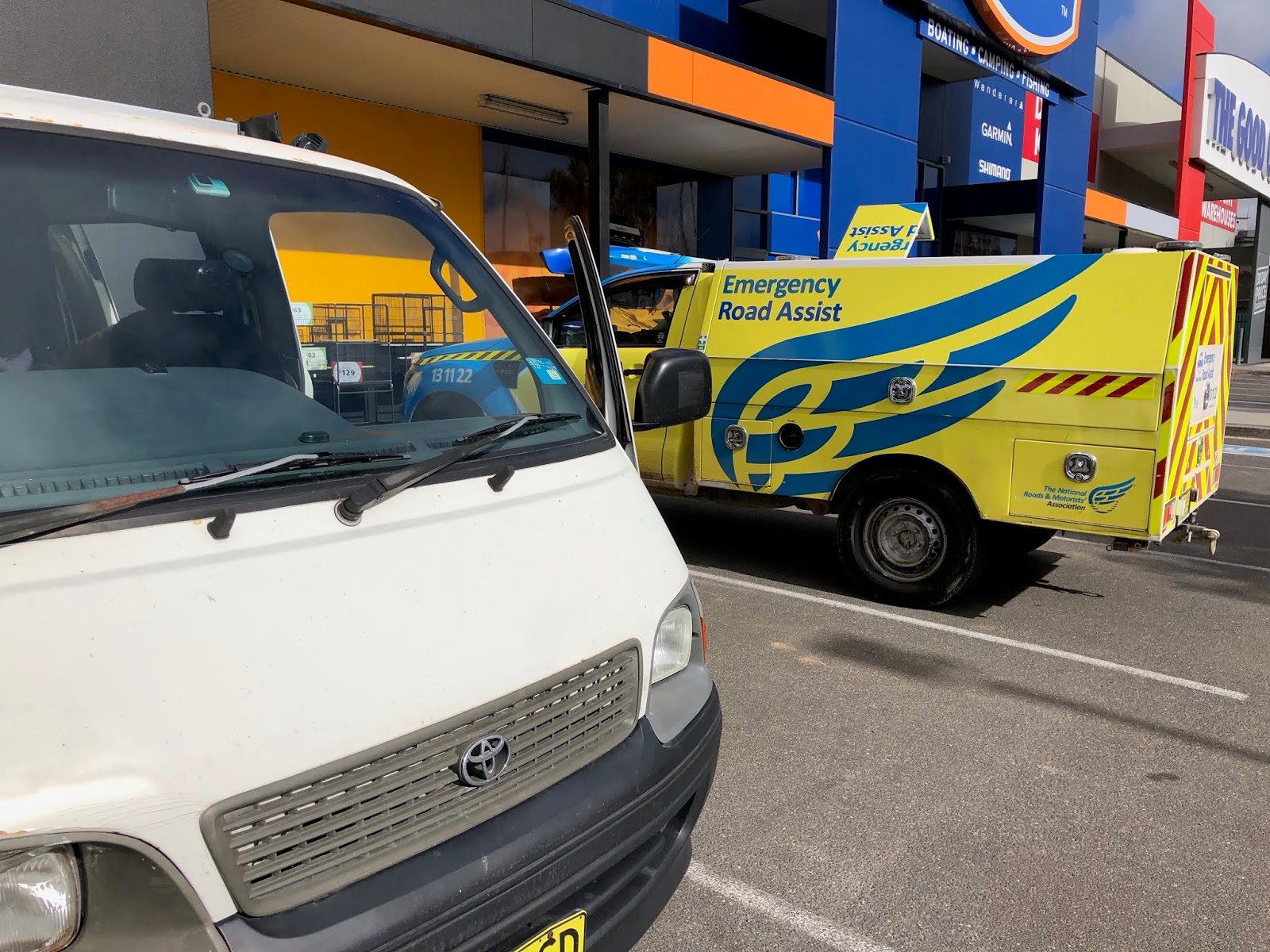
Today I stopped at BCF just out of Wagga Wagga and when I turned the key... nothing.
In these Hiace vans the engine is under the passenger seat. The technician seemed ready for a battery replacement but my volt meter showed me that the battery was fine. The starter motor is underneath and a rap with a hammer and it worked! The guy explained that this is a common short term fix but in the end the problem will re-occur.
I've had the starter motor replaced for $380 (with member discount) and I'm pretty happy with that. They fixed it same day but I'm staying over in a motel. Hitting the road again in the morning.
I feel very fortunate to have broken down in a town rather than up a muddy, rarely used track, with no mobile reception. A close call.
Today I stopped at BCF just out of Wagga Wagga and when I turned the key... nothing.
Because it's an old van I decided to join the NRMA and today I took advantage of that with their roadside assist service.
In these Hiace vans the engine is under the passenger seat. The technician seemed ready for a battery replacement but my volt meter showed me that the battery was fine. The starter motor is underneath and a rap with a hammer and it worked! The guy explained that this is a common short term fix but in the end the problem will re-occur.
I've had the starter motor replaced for $380 (with member discount) and I'm pretty happy with that. They fixed it same day but I'm staying over in a motel. Hitting the road again in the morning.
I feel very fortunate to have broken down in a town rather than up a muddy, rarely used track, with no mobile reception. A close call.
A toilet for the van
I must admit I've been hesitant about this, but touring around in a camper van wondering anxiously about where the next toilet will be found was distracting me.
As mentioned in a previous post, I've been peeing in a bottle to avoid going outside in the middle of the night. Before heading off on the current adventure, I bit the bullet and purchased a small chemical toilet for about $160.
Also purchased was the recommended flush water additive, collection chamber additive and special toilet paper that breaks down fast. I'm advised by camping expert Tim Bowden that the flush additive isn't required and that Napisan can be used in the sewerage chamber.
Currently I'm camping alone so have no qualms about using the thing in the van with the curtains drawn and door locked, not sure how I'll go with my wife on board. Some people use a popup lightweight tent to make a separate outdoor toilet.
It's great to be able to camp at free sites with no facilities such as this spot near Gundagai near the river.
While my ultimate plan is to avoid using the ensuite if possible I was kind of keen to try it just to see how the process works and how nasty it might get. After a few days, and depositing of both number 1 and 2, I looked on the WikiCamps app for the nearest "dump point".
Dump points are fairly common it turns out. Under the lid there's a giant funnel. Next to it is a tap and hose. I wore rubber gloves but found the dumping of the cassette pretty easy and clean. The additive chemical seems to be a strong perfume so there were no unfortunate smells.
After dumping I filled the cassette with water and shook it, then rinsed it out. I did this twice and all seemed reasonably clean.
We forget the magic that city sewerage systems perform. Camping out, using drop or chemical toilets is a reminder of the reality of all this.
VK1UN's nifty FL2K filters
Ross, VK1UN, has built a nifty interface from the FL2K VGA dongle to some low pass filters for transmitting WSPR, he writes:
I’ve gone ahead and put together what I have in mind for the VGA cable with R/G/B out.
I was thinking that, if I am running output to Banana terminals for wire antennas, I would just design 75 Ohm filters to hard connect inside the little Aluminium box between the 3 RCA socket block and Bananas. See the first pic. It is going ahead smoothly despite requiring quite a bit of accurate hole drilling and hole matching with the 3 RCA socket board.I think it will be very neat.
Secondly, I have designed three Constant K 750 Ohm filters that are dual band:
60m & 40m, 30m & 20m and 17m & 12m. Whilst I have not built these all yet, I have modelled them on LTSpice and they look to have very suitable performance and all are using standard component values or a minimum combination thereof.
Here's the box showing how the VGA connector to RCA lead is used.
30m and 20m LPF
75 Ohm, 17 and 12m
I’m stopping at 12m now as I am not sure of the wave from a 17m or 12m Weaver generation, but the multiples of 48K, QRG and Sample rate seem to be close.
I’ve gone ahead and put together what I have in mind for the VGA cable with R/G/B out.
I was thinking that, if I am running output to Banana terminals for wire antennas, I would just design 75 Ohm filters to hard connect inside the little Aluminium box between the 3 RCA socket block and Bananas. See the first pic. It is going ahead smoothly despite requiring quite a bit of accurate hole drilling and hole matching with the 3 RCA socket board.I think it will be very neat.
Secondly, I have designed three Constant K 750 Ohm filters that are dual band:
60m & 40m, 30m & 20m and 17m & 12m. Whilst I have not built these all yet, I have modelled them on LTSpice and they look to have very suitable performance and all are using standard component values or a minimum combination thereof.
Here's the box showing how the VGA connector to RCA lead is used.
75 Ohm, 17 and 12m
75 Ohm 60 and 40m
I’m stopping at 12m now as I am not sure of the wave from a 17m or 12m Weaver generation, but the multiples of 48K, QRG and Sample rate seem to be close.
You can contact Ross at any of the following callsigns @amsat.org: VK1UN, VK8UN, 6O0O, T61AA, EX1UN.
Thursday, July 05, 2018
VK1UN's VGA dongle WSPR spotted in two states
Ross, VK1UN, based in Victoria has been generating WSPR RF using the Weaver method in GNURadio and transmitting with an FL2K VGA dongle acting as a D/A. Naturally, he's using a nifty low pass filter and antenna tuner.
On 40m over night here I spotted him in New South Wales and he was also spotted in Tasmania.
Not bad for an $8 transmitter into a G5RV on a city block.
On 40m over night here I spotted him in New South Wales and he was also spotted in Tasmania.
Not bad for an $8 transmitter into a G5RV on a city block.
Wednesday, July 04, 2018
QRP Low pass filters with surface mount on veroboard
Ross, VK1UN, has been experimenting with generating WSPR RF using the FL2K VGA dongle. The waveform is pretty rough and of course a low pass filter is required. His solution is mechanically very neat I think. Here's a 160m low pass filter.
He builds on veroboard and uses PCB mount SMA connectors at each end. The tracks are cut under the surface mount inductors. Very neat.
In the end these get boxed up. Ross has modified fl2k_file to use any of the three colour outputs so he can transmit on three different bands.
Nice work!
The design and simulation of the 160m filter. Capacitors used were 2200 plus 220 = 2420 and in the T 2200 plus 100 = 2300.
He builds on veroboard and uses PCB mount SMA connectors at each end. The tracks are cut under the surface mount inductors. Very neat.
In the end these get boxed up. Ross has modified fl2k_file to use any of the three colour outputs so he can transmit on three different bands.
Nice work!
Installing wsjt-x on Ubuntu 1804
A note for future me. Installing the latest wsjt-x on the latest Ubuntu fails. (The version in the software catalog is very old). Here's the tricks. The main issue is that the wsjt-x deb is built against libreadline6 which is no longer available. libreadline7 is there but you need to tell dpkg to ignore the request for 6.
Download wsjtx_1.9.1_amd64.deb from https://physics.princeton.edu/pulsar/k1jt/wsjtx.html
If you previously tried to install wsjtx from the deb file you'll need to tidy up with:
sudo apt --fix-broken install
sudo apt install libqt5multimedia5-plugins libgfortran3 libqt5multimedia5 libqt5serialport5
sudo dpkg --ignore-depends=libreadline6 -i wsjtx_1.9.1_amd64.deb
Update: There's instructions on how to install libreadline6 on linuxer.eu here.
Tuesday, June 19, 2018
Sideband in GNURadio for an FL2K VGA dongle transmitting WSPR with the Weaver method
Ross, VK1UN, and I have been tinkering with the low cost FL2K VGA dongle which can be used as a high speed digital to analog converter capable of generating RF.
As the WSPR spots shown here indicate, Ross has been successful. This is a VGA dongle simply matched into a dipole transmitting a WAV file of WSPR tones from Melbourne to Tasmania.
Along the way we've both been learning about GNURadio (or really the graphical interface called GNU Radio Companion or GRC). It's a fascinating tool.
We've been trying to figure out how to generate modulated RF in a form that can be output by the dongle. Our approach has ended up as one of reading the modulation audio in from a WAV file and writing a sample file that is then sent to the dongle using the fl2k_file tool.
Doing things like filtering can be very slow in GRC when you're trying to generate the full RF waveform. Sometimes it has taken me an hour to generate a few seconds of RF.
Last weekend I discussed this with Peter, VK2EMU, while we were on a bush walk and he suggested the Weaver method of SSB generation. Ross has built this in GRC and it works in real time!
Download the GRC file from here. Note you'll need to update the input wav file source.
The generated upper sideband looks pretty good.
The Weaver method of single sideband generation starts by mixing the audio spectrum with a carrier in the middle of that bandwidth. This is quite different to traditional methods that mix up to RF and then filter out a sideband which is much more computationally intensive.
Friday, June 15, 2018
Australian Government reviewing broadcasting into the Asia Pacific
If you have an interest in having Australia resume broadcasting into the Asia Pacific region again, like we did up until budget cuts resulted in an end to Radio Australia's shortwave services in January 2017, I urge you to respond to the review being conducted by the Department of Communications and the Arts along with the Department of Foreign Affairs and Trade.
It closes on the 3rd of August 2018 at 17:00 AEST.
The terms of reference are very broad, seeking to assess the reach of Australia's media in the region, and covering many distribution platforms - they mention television, radio and online.
The striking thing that's changed in recent years is the increased output from China which has in some cases taken over frequencies that used to be used daily by Radio Australia (which of course they have every right to do).
Technical things have changed too:
You can find out more by joining the Facebook group "Supporters of Australian Broadcasting in Asia and the Pacific".
The Strategist has a nice piece by Graeme Dobell backgrounding some of the politics.
I had an opportunity to talk about this on ABC RN Drive with Patricia Karvelas. Former Pacific correspondent Jemima Garrett was interviewed the next night on RN Drive.
There has been some additional coverage:
My tiny camper van came with a Pioneer car radio that has shortwave. I notice that in the afternoons Radio New Zealand belts in to Sydney and could be mistaken for a local AM station.
Let me know if you see more stories I've missed.
It closes on the 3rd of August 2018 at 17:00 AEST.
The terms of reference are very broad, seeking to assess the reach of Australia's media in the region, and covering many distribution platforms - they mention television, radio and online.
The striking thing that's changed in recent years is the increased output from China which has in some cases taken over frequencies that used to be used daily by Radio Australia (which of course they have every right to do).
Technical things have changed too:
- Digital Radio Mondiale has been rolled out in India (although receivers are still not very good)
- Smartphones and mobile data are much more available in the region
- Use of home satellite receivers has declined globally as more content moves online
- Use of shortwave AM radios has diminished but it's interesting to note that there are many new models of radio available.
There are many benefits arising from broadcasting into our region from Australia, perhaps the best defence against Fake News is just the provision of consistent, quality, regular news. Tecsun Radios Australia has a great article on the value of shortwave in the region.
You can find out more by joining the Facebook group "Supporters of Australian Broadcasting in Asia and the Pacific".
The Strategist has a nice piece by Graeme Dobell backgrounding some of the politics.
I had an opportunity to talk about this on ABC RN Drive with Patricia Karvelas. Former Pacific correspondent Jemima Garrett was interviewed the next night on RN Drive.
There has been some additional coverage:
- China takes over Radio Australia frequencies after ABC drops shortwave. - ABC
- China takes up Australia's former radio space in Pacific - RNZ. Also on Loop Tonga.
- China grabs ABC Pacific radio - The Australian (Paywalled).
- China just took over radio frequencies left behind by Australia — and it shows Beijing is winning over the Pacific - Business Insider
- China shortwave foray into Pacific helped by Aus withdrawal - Radio New Zealand
- Supporters of the ABC call for help to revitalise Australia’s voice in the Asia-Pacific - My land my country
- Wireless Institute of Australia national news item - starts at 2mins 53secs in.
- Push to restore full Asia/Pacific service for Radio Australia - Sean Dorney on Radio New Zealand's Dateline Pacific Program
- Pacific Islands Forum SG says shortwave radio is still relevant in region - Interview with Dame Meg Taylor on Pacific Beat
My tiny camper van came with a Pioneer car radio that has shortwave. I notice that in the afternoons Radio New Zealand belts in to Sydney and could be mistaken for a local AM station.
Let me know if you see more stories I've missed.
Sunday, June 10, 2018
Fascinating talk by Hans Summers
Thanks to Bill's Soldersmoke blog for this tip. At the "Dayton" (not actually there any more) hamvention this year, Hans Summers gave a terrific talk about his distain for the archaic NE602 based transceivers and how it's time to upgrade the design using modern methods.
I recommend, grabbing the slides and then playing the Ham Radio Workbench podcast episode. You might like to seek in 1hr 20 minutes to where the talk begins. Hans has also published a paper with more detail.
Hans describes in detail how to generate quadrature signals from an Si5351 clock generator. Great stuff.
Sunday, June 03, 2018
FreeDV digital voice story on WIA broadcast via FreeDV
The recursion appeals to me, here is a story about the new FreeDV 700D mode complete with comparison with SSB. I heard the story via the relay over FreeDV 1600 from Adelaide.
Interestingly I find digital voice decoded is more intelligible in a small external speaker than in headphones.
After the broadcast relay, Mark, VK5QI conducted a callback on 700D with stations VK3PR, VK3RV, VK5DGR and VK5APR. We often got perfect signals despite some interesting selective fading such as this on VK3RV.
The broadcast on FreeDV is at 10am Sunday Adelaide time on 7.177MHz.
700D uses much less bandwidth than sideband, here's a waterfall comparison David VK5DGR sent me this morning.
One thing to note (it confused me) is that FreeDV uses the same sideband as normal voice on each band. This is unlike other digital modes which generally use upper sideband everywhere.
Installing FreeDV 1.3 on Ubuntu or Debian
Not everyone likes to build from source. You can download and install FreeDV 1.3 (which you need for the new 700D mode) as follows:
Download these files:
http://launchpadlibrarian.net/372108070/libcodec2-0.8_0.8-2_amd64.deb
http://launchpadlibrarian.net/372171996/freedv_1.3-1_amd64.deb
In a terminal go to the Downloads folder and:
sudo dpkg --install libcodec2-0.8_0.8-2_amd64.deb
sudo dpkg --install freedv_1.3-1_amd64.deb
Download these files:
http://launchpadlibrarian.net/372108070/libcodec2-0.8_0.8-2_amd64.deb
http://launchpadlibrarian.net/372171996/freedv_1.3-1_amd64.deb
In a terminal go to the Downloads folder and:
sudo dpkg --install libcodec2-0.8_0.8-2_amd64.deb
sudo dpkg --install freedv_1.3-1_amd64.deb
Subscribe to:
Posts (Atom)