Sunday, January 31, 2010

First home brew meeting in the WIA Dural shed

An exciting first, at long last we were able to meet in the new shed at Dural. It was a day of trash and treasure:

trash.jpg

Some calibration of test equipment:

calibration.jpg

The shed it coming together quite well:

shed.jpg

Although it got a little stuffy for some attendees who started to doze off I think:

sleeping.jpg

There was a special visit from John Maizels, the Governor, Asia Pacific Region of SMPTE, showing off the very latest in 2m hand held radio:

maize.jpg

The sausage sandwiches were excellent as usual.

Saturday, January 30, 2010

Getting started with D-Star digital radio

ic92.jpgAt the Coffs Harbour radio expo last weekend I also purchased an IC92 hand held radio capable of digital radio using the D-Star system.

I've been rather sceptical of this technology due to the proprietary nature of the audio codec but as no alternative has emerged I jumped in.

Getting started is not as easy as it could be. I found this video by KN4AQ very helpful.

Next, in order to use the internet gateways you must register here but the amazing instructions here include things like:


  • Enter your Callsign and Password and select the LOGIN option. THE CALLSIGN MUST BE IN UPPER CASE.

  • Enter a space character eg:" " in the Initial field. Do not just leave it blank, it must contain a SPACE character.


I kid you not!

There have certainly been some "bun fights" around all this, I note a document here says, in part:

"When ICOM released the first version of the D-STAR Gateway program, the amateur community worked our way through several challenges, and built a viable network. This was largely due to the spirit of cooperation among the Gateway administrators. Even with a mandatory training course, there were still "experts" who were sure that they knew more than the rest of us, and felt that they didn’t need to follow our recommendations. Some of these "experts" caused serious problems for the rest of the network, to the point of many of us not being able to add users." So it's not just a little unfriendly for end users.

Anyhow, I registered on Tuesday, it's now Saturday and it still hasn't gone through so I don't know what's going on there..

My local repeater is VK2RWN C on 146.9625 MHz. I've been listening and it's pretty quiet. The only thing I'd heard until today was an automated message advising users that they must leave 4 seconds gap between transmissions or bad things will happen.

I called CQ and one of the two stations listed here, VK2HL, kindly responded and answered a bunch of my questions. Now the activity looks like this:

Screen shot 2010-01-30 at 10.05.12 AM.pngThe big list of global D-Star activity is here and it looks impressive.

Anyhow, there's lots to learn. I'm interested in the data channel that can transmit at 1200 baud even while you are speaking. Pity about the proprietary connector on this radio.

The IC92 is full of features but the LCD screen is very disappointing and hard to read. It does seem sensitive but the signal strength indicator is a bit "all or nothing" in my observation.

Thanks VK2HL for being my first digital contact and patiently answering my questions.

Update Saturday 30th at 13:20

My registration just came through from the VK2RWN administrator, Terry, VK3BMX, and I was able to register my single call sign/radio as recommended. Amusingly in this context you must type your call sign in lower case or it gives an error.

For anyone else following along, note that the registration confirmation email directs you to dstar.org.au but you need to go to http://www.dstar.org.au to get there.

Tuesday, January 26, 2010

A Leica for the digital age

Dear friend Tony pointed me to an essay by Michael Reichmann titled "A Modest Proposal For Reinventing the [Leica] M Series".

Like Michael, my brain knows that digital has so many advantages that it is the way to make pictures today, but my hands crave the speed and ergonomics of the Leica rangefinder cameras.

My favourite camera today is a Ricoh GR Digital III. On my recent trip to Coffs Harbour it served me well.

R0011633.jpg


I've started shooting RAW as a matter of course. The extra dynamic range is often handy when I'm trying to capture scenes with a mix of shadow and harsh daylight.

R0011685.jpg


I did purchase the external optical viewfinder for the Ricoh but I need the heads up display that you get on a digital viewfinder. I think what's needed is a mix - an optical viewfinder with a HUD that shows all the stuff you get on the back of the camera but the live view with depth that Michael alludes to.

There's more I want in digital cameras, more form-factors. I want a digital cube camera with a look down viewfinder (like a TLR) too. These days my skill at taking shots unobrutively is reasonable but I need a camera that is able to focus where I want and hold that with ease. Rather like you could on a Leica M3 way back in 1953. Thanks Tony, thanks Michael.

Tecsun PL-310 DSP shortwave radio review

When travelling, I always pack a short-wave radio. Normally it's a little Sony or if I'm not travelling so light, I pack the excellent Sangean ATS 909. At the Coffs Harbour radio expo I plunked down $89 to Av-Comm and purchased the first consumer radio with digital signal processing that I've seen. Welcome to the Tecsum PL-310.

radio front.jpg


It's actually very small, it would fit in a large pocket, like in cargo pants, without too much trouble. 135x85mm not including the tuning knob or antenna.

They had me at the block diagram:

block diagram.jpg


The radio is based around a Silicon Labs si4734 CMOS radio receiver chip. Just look at all the features you get:

features.jpg


The DSP feature means that on AM and shortwave you can choose between bandwidths of 1, 2, 3, 4 and 6kHz. They really work.

Both knobs, tuning and volume are rotary encoders so there's nothing to get scratchy over time.

knobs.jpg


The radio runs off 3 AA batteries and can charge them internally via a mini USB socket. When turned on, the radio defaults to a mode where it will run for 90 minutes (selectable) and then turn itself off. This suits me fine as I tend to go to sleep listening to the radio.

Sockets are the USB charging socket (wouldn't it be great if that was a USB audio output!), stereo earphone out (it accepts a long iPhone plug with no problems, and an external antenna socket.

sockets.jpg


The front panel buttons work well but are a little slow to respond, I suspect keyboard scanning is slow to reduce interference.

Tuning, for a consumer digital radio, is reasonably good. There is some muting as you step frequency but it's not as bad as some I've used.

Sensitivity was equal to or better than the Sangean, but intelligibility was much better on the little PL-310. Side by side, for short wave listening it was much better in my tests. One complaint is that the built in temperature seems a little high to me.

temperature.jpg


Interestingly, station reception is measured in dBu and dB signal to noise. I'm not quite sure how to interpret this, the station it was tuned to in the first shot above seemed pretty weak but read 15dBu and S/N of 6dB. These readings update only every few seconds and I'd prefer a bar meter or at least an option.

The radio has every other feature you might want, lots of memories, scanning and auto memory setting, clock and alarm. The only thing I miss is side band.

It comes apart easily with six screws. The RF stuff is well shielded and the rest just looks like a pocket calculator with a ferrite rod.

inside.jpg


I've used the radio heavily for two days on a set of three 2500mAh NMH batteries, it reported full battery all that time and then suddenly dropped to low. It will operate, and charge, via a USB cable.

Frequency coverage is:


  • LW 153-513kHz

  • MW 522-1620kHz

  • SW 2300-21950kHz


So no 160m I'm afraid. Long wave was disabled by default.

Sunday, January 24, 2010

Mid North Coast Radio Expo 2010

The highlight of our visit to Coffs Harbour has been to again attend the wonderful Mid North Coast Radio Expo. It didn't seem as big as last year, although I came and went very early in the day so perhaps it picked up.

R0011707_2.jpg


Lots of tables with friendly and informative people in attendance.

R0011711.jpg


Some second hand gear at bargain prices.

R0011713.jpg


Like last year the display of antique radios, and not so antique but obsolete gear, was thoughtfully presented.

R0011714_2.jpg


R0011717_2.jpg


R0011715.jpg


Some interesting home brew gear was on display.

R0011723_2.jpg


Remote motorised tuning capacitor.

R0011724.jpg


Lee Andrews was in good spirits and doing a brisk trade.

R0011729.jpg


I purchased a Tecsun DSP radio and a MW Loop antenna that I'd never seen before from AV-Comm. Disappointed that they didn't have any DRM radios on display as advertised.

loop.jpg


A review of the Tecsun PL-310 will follow after I've had a good play with it.

Friday, January 22, 2010

Kempsey Museum visit

We've just arrived at Coffs Harbour ready to attend the Mid North Coast radio expo on sunday. On the way we stopped at Kempsey and stumbled in to a museum. $4 to enter and worth every penny.


Full of interesting historical items from all walks of life including schools, crafts, military, shoe making, and even telephone equipment. A "working" model of a saw mill was particularly amazing.


The museum is well hidden, it's next to the visitor's information centre and looks most uninviting from the front.

We're now in Coffs at a motel. I'm pretty technically confident but I have to admit being a little daunted by the collection of remote controls one has to master to operate things here.


I now realise I missed one - for the air conditioner. This is madness - there has to be a better way. Surely remotes can be unified in some way?

PS: I'm online thanks to my tethered iPhone which seems to work pretty well.

Sunday, January 10, 2010

"Lunchbox" 80m QRP SSB rig progressing well

With pleasure I can report that the single sideband 80m transmitter I started recently is progressing well now that some technical difficulties have been overcome.

Basically the power amplifier stage, an IRF510, oscillated magnificently at 600kHz - something I haven't experienced before. Now that it all works on the bench I've started mounting it in an excellent case I found at the local "$2" shop, a metal lunchbox.

Lunchbox qrp.jpg


This simple rig is crystal locked to 3.58Mhz and I'm planning to put a matching direct conversion receiver in the spare space at the lower left.

Update

The transmitter is all boxed up and puts out very little power. I'm having trouble adjusting the oscillator for decent sounding sideband. I think it's time to make one of those dual-tone sideband test oscillators.

Last week I did a guest spot on local canberra radio 666 and on the way in to the "tardis" (small remote guest studio) I saw this magnificent valve display in a case on the wall:

valve display.jpg


The title reads "The First Transmitters of the Twentieth Century" - Edward D Huckell, Smiree (Aust), 'The Slave of the Magic Lamp'.

Brewing the perfect cup of coffee

So much I didn't know!

How to Brew a Good Cup of Coffee from Ben Helfen on Vimeo.


Great stuff guys.

Friday, January 08, 2010

The cat is making money!

How weird is this:

Screen shot 2010-01-08 at 6.12.07 PM.png


My wife suggests we invest any income into better food for the cat.


Cats and laser pointers seem to be a major meme on YouTube.

Sunday, January 03, 2010

Making soldersmoke again after a gap

soldersmoke.jpgI bought Bill Meara's book "Soldersmoke - A global adventure in radio electronics" many months ago but until the recent holiday break haven't been able to get in to it.

It's a charming book and really inspiring for people like me who love to tinker with amateur electronics. Bill reveals a bit of his interesting life as a US diplomat and shares with us his desire to understand the actual operation of those circuits we construct and hope will work.

When amateur electronics enthusiasts get together and someone talks about a mixer, we all nod as if we know exactly how it works - Bill admits that he didn't fully, and his quest is to understand. As with a lot in physics, there's more to it than you think.

The book mixes stories of Bill's journey through ham radio with technical topics illustrated with diagrams that appear to have been scribbled on napkins.

Bill's soldersmoke blog and the associated podcast, are on my "must listen" list, his book, available through Lulu is to be recommended.

Shortly after I finished the book, my neighbour dropped in with a satellite phone that needed fixing, nothing too exciting just an external antenna connection that had been damaged in a vehicle accident. Primed by the book, the smell of soldersmoke in my nostrils drew me back into the shack and I'm happy to report I've just spent a pleasurable day beginning construction of a single frequency 80m (colour burst) single sideband transmitter.

ssb transmitter.jpg


Above you see a 741 mic pre-amp, an NE602 mixer (Bill knows how it generates the difference frequency) and a crystal filter to accept just one sideband. I'll update as it progresses. Yes, it's real "ugly" construction, but I'm sure Bill would approve.

Monday, December 28, 2009

Avatar and the Apple tablet computer

Screen shot 2009-12-28 at 5.53.54 PM.pngSaw Avatar in 3D at iMax yesterday. Recommended. I don't think it will stand the test of time, in that the story was so derivative that it will fade into memory pretty quickly but the lush visuals reappeared in my dreams which is always a good sign.

Like Minority Report, the film demonstrated some interesting ideas about future computer interfaces.

As CES and Apple's January 26th announcement draw near, I'm thinking about tablet computers a great deal at the moment.

If my hands are on the keyboard a mouse is a very convenient tools for pointing at things, it's close to the keyboard after all. Holding my arms up to a screen at head height is not going to work.

If a tablet was held in one hand then touching the screen to manipulate objects with the other seems to be the natural way to interact. I'm definitely looking forward to that.

The iPhone 3Gs 'oleophobic' screen coating shows that it's possible to have a capacitive touch screen that doesn't end up covered in grease smear - so that's an important technology.

The screens in Avatar were touch controlled, the only silly thing was that they were see through, presumably to enhance the movie scene. Aside from heads up displays, I can't imagine why you'd make screens transparent.

Here's my guesses/wishes on the Apple Tablet.

  • Will run Cocoa Touch - like the iPhone/iPod touch

  • The existing 90,000 iPhone apps will run out of the box in little gadget like windows

  • XCode will be updated with a new way to go full screen if required

  • The App store will be more like the iTunes store and include movie rental, and periodical subscriptions

  • Device will have WiFi, Bluetooth (to link to Magic mouse and keyboard), and 3G (mininum) data. After all, Apple knows how to do all this from the iPhone

  • Screen will be 1280x720 so that HD movies look awesome

  • Video hardware will decode H.264 at 30fps without using too much battery

  • Solid state disk - or at least an option

  • Will be jailbroken within 24 hours of shipping

  • Called iPad or iSlate - it's got to be i + one syllable so not iTablet


People criticise the iPhone for not multi-tasking but poor battery life complaints hurt much more. I wouldn't be surprised if the iPad only uses power for the frontmost app and sleeps everything else. The notification system is the right answer for this in my view.

The big unknown is the screen technology. If we are to replace newspapers and magazines then this device needs to be readable in daylight. When the iPhone screen debuted it was way ahead of any other phone screen, it wouldn't be a shock if they had something ready to go again.

Saturday, December 26, 2009

WSPR is hot tonight

Amazing amount of activity tonight. Here's my station.

Screen shot 2009-12-26 at 8.28.51 PM.png


And here's the world.

Screen shot 2009-12-26 at 8.34.49 PM.png


40m is going crazy!

Screen shot 2009-12-27 at 7.59.05 AM.png


The fact that my 5W signal can be heard 16,000 Km away is incredible to me.

Friday, December 25, 2009

How to build WSPR on MacOS X Snow Leopard

First, the bad news, it doesn't get very far, but I'm working on that.
Screen shot 2009-12-25 at 8.42.12 AM.png

Using MacPorts:
port install portaudio
port install fftw-3-single +g95
port install g95
port install py26-numpy
port install py26-scipy


Using easy_install or pip or whatever:

pip install f2py


There is a python patch I needed:

crackfortran.py in numpy line 1586 has a variable named 'as' that causes a syntax error in python 2.6. I renamed it asx.

To build:

./configure --with-portaudio-lib-dir=/opt/local/lib \
--with-portaudio-include-dir=/opt/local/include
make

Screen shot 2009-12-25 at 8.42.34 AM.pngIf I run the program is crashes shortly after the UI comes up.

I hadn't found what I needed to get this far anywhere so wanted to share. Please let me know if you're got WSPR running on MacOS.

My sincere thanks to the MacPorts users mailing lists for help last night. And thanks of course to Jo Taylor. I'll update when I have some progress to report.

Wednesday, December 23, 2009

Thoughts on digital photography at Xmas time

Did a spot this morning with James Carelton on ABC Radio national where we discussed digital photography and showed a wonderful book about the Golden Lotus Chinese Restaurant in Killarney heights.


For those who've wondered what the guy who does "what the papers say", here's James in the radio studio that's gradually turning into a TV studio.

James Carelton.jpg


(He didn't really want to be photographed in that shirt but seeing as I was forced to wear a cardigan..)

Thanks to Roi for the filming and post production.

Tuesday, December 22, 2009

Telstra Bigpond guilty of DNS Hijacking

Just noticed that if I take a web browser to a non-existent domain name, instead of correctly returning an error as it should Bigpond now directs me to a web page with a Yahoo search.

Screen shot 2009-12-22 at 10.46.36 AM.png

This is called DNS Hijacking and it's very annoying.

As a programmer, I rely on receiving error messages when appropriate and being able to do the right thing in response. These days a lot of software works by sending HTTP requests and if these requests, to perhaps an internal domain, succeed when really they should fail all sorts of bad things can happen.

One solution is to use Google's new public DNS.

Screen shot 2009-12-22 at 10.58.33 AM.png


Dear Bigpond, please don't mess with my internet connection, or at least let me know about the setting and allow me to opt in or out as I wish.

Saturday, December 12, 2009

SDR to WSPR from Ross T61AA

Old friend Ross, (who needs to start his own blog), sent me some progress notes on how he's going trying to combine a SoftRock with WSPR software. He writes:

"I have found that the SoftRocks are not very stable when left to themselves. I have attached a screen dump of WSPR and SpecJT and also the list of spots on the site. You will see that the received spots are a lot more stable than the off-air reception by SoftRock Xtall+USB V9.0 Rx. Next that I will do is find the Kuhne crystal ovens that I have somewhere in Kabul, when I am up there in a week or so and attach to the Si570 local oscillator to keep at a steady 40 deg C and see how that affects the stability.

At least though I have got WSPR working through the Virtual Audio Cable OK and managed decodes."

20m SoftRock test stability.JPG

Later:

"Have spent the entire night on 40m and, while the SDR is not as sensitive as the Icom, I have many spots on 40m overnight, including PY8ELO and an LX from South America. My fix for the drift will be a crystal heater such as Kuhne Electronics QH-40A - I have two sitting in my junk in Kabul and must find them. Next issue is to get a program that provides I and Q out for Txing on WSPR."

20m spots as on WSPR.org to compare with SoftRock.png

Ross tried various software to patch the audio but in the end:

"You know what, I had the solution already and did not see it because Rocky did not want to work with the el-cheapo USB sound card.

When I was home I found that WSPR just did not work properly with the in-built sound card in the MSI U100+ netbook that I got for WSPR and WSJT. I got a really cheap USB sound card and found that WSPR worked quite well with that. When I first tried Rocky the SDR prog I found that it did not like the el-cheapo USB but would only work with the in-built Realtek HD Soundcard and was stuffing around trying to get rid of all the associated drivers that did all the Dolby-surround and other tailoring on the sound - I wanted it barn-door-wide.

I also subsequently found a simpler SDR Rx prog called SDRadio by I2PHD which, strangely enough, will not work with the Realtek in-built but works fine with the el-cheapo USB - problem solved two USBs and an actaul hard cable cross-connected and Voila! Simple."

Putting a solid state drive in a MacBook Pro

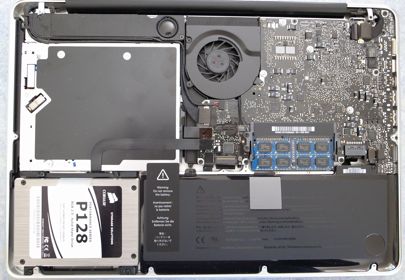
This week I ordered a Corsair P128 128Mb Solid State drive and it's now in my MacBook Pro 2009.

macbookpro.jpg

Purchased on ebay at AU$520 (the buy it now price), it arrived within a few days. I tried to find a store that stocked them but all the places I called had them at higher prices and had no stock - so there's no point in not ordering on line.

I'd only used 100GB of space on the existing drive so I wasn't too concerned about a smaller drive and these days I'm storing a lot on line any way.

Disassembling the MacBook Pro 2009 is surprisingly straight forward, no scary keyboard prising or any of the things I've faced with other models. Just a bunch of Philips 0 screws in the back and the whole rear plate lifts off as you see in the picture above.

A Torx T6 driver is needed to take the mounting pegs out of the drive and while I probably have one, I couldn't find it and had to go and buy one.

The result? "Bong" to login prompt used to take about 40 seconds now it's 14, but I rarely shutdown so that's not much of a gain. Application launch time is noticeably snappy, with the Safari window up half way through the first bounce. Tools like Eclipse start much faster and I know I'll enjoy that.

Here it is launching Apple Pages:


Normally, Pages takes about 7 bounces plus a second to launch so this is an amazing improvement. You can't read it but I type "that was quick!".

I hear mixed reviews in battery life, some say it will be better, some say it won't. I'll update when I have some impressions.

While it's certainly a luxury option the biggest thing is that it's more robust than a spinning disk in a laptop. I would often hear the drive's heads retract if I moved the laptop too quickly.

Update

After using this for a week I'm pleased to report that it was worth it. The snappy application launch performance makes it feel like a new machine and will certainly extend the life of this one. Battery life does not seem to be longer in any noticeable amount. It might be that I'm using the laptop more due to the novelty.

Sunday, December 06, 2009

Wonderful ham shack tour by VK3ASE

Dave, VK3ASE, just posted this video of his visit to Herb VK3JOs shack. Inspirational, for me anyhow.


Dallas does an excellent interview with Herb in the latter part.

Thanks Dave.

Saturday, December 05, 2009

Getting the scientific analysis on climate change

Screen shot 2009-12-05 at 7.20.19 PM.pngThis week I started a lunchtime discussion at work to find out what people thought about the failure of our democracy to act on reducing the "man" made impact on climate change.

It was amazing to find that many regard it all as "just another tax", some sort of plot by government to raise revenue. Indeed one of my colleages sent me a brochure full of wild claims presented in bullet form.

Despite having seen An Inconvenient Truth, and listened to a lot of debate in parliament, I realised that the facts are not at my fingertips.

Two sources stand out, The Copenhagen Diagnosis, and the Intergovenmental Panel on Climate Change. The Copenhagen document is rather fluffy and full of pretty pictures while the IPCC reports, available here, are really excellent.

Full of careful language, extensive peer review, and a range of interpretations.

I highly recommend this. I fear, as my friend Jonathan suggests, perhaps democracy is unable to deal with things like this until we are in crisis.

Update: reactions

I've had some interesting direct responses to this little post so far. If I can summarise:

  • Everyone, so far, seems to feel that the evidence is convincing that we are experiencing warming at the moment

  • Having said that, one correspondent claimed that the shipping lane in the arctic that is reported to have opened up in September 2009 has, in fact been open to the Russians for a long time

  • "Man" made climate warming, is a tiny effect compared to the effects of natural processes, such as us coming out of a cyclic ice age

  • The whole push to have developed nations intervene on climate change is a conspiracy by the socialists to re-distribute wealth from rich nations to poor, slow development, or simply gather extra tax revenue for government purposes

  • The whole push to have developed nations intervene on climate change is a conspiracy by the capitalists to make huge profits from carbon credits, which are a derivative that will let them build value out of nothing

  • Many people have said "it's just another tax"

  • All sorts of allegations about reports such as the IPCC report, which, to my reading is very solid, are claimed to be full of holes, deliberate distortion of data, and witheld raw data

  • Finally, there is said to be a media and scientific publication conspiracy to silence doubters and take away their right of argument


Perhaps what is needed is an alternative paper, with the thoroughness of the IPCC paper, then we could weigh one up against the other by comparing their data and analysis. I'd be most grateful if someone can point me to it.

Right now I'm completely boggled by this mix of politics, science, religion and economics - what a weird conjunction!

Update 2

Just noticed this on the "conspiracy of the century"...


Update 3

I've done a lot of reading in the past few days and while there are a few dubious graphs about most of the criticisms are unreferenced or come from dubious organisations.

Science isn't a democracy, but Wikipedia has a great list of well known scientific organisations that have given a view. I do not see any substantial evidence to contradict the statement that "human actions are "very likely" the cause of global warming, meaning a 90% or greater probability". There are limits to scepticism.

If it isn't linked, then I think we should live sustainably any way.

Tuesday, December 01, 2009

Installing Ubuntu 9.10 on an iMac

Fired up after the Open Source Developer's conference in Brisbane, I decided to try dual booting my recent iMac with Ubuntu 9.10 and MacOS X.

Boot camp assistant lets you resize the Mac partition down a bit to make way for a "Windows" partition.

boot camp partitioner.png

Then I inserted the Ubuntu installer CD and rebooted. Up comes the familiar Ubuntu installer.

ubuntu on imac.jpg

The partitioner knows about MacOS and the only glitch was that the partition slider acts a little strangely. Nothing bad happened though.

partitioner.jpg

As with my last install, it took a long time downloading language files for Australia but in the end it finished and my first reboot ended in a pretty crash.

crash.jpg

In the end all is well and I can boot into either MacOS or Ubuntu by holding the Option key at boot. Choosing "Windows" gives me the Grub boot menu which I notice offers MacOS X (haven't tried booting that way yet).

Normally I run Linux on a netbook where it works nicely thankyou. Switching between MacOS and Ubuntu on the same hardware makes me appreciate what a polished OS MacOS is. It's silly, I know, but the fonts are just better on the Mac and that makes a difference to me.

Ubuntu on iMac for me doesn't reboot cleanly for some reason but otherwise things work, including my Bluetooth Magic Mouse (although no right-click or scroll).