Saturday, May 16, 2020

Townhouse antennas

My first antenna in the rental townhouse was a dipole for 20m which has been working pretty well. The challenge here is that the windows seal tightly and it's not possible to run coax through them so I had the balun inside and the two legs of the dipole stuffed through the window seal.


One leg ran straight out and the other around the corner to the left. The KX3 tuner is excellent and could match this quite well.

Today I visited Jaycar and purchased some iron powder toroids, some wire and a soldering iron (all my electronics is still in storage). I constructed a QRP 9:1 Unun. (Three turns to 9 turns).


The end fed wire goes out through the window, around the corner, over a citrus tree and is held on the side of the clothes line. This now tunes up well on 20m, 30m and 40m.

Compared to the dipole WSPR reception has worse signal to noise but the addition of extra bands, particularly 40m, makes it a much better option. I'm receiving well and transmissions on 40m are getting out quite well.


I did notice that a ceiling fan turned itself on after I'd been transmitting and I'm worried about affecting TV reception so I'll be receiving mostly until I test that. Amazing what WSPR can do even in very challenging circumstances.


It's Sunday morning and I've been able to listen to the 40m broadcast from South Australia and also from Dural near Sydney. Here's a snippet. It does fade up and down but is mostly audible.


Saturday, May 09, 2020

Moved to Melbourne

We've now moved in to a townhouse in Alphington which is north east of Melbourne. It's much smaller than our home in Sydney and even though we still have stuff in storage it has been a bit of a struggle to downsize enough to fit in.

The area is nice and I've enjoyed walking along the river which is nearby and through some lovely park land.

In the photo above you might be able to make out the yellow wire which is one leg of a dipole for 20m. It's a bit of a challenge to run cable to the antenna as the sliding glass windows seal tightly. Currently I have a balun inside and run the two legs of the dipole out through the window. It tunes up quite well but I'm sure the trees absorb quite a bit of the transmitted signal. WSPR works ok and I'm hearing stations around the world to some extent.


Unfortunately the power lines for the block attach to the corner of the room I'm using for my office so there's quite a lot of noise.

There's lots of FT8 activity visible but so far no contacts. I called CQ on PSK31 but nothing heard just yet.

Internet

The unit has Telstra cable NBN connected and I've arranged a transfer from Sydney. Even though I can see that the cable is active they want to deliver a new wireless router before we can use it. It's been mobile data for a few days but I plugged our Sydney router in and it works! This is handy as yesterday we were informed that delivery of the new router has been delayed beyond the promised date of next Tuesday.

Vale Tim Mills VK2ZTM

Sad news that ARNSW volunteer Tim Mills died this week. He's been a dedicated part of the NSW amateur radio community who I've seen every time I've been at Dural and often heard on the Sunday broadcast. Many years ago he was one of my first contacts when I put up a new antenna at Killarney Heights in Sydney.

Tim was always cheerful and helpful. He worked behind the scenes to keep everything running smoothly. I didn't know him much beyond saying hello and chatting about the sausage sizzle and other trivia but I know he was a big part of the organisation.

It's my birthday today and it's a big one as I'm now eligible for a seniors card. Only a few of my friends have kicked on but I guess it's something that will become more frequent as the years pass.

Australian COVIDSafe app source code

The Australian Government has released the source code to the COVIDSafe app for both Android and iOS. I have downloaded the iOS code and have been reviewing it.

The source code in Swift looks modern and well written. There are few comments but names are well chosen. (I suspect many comments and attribution has been removed).

There has been some criticism about how the app needs to be running in the foreground on iOS to beacon and find other users but this is not a complaint about the app but rather a deliberate limitation that Apple enforces. iOS can respond to beacons without an app running but this is done at the operating system level and it looks like that capability will be added in the next update.

The app uses a CoreData database to store timestamped records of beacons it has detected along with their signal strength and transmit power which can be used to estimate distance.

Communication with the Amazon server API is protected with SSL and certificate pinning, so you shouldn't be able to intercept them.

I think it is great that the Australian Government and DTA have released the source. (Of course, there's no guarantee that the code in the app you install is the same as the source code we have seen but I feel more secure that it probably is).

If you haven't installed the app, please do, but note that when you are near a group of people you'll need to run the app and leave it in the foreground for the duration of your encounter.

Friday, May 01, 2020

Moving house after 25 years

We've lived in Killarney Heights for about 25 years (with a few gaps including two years in Hong Kong). It's a quiet suburb north of Sydney and was a nice place for young kids. 

During that time, I've become very friendly with some people in our street and beyond. (That photo on the right was taken before social distancing).

It's a conservative electorate. Tony Abbott was our federal member but he was thrown out by a large swing at the last election. The suburb has a very active Facebook group which is both funny and useful. There's also a satirical blog that sends up observations about the area but hopefully with a warm heart.

Moving house is an eye opening experience.


I've accumulated too much stuff over the years and during packing I can see the folly of my ways. I've bought the same thing multiple times after losing sight of the previous ones. I've bought things and never used them. Getting rid of things takes work. A few things were sold on line and the local Facebook group is a good place to get people to take away things for free.

In recent years the rubbish bin has been replaced with a smaller bin and the local tip is quite selective about what they will take, so it's actually hard to get rid of stuff.

Our kids both live in Melbourne so we're moving there. I will miss this area and my friends throughout NSW but if COVID-19 has taught us anything it's that video conferencing is a great way to chat.

I'll particularly miss my 40m dipole over the large gum tree at the back of the block here. I'm sure the antenna situation in inner-city Melbourne will not be as low noise.

Sunday, April 26, 2020

ARNSW Radio Experimenters Group meeting again via video

Since the COVID-19 isolation came in to effect, we've been having meetings of the ARNSW Radio Experimenters (Home Brew) group via a Skype meeting. Today we held the second "normal" meeting. (We've also been holding a few lunch meetings which are less structured and more social in nature.

Today we had Ali, Gary, John, Stephen, Colin, Kevin and Peter.

Peter, VK2EMU, was mentioned in dispatches on the most recent edition of the Soldersmoke podcast. He had been mentioned in the last episode as the builder of a power amplifier with 6 meters. A misunderstanding! It turns out that it's an amplifier for 40m that has six meters on the front panel. See below.


We had a pleasant chat about what each of us is up to that went for about an hour. I recorded the audio and you can hear it here.

I talked about a few topics of interest to home brewers including:

* QSO today interviewed VK3HN, Paul Taylor where he talks about home brew radios for SOTA.
* A recent podcast from Hackaday drew my attention to the fact that you can buy surface mount components in the form of a book. For example, here's one from Little Bird.

Today, I had the final radio operation from the current QTH. I listened to the Sunday broadcast on 20m with a small dipole in the front yard and participated in the call-back. Next stop is a small unit in Alphington in Victoria. It looks like there's a bit of a yard with a tree so I hope to throw some wire up shortly after moving in.

Wednesday, April 01, 2020

Class E PA for WSPR with home brew variometer in the antenna coupler

Ross, VK1UN and EX0AA, is a frequent traveller and likes to get on air with WSPR under challenging conditions including using stealthy end fed antennas deployed from a window from hotels or flats. Currently he’s transmitting in Bishkek, Kyrgyzstan and getting amazing results even on 160m or lower.

His current configuration is interesting in several ways, he uses an Ultimate3 Beacon from QRP-Labs to drive a very efficient home brew class E PA that is coupled to an end fed wire antenna via a coupler with a home brew variometer.

The Class E PA is designed for 12V and 10.09W which, with an IRF530, gives a MOSFET R of exactly 4 Ohms and the PI output network of exactly 4 Ohms input and output as well. 

Why not 50 Ohms?

These PAs are designed for a single series C from PI out and shunt L (variometer) to match to a long wire. Also, he has a decent 4 Ohm load that can be used to test stage one of these PA's operation at 4 Ohms. The main strategy with these PAs is that, if the antenna changes such that the input |Z| is different, he can change the series C and L on variometer very easily.


L4 is the variometer and the secret to easily tuning different end fed antennas. When Ross had a good match direct from the PA via a series L (FET match) and then series LC match to the wire with a lumped inductor, a change the the wire's |Z| required a lot of work calculating and re-winding a new toroid. A variometer is a low cost and easily adjustable alternative to a roller inductor and can be home built.


The other advantage is, that in a 4 Ohm PI out can use 50V SMD caps without exceeding ratings and can get all values unlike those available as 500V caps.

Ross has built versions for several bands but most recently a 160m version which puts out 3W at 5.75V with good results and has a near perfect D-S waveform and good looking spectrum.


DC power input is very modest and efficiency is about 95%.


Here's the PA.


Ross is well received on WSPR from his remote location. Here's the display in the new WSPR Watch for macOS.


Thanks to Ross for sharing this project with us.

Sunday, March 29, 2020

ARNSW Home Brew Group meeting via video conference

With our normal Dural meeting off this month due to the COVID-19 pandemic, we moved online and had a group meeting using Skype. It went pretty well.


Thanks to everyone who participated and we'd love to do this again in the future.


Perhaps, as we meet physically every two months, we could alternate with an online meeting?


Next Skype meeting is planned for noon on Sunday 26th of April 2020.

Tuesday, March 17, 2020

ARNSW Home Brew group & Trash and Treasure meetings suspended due to COVID-19

Today I heard from Mark Blackmore and Peter O'Connell that physical meetings at Dural NSW of the Amateur Radio NSW Home Brew Group and the Trash and Treasure events are to be suspended. Mark suspects that this may be right up until September, but it depends on how things pan out.

This is very wise as the age profile of the attendees includes some people of an age that getting the novel coronavirus could be devastating.

I am recovering from a quite unpleasant bout of flu. As I wasn't eligible for a test I have no idea if it is the flu. The symptoms all line up - headache, sore throat, temperature, dry cough. For me, it wasn't serious enough to warrant a doctor and symptomatic medication was enough, although it was rough particularly at night. It's taken about ten days so far and I'm feeling better each day.

Social contact via Ham Radio seems like an excellent option at times like this. As Bill, N2CQR, points out in the latest edition of the Soldersmoke podcast there is no evidence, at this stage, that the virus can be transmitted via amateur radio, although there is some concern about 80m.

Sunday, March 15, 2020

Radio Australia Shortwave broadcast antennas in use again!

This weekend there is a special event under the callsign VI3RA where amateurs are able to use the amazing antenna array that used to be used for Radio Australia at Shepparton.

I listened in on 40m using the VK2OB KiwiSDR at the CSIRO Australia Telescope Compact Array at Narrabri NSW. As expected, the signal was excellent.

Of course I really wish we were still broadcasting on shortwave to Australia, the Pacific and Asia from this or another facility but sadly that is not the case.

Here's a short recording.


These Web SDRs really are a fantastic development.

Friday, March 13, 2020

Ham Radio on a Chromebook?

Chromebooks are generally low cost, low spec laptops that run a simpler operating system than Windows, Macs or Linux machines. As there’s less going on, the battery life can be excellent, sometimes ten hours or more. The Chrome browser runs really well and if you live in the cloud, and do everything through a web browser, a Chromebook is a great choice.

Chrome OS is very secure and updates itself regularly. The Google suite, which includes all of the office apps you might want, can be set to cache a copy of docs locally so you can work on them offline.

Under the hood, Chrome OS is a locked down version of Linux. There have been ways in the past to turn off this security so that other Linux apps could be installed but that was risky. In 2019, Google announced proper Linux support for Chrome OS.

To maintain the secure environment, the official Linux environment runs in a virtual machine. There’s a handy way to copy files over to your Linux home directory right in the Files app but the Linux environment can’t access the Chrome OS files unless you explicitly choose “share with Linux” in the Files app.

What you get is a terminal and a pretty standard Debian 9 world with a few things installed such as git, vim and ssh. Using apt you can install many popular ham radio packages such as fldigi and wsjt-x. Here is fldigi running next to an Android app on Chrome OS:


The virtual Linux environment has access to networking, USB ports and the ability to draw windows on screen and it seems to run quite well. The bad news, at the time of writing, is that sound doesn’t seem to work. I can see likely looking sound devices listed in the PortAudio device popups but no sound seems to come in or get out.

There’s a ticket open about audio capture, it appears to be an issue that the Linux VM needs a way to be given permission to access audio devices on Chrome OS. Work needs to be done both by Google on Chrome OS and by the Linux kernel maintainers on Linux.

Note that running the Linux virtual machine is said to cut battery life by about two hours.

Modern Chromebooks can also install and run many Android apps by simply using the Google Play store. Android apps seem to run in a phone sized window and work pretty well. The first ham radio app I went looking for was SDR Touch but unfortunately it’s not listed. My guess is that the special access it needs to talk to an RTL-SDR is not possible on the Chrome OS platform.

Chrome OS Observations


The micro SD card seems like a good way to expand the small built-in storage (64GB in my case). I inserted a card with music on it but when the Chromebook wakes from sleep it complained that I hadn’t unmounted the card before ejecting it. Battery power had drained much more than usual during this sleep as well, perhaps it was waking to check the card or something?

I find the icon for settings, a cog, is visually similar to the icon for screen brightness, a sun circle. Several times I’ve clicked the brightness hoping to get to settings.

The “shelf”, which is like the dock on macOS, can be used to launch applications including those in the Google suite. It took me a while to figure out how to put website launch buttons there. The trick is to go to the site, click the three vertical dot menu top right, open “more tools…”, choose “create shortcut…” and then make a shortcut to the site. These shortcuts appear on the “desktop” which can be accessed from the search key. Show the desktop and drag the icon to the shelf. This should be easier.

Lenovo Chromebook S340-14


I purchased this 14 inch Chromebook for $397. The main reason, apart from learning about Chrome OS, is to use it for reading mail and news in the morning while having breakfast. The morning routine is exclusively looking at web sites in a web browser so a web only machine is a perfect choice.

This Chromebook has a high resolution screen for the money. 1920x1080 with a matt surface. It’s said to be 220 nits in brightness but I find the contrast quite low. Many Chromebooks, and in fact surprisingly many low cost Windows laptops have screens that are just 768 lines high and this is not enough for viewing web sites that increasingly overlay the page with annoying requests to agree to cookies, sign up for newsletters, or have you watch floating videos.

The chiclet keyboard is good and the trackpad works very well - not to Apple standard - but responsive.

This laptop has USB-C ports on both sides, something I wish Apple would do on all laptops, so you can charge from either side with minimum cord crossing. It comes with a 45W USB-C charger but charges just fine from various USB-C chargers I have around the house. Other ports are two USB-A ports, headset, microSD slot.

CPU is Intel Celeron N4000 (2C / 2T, 1.1 / 2.6GHz, 4MB). 4GB RAM and 64GB eMMC storage. If you use Google’s cloud storage, this is perfectly fine. The camera is pretty bad. Sound from the speaker is tinny.

Running Chrome OS means that the laptop boots quickly, wakes instantly, and runs the Chrome browser better, I think, than any other platform.

Battery life is good. In my use as a breakfast news consumer, I charge it every few days (perhaps 4) and don’t feel panic as the battery level drops. It does seem to run down rapidly towards the end though.

I'm a big fan of USB-C, I know it's not cool to say so. Plugging a 4k monitor in via a USB-C cable worked perfectly and a second desktop appeared with plenty of space. It defaulted to tiny text but that's easily changed in device settings.


As expected, this single cable not only passes video and audio but also charges the laptop.

Conclusions


If you’re looking for a low cost laptop for browsing the web, particularly if you use Google’s mail and other cloud tools, a Chromebook is a great choice. I would recommend one to a non tech savvy user just as I would suggest an iPad.

The recent feature of being able to run Linux apps is interesting and means that as a unix user I can install power tools like Visual Studio Code, python, even graphical Linux apps.

Ham Radio on a Chromebook?


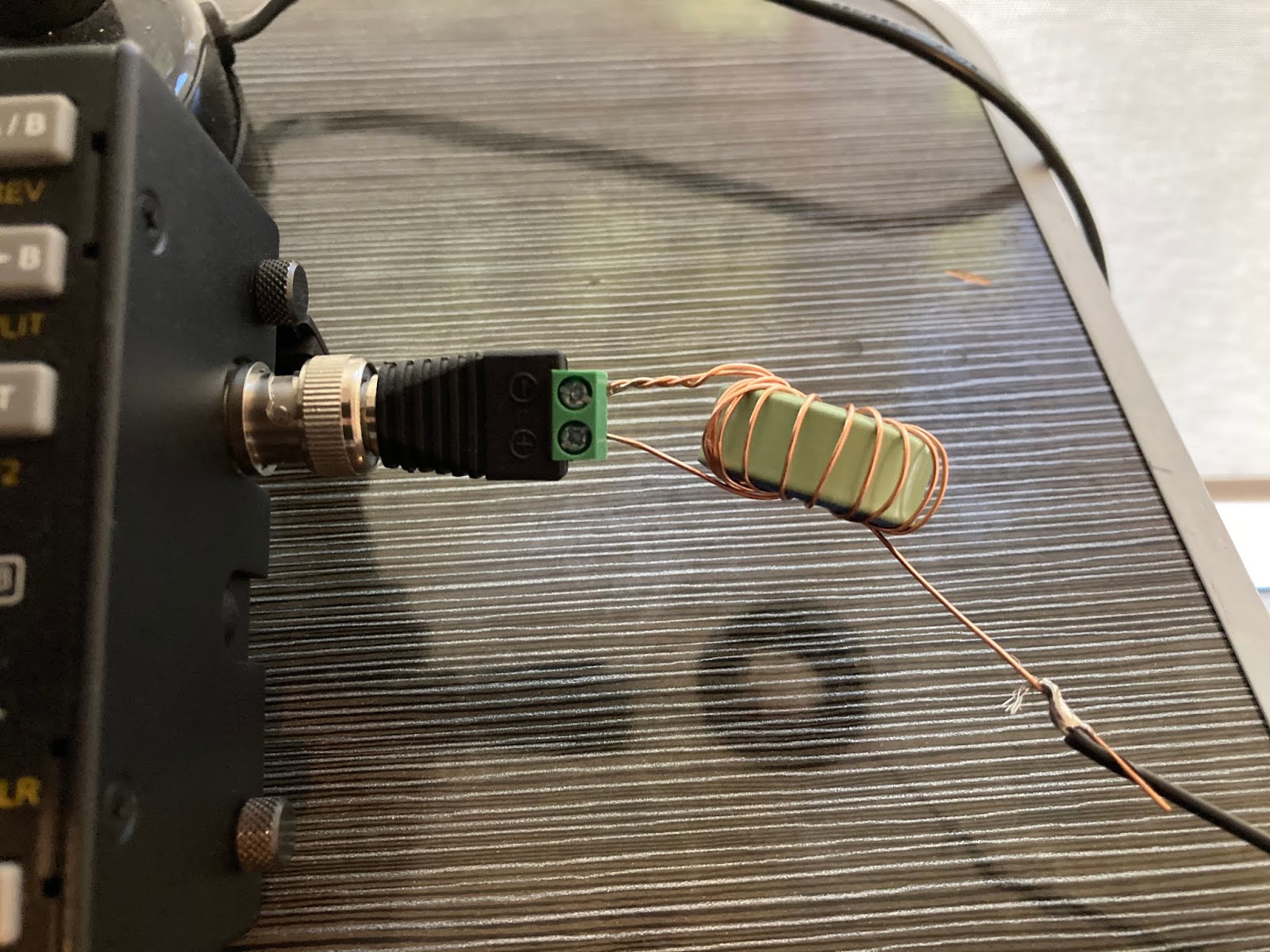
At the time of writing, the main missing piece for Ham Radio applications is access to sound. Devices are listed and I’m sure one day soon this will be solved. So, ham radio on a Chromebook? No. Not quite yet.

This conclusion is in line with Betteridge's Law.

Monday, March 09, 2020

Enjoyed the 48th Model Railway Exhibition at Forestville

One thing I'll definitely miss as we move away from this area is the annual model rail exhibition that is just up the road. Here's a few impressions:


WifiTrax is a good idea but it didn't work very well in a busy environment with lots of hot spots.


Hearty congratulations to the North Shore Radio Modellers Association Inc. who run this fantastic event.

Tiny toaster ovens are the best ovens

As part of the downsizing project here we threw out or sold a lot of things. Our old toaster oven had been damaged by me cleaning it with oven cleaner. Big mistake on aluminium walls!

I really missed the toaster oven. The small internal volume means that it gets up to temperature in seconds and the heat is very even.

After struggling with the big oven in the kitchen for a few months I decided to lash out and purchase a replacement. The Sunbeam 9 litre shown here at Myer was available at The Good Guys for $59 so that's where I purchased it.

The signature dish in one of these is a ham, cheese and tomato toastie, but tonight we had little quiches. Very nice.


Thursday, March 05, 2020

How to see LoRa on an RTL-SDR waterfall

I've tried to see the LoRa chirps in the past but they were always too quick. John, VK2ASU, has figured out how to slow down the chirps and spread the spectrum enough to see this:


Here's the settings used:

LoRa.setSpreadingFactor(20);
LoRa.setSignalBandwidth(62.5E3);

Thanks John!

Decoding a Digitech Wireless LCD Thermometer

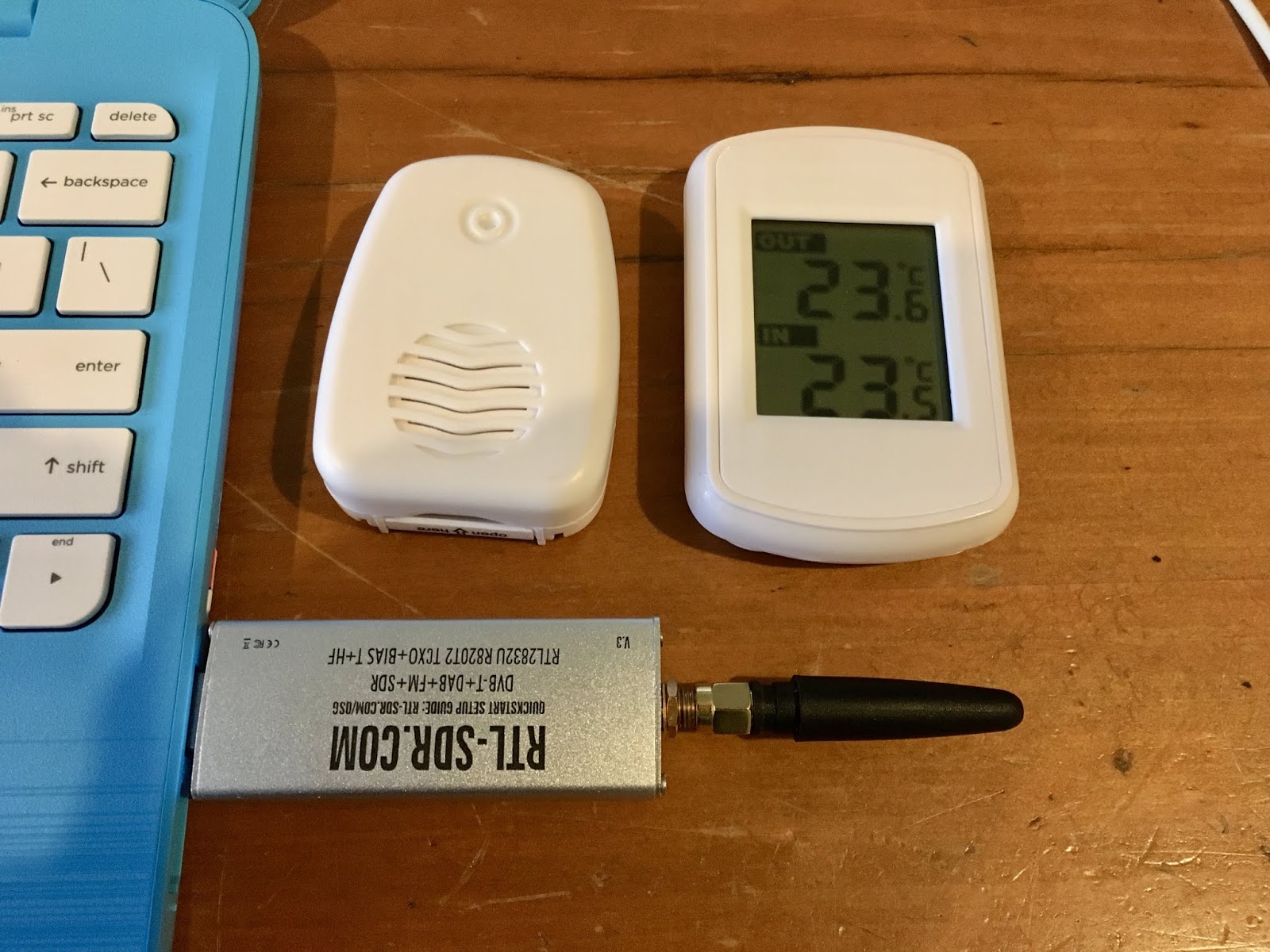
Just picked up a AU$20 indoor/outdoor wireless thermometer from Jaycar. It mentions on the back that it uses 433.9MHz so I connected an RTL-SDR and ran the omni decoding rtl_433 command line tool. Simply installed using apt on Ubuntu.


The remote FT-004-b temperature sensor sends a reading once every 60 seconds. There's a little LED that blinks just before it sends. Here's the setup.


rtl_433 can output decoded data in a variety of formats: kv|json|csv|mqtt|influx|syslog,  so this could be handy for logging temperatures. rtl_433 can decode about 150 different devices and there is documentation on how to add more.

It supports the following modulation types:

OOK_MC_ZEROBIT :  Manchester Code with fixed leading zero bit
OOK_PCM :         Pulse Code Modulation (RZ or NRZ)
OOK_PPM :         Pulse Position Modulation
OOK_PWM :         Pulse Width Modulation
OOK_DMC :         Differential Manchester Code
OOK_PIWM_RAW :    Raw Pulse Interval and Width Modulation
OOK_PIWM_DC :     Differential Pulse Interval and Width Modulation
OOK_MC_OSV1 :     Manchester Code for OSv1 devices
FSK_PCM :         FSK Pulse Code Modulation
FSK_PWM :         FSK Pulse Width Modulation
FSK_MC_ZEROBIT :  Manchester Code with fixed leading zero bit


Thanks to John, VK2ASU, for the nifty 433MHz SMA antenna.

Tuesday, March 03, 2020

WSPR Watch app comes to macOS

Some years ago I created an iOS app called WSPR Watch that queries the WSPRnet.org website and displays spots. As WSPRnet is free, my app is free (unlike at least one other).

Last year Apple released the ability to easily port iPad apps to macOS and so with just a few changes I was easily able to produce a macOS version.

Here's how it looks showing spots received by Phil, VK7JJ, who has particularly low noise reception in Tasmania.


The app has been approved by Apple is now available in the macOS App Store. Because of the Catalyst porting system it is only visible to people running macOS 10.15 Catalina.

I hope you like it.

Sydney house sold

The process of selling our home in Sydney is over. We accepted a reasonable offer a few days before the auction. While there's a chance of a bidding war pushing the price up at the auction, there's also the risk of only low or no bids so it seemed wise to take the offer.

We selected a well known real estate agent and basically took all of their advice except that we didn't bother with advertising in the newspaper. I figure that the buyers would be a young family who would most likely only look online.

After downsizing and storing lots of possessions in Victoria (where we are moving), the house was "styled" which means lots of cushions, throws, big lamps and vases. (See photo above). Looking at other houses on the market it seems they all look the same which I guess helps when comparing.

Having the house open for inspection is an intrusive affair. Visitors seem to open everything, including draws in furniture which is not part of the property. We got very good at cleaning the place but I'm happy that's over.

Now that the "styling" has been taken away, I've thrown a wire out and am listening on 20m for WSPR signals again.

It's a long settlement so we're here until May. Next step is to find a rental in Melbourne and then start looking for a new home.

Tuesday, February 25, 2020

Wyong Field Day 2020

The Amateur Radio field day at Wyong this year seemed relatively quiet but had some very interesting gear on display.

All sorts of old gear was on display under the awning.


Commercial displays were in a large tent.


Tecsun Radio, who are mostly known for selling shortwave receivers, now have an amateur transceiver, the XIEGU G90, in their range.


The Amateur Radio NSW Home Brew Group had a wonderful display and here's John, VK2ASU, ready to explain the gear.


Recently, John and I, have been experimenting with LoRa transceivers and John showed a short message transceiver system.