The theme of today's ARNSW Home Brew group meeting was "making frequency" and we had a diverse range of approaches on show. It's fascinating how technology has moved from crystal oscillators, to phase locked loops to computer controlled DDS in a few short years.
John, VK2ASU, demonstrated how to raise the frequency of a quartz crystal by carefully grinding it to make it thinner.
This is done first with 600 grade sand paper and later directly on a glass sheet using a fine compound such as toothpaste.
The evolution of a flexible Atmel processor controlled DDS based oscillator was shown, starting with the prototype and ending with a very nicely boxed up unit with plenty of space to house perhaps an entire transceiver at a later date.
Here's the prototype:
Here's how the completed project turned out:
Stephen, VK2BLQ showed a "Huff and Puff" stabilised oscillator he had constructed.
It's amazing to me how even non-computer nerds are getting in to embedded processors for ham radio applications these days. Mostly the Arduino and Raspberry Pis are popular but here's a nice board Bob made:
Peter, VK2EMU, explained phase locked loops and DDS and the crowd had a great time.
In other news, my build of Peter, VK3YE's "Knobless Wonder" is now transmitting well - I had a good report on my audio and signal from Mal, VK2BMS.
I've been having some trouble with transmit RF oscillation - due mostly to my use of long, unshielded wires, but I'm gradually improving things. Both transmitter and receiver work but I have yet to add a relay to allow easy switching.
My transmit audio is reported to be clear but "thin", Mal does say it's very readable and "communications quality". Great progress!
Do you remember the tradition of meeting up with friends or family, a few weeks after they'd returned from an overseas trip, to view a (hopefully edited) selection of their photos.
Those days have ended.
During our trip away, friends and family have seen photos hour by hour via photo sharing on Instagram and Facebook. It's made the trip have a different feel to "getting away" in past years. Everywhere we stayed has WiFi to the internet and between the four of us we brought a lot of computer gear: 4 smartphones, three tablets and two laptops in all.
To charge all this I brought a power board from home and a single international plug adapter so the normal chargers could be used. (This is a great idea from John O'Brien).
One place we stayed had WiFi internet provided by a little Huawei e586 device which unfortunately can handle only five connections.
I'm not sure if it was the fault of the e586 or the way iOS devices give up their WiFi connections but we had real problems finding a slot and I ended up paying for BT Wifi for a few days. I do not recommend a five connection device for a household.
Presumably triggered by the record high Australian dollar a few months ago, I've been following several friends who are also out of the country at the moment - cheers to fellow travellers Ben, Tony and Marc - it's been fun following your adventures too this month.
We're coming to the end of a four week European vacation. Most of our accommodation was booked through Airbnb and I thought I'd share our experience.
Airbnb, and similar sites, let people with some space to rent do business securely with travellers who need a room. Typically these are self-contained units and while sometimes the owner lives nearby, or even upstairs, we didn't generally interact with the proprietor after an initial greeting and key hand-over.
The great thing is that compared to a hotel room you get a kitchen, clothes washing facilities and an internet connection. I particularly like not having to go to a restaurant for every meal. The host is available by phone if you get stuck which is reassuring.
As you are renting from inexperienced landlords, they do tend to have some quirks. Some of the spaces were oddly cluttered with nicknacks that they might have thought enhanced the spaces, but really meant that we had no place to put our luggage.
Sometimes the host has a lot to say when we first arrived, tired from a long flight, and it might have been better if they left us to it and dropped back for the "orientation" session.
Like eBay, Airbnb lets both parties review each other and from what we heard some guests leave a big mess so we've tried to do the right thing in each place. Reviews of land lords tend to be positive and subtly hint at issues rather than being clear about them. (My guess is that when you write a review of a place knowing that after reading it, the other party will review you, it tends to calm things down a bit).
The biggest issue we had was hot water not working due to insufficient flow from the shower to trigger the on-demand heater. Looking back at past reviews it's clear this isn't a new issue.
A good thing about travelling is remembering how great it is to live in Australia. Spacious houses, modern bathrooms, comfortable beds and a lack of street crime. Big European cities seem like the "third world" in some ways compared to how we live in Sydney.
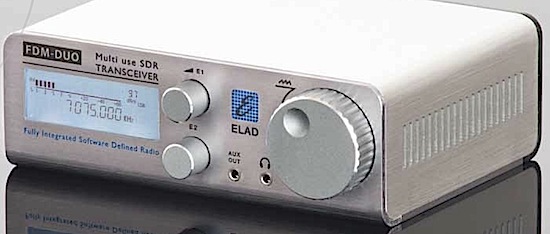
While on tour in Europe I do miss my radio shack. Searching around I stumbled upon this interesting SDR in a box with knobs coming soon from Italy.
There's more information on the FDM-DUO available but basically it's a flexible software defined radio transceiver, with 5W out, that can be used either with a computer as the back end or with just the knobs and buttons on the unit itself.
We're clearly at a cross-road at the moment, where many of the standard amateur radio transceivers are of very dated design (it's amazing to me that the FT-817 is still a current product) and the plummeting price of embedded computers means that advanced software defined radios should be very cheap to manufacture.
I love how in Bologna in particular there are many many cyclists of all ages. The other thing that I like is that there are some very small cars. I did see lots of Smart cars for two, some of those three wheel motorcycles and a few other small cars like these which I think are used by the postal service:
I'm not really a "foodie" but we spent a pleasant day looking at three foods made in mostly traditional ways here in Bologna. There's an official process which gets the D.O.P. stamp in each case.
First we looked at the way Parmesan cheese is made. Big vats with a steam jacket and various mixers both manual and automatic are used.
Once curdled, the cheese is removed in "cheese" cloth.
"Wheels" of cheese are soaked in salt solution.
Finally it ages for years in a storage areas where inspectors come and tap it with a curious little hammer.
Next up, Balsamic vinegar, which is made by taking fermented grape juice, ageing in different wood barrels and progressively moving to smaller barrels.
The most expensive version we tasted was liked by most of us less than the cheaper stuff, but my taste may not be highly trained enough for this sort of thing.
Finally Mortadella, which is made from the hind quarter of happy pigs. It's dried in salt and aged for years until the inspectors feel it's just right.
Our guide urged us to only buy products marked as made in Modena and certified D.O.P., he explained how expensive and time consuming the process was and in the end I asked how much money they loose on each product sold.
At the end of all this, we enjoyed the scenery in the hills above Bologna and ate an enormous lunch that ironically did not feature any of the foods we'd seen.
The reason we chose to come to Bologna is to take a tour of the museum at the house where radio pioneer, Guglielmo Marconi spent his childhood and did his initial experiments with electricity and, most famously, increasing the distance of radio transmission. Villa Griffone is an imposing building.
And here's the view back towards the highway.
To get there we caught the Number 92 blue bus from Bologna, it was €7 return for both of us and the trip took about an hour (but it might be quicker with less traffic).
You can clearly see the house from the bus but there's trees before and after so I'd ask the bus driver to warn you as it approaches. The stop is about two stops past the centre of Borgonouo.
You need to book a tour to visit, it's just €5 per person but it's well worth while. Here's some photos which were highlights for me, but there's lots there besides this.
Marconi improved on the distance that spark transmitters could be detected in several ways. On the left you can see the equipment with an antenna above and earth plate below.
We now know that these are much too small for the long wavelengths he was probably dealing with but anything was an improvement.
In particular, Marconi improved the "coherer" as detectors were known in those days, he added a little hammer that re-scrambled the metal filings in the tube that helped them to stay highly sensitive to electric fields.
A coherer, a tube of metal filings, used to detect radio frequency signals.
Here's a reproduction of Marconi equipment that would have been using on board a ship.
A beautiful reproduction spark gap device.
This next one was new to me, it's a detector that uses magnetic hysteresis in iron to detect radio signals. To operate it an iron wire must be drawn through concentric coils, one has the antenna connected to it and the other goes to an amplifier for the detected signal.
There is a fully working spark gap transmitter and receiver setup too, imagine the interference this would cause!
And here is the receiver:
There's lots of interesting gear on show, while not part of the Marconi legacy, this was the first time I'd seen a feld hellschreiber machine in person. (A clever German device that sent a kind of fax of a line of text via simple on-off keying).
Here's an early Motorolla hand held transceiver with my phone next to it.
Interior of the Motorolla transceiver showing the compact valve construction.
This interesting display let us compare different types of rock for their semi-conductor abilities for use as a diode detector.
In one of the pine trees near the house, original antenna wire from a young Marconi was recently recovered.
Marconi's upstairs workshop with the kind of equipment he used. The museum has reproduced many of his instruments and actual working models of experiments for the display.
This is the original of the iron hysteresis detector built in a cigar box by the looks of it.
We were very lucky to have Marconi scholar Barbara Valotti as our guide. She has been researching early Marconi notebooks and helping to re-write the somewhat distorted history of the man who is often portrayed as a lone genius who had flashes of inspiration rather than a methodical self-taught scientist who experimented over many years to develop technologies that could be commercially exploited.
Although we came to Bologna to visit the Marconi Museum, I would add that we've found it a wonderful city to visit. The people are much more friendly than at the tourist locations elsewhere and despite my embarrassing lack of Italian everyone has been helpful and understanding.
I'd highly recommend a visit. My thanks to G4FTC who's web site tipped me off to this great attraction.
Normally I like to look at shoes and handbags but my wife insisted on some science content for our current tour.
Galileo Galilei lived until 1642 and was revolutionary in terms of evidence based knowledge in an era when the church laid down physical laws without question. Here's a machine that explains the (extremely complex) mechanism by which the earth could be at the centre of the universe.
Galileo used, and improved the telescopes of the time to make his own observations and came up with conclusions at odds with conventional wisdom.
In the 1600s, 1700s and 1800s it seems that science was a very popular topic and demonstrations of phenomena which were not well understood, like atmospheric pressure, electrical charge and momentum were a common parlour trick to entertain the rich. Some wonderful devices, beautifully crafted in wood and brass survive and are on display in the museum.
An electrostatic generator:
Glass rubbing electrostatic generator:
Vacuum pump:
Lens grinding machine:
Even an executive toy:
Galileo was tried by the Catholic church and found guilty of heresy. He was tortured and forced to agree that the sun went around the earth, although it's said that under his breath he said that it wasn't true on the way out. He lived under house arrest for the remainder of his life.
In October 1992, Pope John Paul II expressed regret at his treatment, so I guess we can look forward to apologies for contemporary crimes in just a few centuries.
Twenty five years ago, Phillipa and I travelled to Europe together. We booked through a travel agent who suggested accommodation that met our budget - mostly "pensiones" as I recall.
I was always suspicious that the travel agents would recommend places with the best kick-backs.
In Florence I proposed that we marry and a quarter of a century, and two adult children later, we're back, but a few things have changed...
This time we booked with Airbnb where individuals rent out their apartments and are reviewed by clients. By the same token, clients are reviewed by hosts. We've paid as little as AU$80 a night for a complete flat which suits us just fine - it's great to be able to be able to make our own breakfast and do washing.
Technology has changed too. Last time I was here everyone had film cameras, now it's digital and there's a lot of people shooting on smartphones and sharing on Facebook. One of the key review points for a flat is the quality of the included internet and wifi - so far it's been pretty good (but not as good as at home).
The other fun toy is using a Fitbit dongle to count steps. On holiday, I do quite a lot of walking and am hitting up to 20,000 steps in an active day.
While free Wifi is quite common you have to seek it out and often it has annoying terms and conditions to agree to. In each new country I receive a string of scary messages from Telstra warning me about high roaming fees. Surely the cost is just a transaction fee which should tend towards zero. Is mobile data really a scarce resource? I think travellers are being exploited deliberately.
My strategy has been to purchase pre-paid global roaming data and to enable roaming data just when I specifically want to look something up - like on a map.
I'm also using off line maps from CityMaps2Go and travel info from Triposo.
There are commercial Wifi services too, I purchased a month of boingo but have not found it useful - the only place if offered service had 45 minutes free anyhow.
$15.36/MB, really! How on earth can that be justified? I do like the warnings but as I have purchased an international data pack it would be good to be aware of that.
Over the past few weekends I've been building VK3YE's "Knobless wonder" a fixed frequency SSB transceiver for 40m. It's at the point of starting to work, although transmit sound is very poor right now.
A scan of the circuit is here. I've enjoyed the build, it's simple enough for me and I was careful to build and test stage by stage, stopping if something didn't work and figuring it out before going on. The main thing that goes wrong for me, aside from failure to follow the circuit accurately, is that sometimes I have mis-filed components that I grab without checking.
The technique I've used is "Manhattan" ugly construction using snap off squares I purchased on-line and super-glued to the base boards. This turns out pretty neatly and makes the board look like the circuit diagram so it's easy to debug.
So far the receiver seems pretty deaf, although it hears my shack oscillator sweeping quite well. The transmitter has been heard by VK2BMS a few Km away although the audio is not good at this stage. I think the oscillator isn't tuned correctly yet - I need to figure out the best way to adjust this.
My thanks to Peter for a nice design that is easy to reproduce. I think this is a great group project for people who live pretty close together.
It's been a great pleasure working with the ABC TV rage team, a wonderful graphic designer and producers to do an update of the popular rage app.
The design is pretty wild but from a software developer's perspective I've focussed on minimising internet traffic by doing HEAD requests and only pulling down playlist data, artist images and bios as required.
Playlists are cached in a local core data store so that opening the app is fast and memory use is minimised.
It's amazing that this TV show has been on air since 1987.
Please check out the app and if you like it, give us a rating and review. (If you don't like it, I hope you'll contact us).
Many of us work inside fire walled networks where virtually all ports are blocked and web traffic goes through an annoying proxy server. A VPN connection makes your computer appear to be on another network and these issues go away.
Another big reason to operate through a VPN is if you are on someone else's network, perhaps a cafe Wifi service, and are (rightly) concerned about your traffic being snooped.
There are commercial VPN services available but I've recently set up a raspberry pi as a server and it works really well sitting on my home internet connection.
OpenVPN requires a single port, either TCP or UDP, between client and server.
Installation is well documented in several places, but I referred to the excellent instructions on Remi Bergsma's Blog.
I made two changes:
Used tcp rather than udp as for some reason I couldn't connect via udp - update the setting in /etc/openvpn/server.conf
Enabled nat on the pi as I was unable to set a static route on my home router - an Apple Airport extreme.
I added that to /etc/rc.local so it will be re-applied on each boot.
Finally I forwarded the TCP port I want to use to connect from my home router to the Raspberry Pi. My home internet connection occasionally changes public IP address so if that becomes a problem I might use a dynamic DNS service to keep track of it.
Client
I use MacOS mostly and I'm using the Viscosity client which has a 30 trial period (which I'm still in) and then costs just US$9 which is very reasonable. At first I tried the free Tunnelblick client but it doesn't quite work at the moment with Mountain Lion (I can't get it to correctly set the DNS to the remote end of the tunnel).
Please be advised of the second Radio Australia HF test using the digital text modes MFSK and FLARQ. Freeware fldigi will handle these automatically - see http://voaradiogram.net/ and http://www.w1hkj.com/
The text will contain text and images from Radio Australia's web site as well as contact details for sending responses. Note 2150 UT Sunday is Monday morning 0750 EST in Melbourne etc.
All dates/times are in UT, all frequencies in kHz
Saturday/Sunday 8/9 June 2013
0850-0857 UT on
7410 (PNG & south-west Pacific)
11945 (south Pacific, NZ, central America, Europe)
1230-1237 UT on
6080 (PNG, west Pacific, Philippines, Japan), new freq for MFSK
9580 (central Pacific, NAM)
12065 (central Pacific, NAM)
2150-2157 UT on
11695 (south-east Asia, Europe) new freq for MFSK
21740 (central Pacific, NAm) new freq for MFSK
with 40s of RA tuning signal (Waltzing Matilda) at the start of each session.
Extremely poor reception here this morning of 11695. I could barely detect that there was a station there and only a few words were decoded.
Update
The tests have been a success and reports are coming in from around the globe. The Voice of America's Dr Kim Elliot, reports on his reception in Northern Virginia where despite poor audio reception, the digital text message was perfect.
Peter, VK3YE, recently showed me a new home brew fixed frequency single sideband rig he dubbed the "knobless wonder". I think this is a great group project where the fact that it's fixed frequency is an advantage in encouraging contacts between builders.
He's given permission for the circuit to be published here (click to enlarge).
I highly recommend Peter's walkthrough video complete with a series of contacts on the actual rig.
If you are near a radio this evening, tune in to ABC Radio National where I join host Marc Fennel and co-guest Claire Porter (from news.com.au) to chat about human technology matches and mis-matches.
Can't tune in? guess what, you can download this show or subscribe to the podcast by searching for it in your podcast app or iTunes.
Always a pleasure to join Marc and other guests on my beloved Radio National.
You don't get much fashion advice on this blog, until now. If the M65 field jacket seems familiar, it's because Robert De Niro wore one in Taxi Driver, Al Pacino wore one in Serpico, Sylvester Stallone wore one in multiple movies and Arnold Schwarzenegger wore a decorated one in Terminator. And that's just the start, check Wikipedia for about 40 references.
Introduced into the US military in 1965 to replace the M51 which replaced the M43 (you can figure the years).
The exterior is poly cotton mix, there is a 100% cotton lining and a further, buttoned on detachable inner warm layer. The instructions warn not to dry it on a stove, so I guess that was a problem.
What's amazing is that in 1965 they correctly predicted the dimensions of the now popular seven inch tablets and a Nexus 7 fits nicely in the side pockets. Great forethought there. Available at army disposals stores globally.
News of the availability of very low cost AD9850 DDS boards from China via eBay has swept the home brew radio community in recent weeks. These chips alone were quite expensive and the surface mount soldering was a challenge.
Now the chip, mounted on a nice carrier board, with 125MHz crystal, is available for a very reasonable price. Here's mine sweeping a few frequencies near 10MHz:
The Arduino code I used is from NR80 which in turn is based on code from Andrew Smallbone.
I simply powered mine from the 5V on the Arduino and it seems to work just fine.
Our plan is to make a little crystal replacement board for QRP purposes with a multi-position switch to select the frequency.
Purchased a blank Arduino shield board and have now mounted the DDS board nicely for future software development.
.jpg)


.jpg)
.jpg)
.jpg)



.jpg)


