Sunday, March 10, 2024

A pleasant trip north via "The Dish"

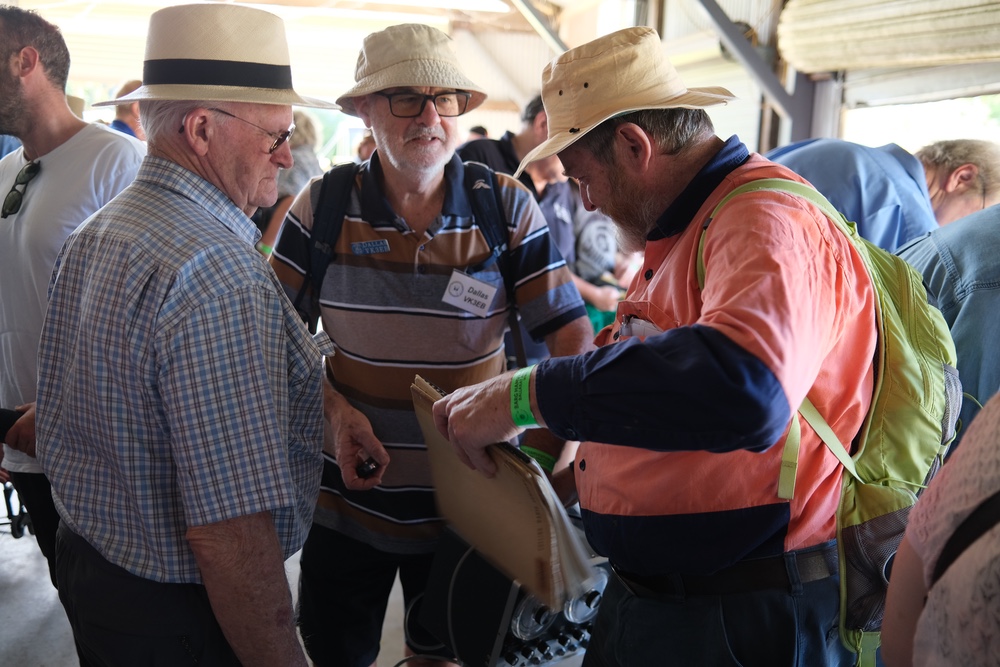
A friend had some boxes of yachting gear left in Melbourne and I kindly agreed to drive it up to him at Dorrigo NSW. Along the way I visited John, VK2ASU, Merv and Dallas, VK3EB. 

On the way back I dropped in a Parkes and took another look at the CSIRO Dish.

It was a long drive in the Jimny and to avoid the high noise level I listened to podcasts in noise cancelling headphones.

I stopped for two nights at Port Macquarie and was interested to note that a podcast I listened to later, which was obviously downloaded while I was there, had local Port Macquarie targeted ads inserted in-line.

The return trip was more rapid and the final run from Dubbo to Drummond was a marathon in hot conditions.

It was good to get away and to catch up with friends. It's good to be back.

Here's a circularly polarised log periodic antenna.

Here's an Apollo 11 S band OMT:


S Band is 2.4–2.483 GHz. I think an OMT is an Orthomode transducer which is a waveguide component referred to as a polarisation duplexer.

Here's an impressive bit of work, a C30 Converter:


Monday, February 26, 2024

Simple Arduino rotary tuning knob for SDR

I like using SDR++ to remote control my AirSpy receiver but I was missing the tuning knob. SDR++ can be tuned with the mouse wheel but I find it a bit difficult.

Using an Arduino UNO R4 Minima I've made a very simple Rotary encoder that sends left or right arrow keys to the computer. I can't get the interrupt driven encoder code to work so I'm just polling but it seems fine for me. 


Soon I'll box it up for desktop use.

Embarrassingly little code is needed for this.

#include <Keyboard.h>
#include <Rotary.h>

Rotary r = Rotary(2, 3);

void setup() {
Keyboard.begin();
r.begin(true);
delay(1000);
}

void loop() {
unsigned char result = r.process();
if (result) {
if(result == DIR_CW) {
Keyboard.press(KEY_RIGHT_ARROW);
delay(10);
Keyboard.releaseAll();
} else {
Keyboard.press(KEY_LEFT_ARROW);
delay(10);
Keyboard.releaseAll();
}
}
}

Here it is all boxed up like a bought one:


Sunday, February 25, 2024

Wyndham Amateur Radio Club radiofest a good show

It's only a few short weeks since the Ballarat hamfest but as I live pretty close it was a no-brainer to head over. There was an excellent turnout and the new venue, Rowsley Hall, wasn't really spacious enough for everyone to get in.


Lots of interesting older gear to look at. I was tempted by the high voltage variable capacitors.


In the end I came away with a 1994 edition of the ARRL Antenna Handbook. It has calculations written in it by a previous owner.

Friday, February 23, 2024

New radio streaming iOS app - Sound Salvation

The name is inspired by a line from Elvis Costello's song "Radio Radio". I like to listen to radio in an earpiece when I wake during the night. Where I live there is no FM (or DAB+) and the house interferes with AM reception so I've been trying various radio streaming apps.

The apps I've tried are often very annoying in one way or another. Some force ads on the listener - one even made me watch a full screen video ad after a while. Many have various types of in-app purchases or subscriptions.

Sound Salvation is low cost (AU$2). It doesn't collect any information on users. It doesn't show any ads in the app. The radio station directory comes from https://www.radio-browser.info/ which has over 46,000 stations in its database. The only monitoring the app does is to send a "click" to Radio Browser for each play of a station for their popularity ranking.

You can add your own station if you know the streaming URL. The app also supports a URL Scheme so that opening a URL on device like the following one will add a station to the list.

soundsalvation://add/?title=Radio%20National%20Sydney&url=http%3A%2F%2Flive-radio01.mediahubaustralia.com%2F2RNW%2Fmp3%2F 


Being a brand new app I decided to use the very latest Apple technology so it's built in SwiftUI and uses SwiftData for the database. The experience was a very smooth one but means that the app requires iOS 17 and above and I know that's a problem for some people with older devices.

Like all good apps, I wrote this for myself. If you want to stream radio, please give it a go.

Update

Well, I'm slightly boggled to see that currently Sound Salvation is the number 1 paid app in the Entertainment category.


Just ahead of "iFart" and that's undoubtedly a high bar. ;-)

Thursday, February 15, 2024

Listening to shortwave on my 80m loop antenna

Recently I strung 80m of wire up in a loop attached to trees. It's not as good as my dipole for transmitting but it makes an excellent receive antenna. I've got an AirSpy HF+ SDR running with SDR++ in server mode so I can tune from the house (which is separate from the shack). This is running over two Wifi links but as you'll see it's a pretty good experience.


I'm currently reading Geoff Heriot's excellent book about International Broadcasting titled "International Broadcasting and Its Contested Role in Australian Statecraft - Middle Power, Smart Power". An informed and thoughtful examination of the topic.

Saturday, February 10, 2024

WSPR Watch 4.10 - fixed a long standing thread crash

WSPR Watch, my iOS app for quickly looking at spots on WSPRnet, is 12 years old. During that time it has been updated as the software tools and frameworks have changed.

First it was Objective C and UIKit. Next came the move to Swift. Version 4 was a move to SwiftUI.

I've always used background threads for doing the time-consuming requests to the different data sources. Most recently I've been using async/await and Actors. 

When I moved the app from storyboards to SwiftUI about half of the old code was no longer required. Things look much neater now. For a long time I've had a few crash reports coming in. These have been mostly in the map view. This app really hammers the map by drawing, sometimes, 10,000 or more overlays on it. 

I'd heard of the ThreadSanitiser that is part of the LLVM toolchain and available in Xcode. When I turned it on and ran the app in a Simulator it quickly showed me three data races that I hadn't noticed. My mistake was adding to an Array from a background thread when that Array was also available from other threads.

Having fixed these, I am now seeing zero crashes from users of version 4.9 and later. I expect to see a few due to being out of memory of killed in other ways but so far it looks good.

My thanks, as always, to my wonderful testers and users for their suggestions.

Sunday, February 04, 2024

Enjoyed the Ballarat Radiofest 2024

A few friends came from around the state including Shepparton, Bendigo and Melbourne. We stayed at a local motel and had a nice dinner and walk the night before to check on shortwave reception.


It was a warm day but thankfully there was a very pleasant breeze to keep things comfortable. By opening time, 10am, the crowd was keen to get in to see the gear for sale.


There were lots of older generation transceivers for sale at fair prices but I wasn't particularly tempted.


Quite a few members of my club, the Macedon Ranges Amateur Radio Club were on hand as were members of the Bendigo club who even organised a bus.


I picked up a few 27Mhz AM transceivers in the hope I could find one I can move to the 10m amateur band. I couldn't resist an Icom IC2A 2m handheld transceiver for $3.


A very enjoyable day. My thanks to the organisers.

Wednesday, January 31, 2024

LiPo Battery box - a modest project

I have a 12.8V 12Ahr Lithium battery but I wanted to avoid a mess of wires when using it in the field so went looking for a box to house all the bits.

Annoyingly hardware stores don't seem to list the internal dimensions of these boxes on their web sites but I found one at Bunnings for $35 that is perfect.


Not much to this project. There's an in-line automotive fuse holder, I've fitted a 30A fuse for now. A nice big switch and a panel mount Anderson connector.


The fit is tight enough that the top of the case presses a little on the top of the battery and stops it moving around.

Next step.... SOTA!

Friday, January 26, 2024

Raspberry Pi Pico RF transmit

Some great work by Jon Dawson on his 101 Things project "A collection of cool projects to make!". Jon clearly describes how he has built:

  • SDR Receiver
  • SDR Transmitter, including SSB, AM & FM
    • A Class E (and D) power amplifier
  • Multi-effect Guitar unit
Source code is shared on his Github repository

He has a video about the transmitter:


I set up the native C++ build tools for the Raspberry Pi PICO on an Intel Linux machine. I got the FM transmitter working, well it builds, and creates a carrier on 88MHz but the audio I'm streaming it it isn't modulating it for some reason.

There's no comments about how to run this but I deduce that you use a python program to stream a sample wav file over serial to the PICO which should then generate 88Mhz and FM modulate it.

python3 transmit.py Audio_Sample_-_The_Quick_Brown_Fox_Jumps_Over_The_Lazy_Dog.wav 

Available Ports

0 /dev/ttyS0: ttyS0 [PNP0501]

1 /dev/ttyACM0: Pico - Board CDC [USB VID:PID=2E8A:000A SER=E669BCF8E72E682F LOCATION=1-2:1.0]

Select COM port >

1

I did run into a build issue on Intel Linux so I raised a bug report. Jon looked at it overnight and did some updates.

The pico_setup.sh script runs on my machine right up to the point where it tries to install Visual Studio Code. The different samples all now compile. Jon seems to have removed the 19_fm_transmitter example which I was trying to get going.

I have some FST3253 on the way so I can try the transmitter sample.

This work has really driven home to me what a fantastic chip the RP2040 is.

Update

I wrote to Jon about the issues I found and he has updated the code and things are building and working correctly now. If you got the source code early on, do a git pull now and try again.

Here's my version of the board:


And here's some very rough looking AM:


"The quick brown fox..." Here's some sideband:


Wednesday, January 24, 2024

Tried a raspberry pi pico WSPR transmitter with no external oscillator

Someone mentioned that it's possible to generate RF with a Raspberry Pi PICO with no external oscillator. There is a library by Roman Piksaykin, called pico hf oscillator and it's used in a simple WSPR transmitter available here.

To build this project you need the native C/C++ toolchain. There are good instructions around for getting this going on a Raspberry Pi, but I did run in to a few issues getting it going on my Apple Silicon Mac. In the end it compiles.

The code dedicates one of the two CPU cores to generating the RF signal and it can go up to 33Mhz.

The waveform out of GPIO pin 6 looks like it has a bit of jitter on it.


It sounds good on the receiver and was easily decoded locally. 


The BNC to the CRO was unplugged and connected to a 40m dipole and stations heard me.


It looks like it drifts slightly during a transmission but not too much. Thanks to Roman Piksaykin for his good work on this. 

The Pico is a remarkable platform and I've started looking at this amazing work to produce other signals including sideband from 101 Things.

World Economic Forum lists AI as the second top risk

This week I discussed the World Economic Forum's risk report which lists AI as second only to climate change.

You can listen here if you wish.

I'll be back again next Tuesday evening for more tech talk.

Sunday, January 21, 2024

AI noise reduction on sideband radio

David, VK3KR, drew this to my attention. There is amazing work being done to remove radio noise from sideband signals. Check out the demonstration on the RM-Noise Video page

RM-Noise only has a Windows client and does the work in the cloud. I look forward to the day when this is built in to HF radios.


Tuesday, January 16, 2024

Powering a QRP radio for portable operations with a Powertech battery inverter

I was looking around for a nice way to power a small radio when operating in the field. I have various batteries but nothing in a convenient box. A solution was right under my nose! I have a little (155Whr) Powertech rechargeable battery. It has USB outputs and a 240V "modified" sine wave inverter. This will run a Dometic fridge in the car during a trip to the supermarket to get frozen food.

It also has three 2.1mm coaxial sockets marked "DC Output 12V" and I wondered if these were fed by a buck converter and might be noisy. It turns out there is no noise on these DC outputs.


The box has these specifications:


I thought I'd have a peek inside partly to see if the markings on the battery match the claimed capacity. It's fairly straightforward to open except I think the bottom screw might have been glued in. Obviously a unit that generates 240V is potentially dangerous.


The unit is a quality construction from what I can see. The battery pack is made up of 18650 cells.


Markings on the battery pack match the claimed capacity. The voltage is marked as 11.1V but when fully charged I see 12.4V so it's likely that a radio powered by this would need to be able to work well below 12V.

This unit is an old model and the new version has a USB-C output, although I wonder if it's USB-C PD?


Saturday, January 13, 2024

Full wave loop for 80m

Fortunate to have space for this, I have put up a horizontal full wave loop for 80m. I cut 82m of wire, put up the loop and trimmed it down until it's resonant in the band. The resonance is quite sharp though.

I initially used a 1:1 balun to feed the loop and it matches quite well.

Now I can switch between the full size dipole for 80 and the full size loop for 80m.

Noise, and signals are lower on the loop. The real test is measuring signal to noise ratio and I've been switching back and forth while receiving WSPR to get an idea on this.

So far I can't see that SNR is better on one or the other. HF conditions vary all the time so perhaps I need to set up two receivers to really compare.

The loop is quite low to the ground, perhaps 2m high for much of it which might explain why it's not superior to the dipole which is quite a bit higher up.


Thanks to Frank, K4FMH, for bringing his excellent presentation on optimising horizontal HF loops to my attention:


Clearly my height above ground is too low for 80m use. The shape of my loop is far from square, more like 5 sides attached to trees.

Here's an SWR plot using nanovna-saver with the 1:1 balun I used at first:


After watching Frank's excellent talk, I changed to a 4:1 balun and things are improved on the higher bands:


The loop works on several bands very well. (Today I learned that NanoVNASaver-saver has an option to show the amateur bands on the SWR plot).

I joined the weekly MRARC 80m net tonight and switched back and forth between my high dipole and the loop. Several stations reported that the signal strength from the loop was 10dB down on the dipole. I think the loop is too low.

Thursday, January 11, 2024

Antenna performance makes more difference than anything else

Last night I joined the weekly Macedon Ranges Amateur Radio Club 80m net on 3685 for a chat with the group. I called in as usual and was acknowledged. Net controller Joe commented that my signal was a bit down but I was fully readable. 

After my first over I had a look and noticed that my transmitter was transmitting just 2% of the normal 100W as I'd been using it for WSPR earlier in the day! Despite this, everyone could hear me, including Peter, VK3RV, who was operating from South Australia. 

Note also, that there was a very high level of noise from remote lightning happening in NSW.

I'm fortunate to have the nice dead tree you see here as the central support for my dipoles. The 80m dipole was raised with the generous assistance of Dallas, VK3EB, shortly after I moved to this location. The ends of the dipole are quite slack and have survived quite high winds over two years. (One end did come down on one occasion). 

The 80m dipole slowly moves lower in resonance due to wire stretching so I pull it down periodically and fold back the ends a bit to move it up again.

I've used trap dipoles, G5RVs, off centre fed dipoles, and loops in the past with good results but I find plain old single band half wave dipoles work the best for me. I now have separate dipoles up for 80, 40, 20, and 10 meters.


When not in the shack I leave WSPR running so I can take a look at band conditions. At the moment I'm running a QDX from QRP-Labs. This runs under 4W but is heard around the globe. I've noted in the past that transmissions from the QDX are especially pure as they are not mixed audio and seem to be very well decoded.

Here's a transmission on 20m just now with 25 decodes in one over. Amazing for a transceiver that fits in a shirt pocket.

Later I was spotted by 72 stations in one transmission:


A simple but decent home brew dipole makes more difference than any fancy gear or additional power.

Wednesday, January 03, 2024

Talking Tech on ABC Radio

I joined Lisa Pellegrino last night to wrap up the past year in technology and look at what I expect for the new year.

Topics included:

  • Twitter X train wreck
  • Wearable health sensors
  • Crypto's bad year
  • Home automation still a mess
  • USB-C won
It's amazing to me how much the radio audience interacts with the Nightlife program.

My audio this week was via a Sennheiser USB mic. We used Zoom and I set the audio to a higher quality by choosing the "Original sound for musicians".

Friday, December 22, 2023

Olivia experiments

There seems to be increasing interest in Olivia. It's a keyboard chat digital mode built in to Fldigi that gets through when signal to noise is poor. 


The Olivia Digital Mode website gives some useful information including suggested calling frequencies and sub-modes. Because Olivia can be decoded well in to the noise you can't always see the calling station on the waterfall so knowing where to listen is important.

You might notice that I've changed the waterfall scale in Fldigi to show actual frequencies rather than audio frequencies - I find this helps. Most of the time I use 8/250 and Stephen, VK2BLQ, and I have had several contacts between my QTH in Victoria and his home in Chatswood.

Over Xmas there is a "QSO Party" which I plan to participate in.


Wednesday, December 20, 2023

Talking Tech on ABC Radio

This week I was a guest on the national ABC radio program Nightlife with Philip Clark. My tech topics are:

  • EU investigating Twitter under the Digital Services Act which could lead to a fine that is up to six percent of global turnover
  • Apple moving to protect iPhone owners who have their phone and PIN stolen.
  • Vodafone turned off their 3G network last week. Telstra and Optus will follow in 2024. What impact will this have?
  • A child's toy has been launched that uses generative AI to converse with the kid. Is this a good idea?
  • Generative AI is being used to call voters as part of a political campaign. Every call is unique and tailored to the interests of the voter.

This week I used a Sennheiser USB microphone and called in over Zoom. 

Sunday, December 17, 2023

Join an Amateur Radio club to build a real social network

It's now two years since I moved to country Victoria. One of the first things I did was find the local amateur radio club. For me it's the Macedon Ranges Amateur Radio Club.

During this relatively short time I feel like I've made some significant new friends and I have no feeling of isolation which I imagine might affect people who've made a move like this.

We had our annual Xmas meeting this week with an amusing quiz and some finger food. I wrangled the group to stand up for a photo.


There's some very interesting people in the group and I very much enjoy the weekly club nets, coffee mornings, and meetings. I'm looking forward to the picnic in January.

My thanks to those that created the club and do the work to make it all run so smoothly.

If you are feeling a bit isolated, I heartily recommend becoming a part of your local amateur radio club.

Friday, December 08, 2023

WSPRnet down with database error

Users of my WSPR Watch app have been reporting problems over the last day. It looks like WSPRnet.org is down with a database error. "PDOException: SQLSTATE[HY000] [1040] Too many connections in lock_may_be_available (line 167 of /data/var/www/drupal-7.98/includes/lock.inc)."


Unfortunately, my error handling code is looking for a connection error but is failing to pick this up and fails silently as if there's no new data.

WSPRnet handles a huge amount of traffic and I hope they're able to fix this soon.


Wednesday, December 06, 2023

Talking tech on ABC Radio

Another chat with Philip Clark last night on ABC Radio across Australia. If you like, you can listen here.

I've purchased a new microphone, a Sennheiser Profile USB. Frequency response is mostly flat but it has a nice peak in the high frequency which I think makes it sound clear.

Knobs on the front make it easy to set mic gain, headphone level and the mix between return audio and local foldback. There is a quiet to operate mute button.

The era of USB-C is giving me an excuse to upgrade many things.