Monday, January 24, 2022
Using an IC-705 remotely from macOS using SDR-Control
Sunday, January 16, 2022
An off centre fed dipole antenna for more bands
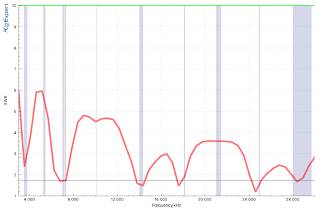
It's been great having a dipole up high in the trees but I wanted to be able to use more bands so I made an off centre fed dipole, cut for 80, fed with a 4:1 balun. This gives me a number of bands with a low enough reactance that the IC-7300's tuner can match it. Here's a plot using AntScope2 on macOS.
The grey bars are ham bands. I'm sweeping from 3MHz to 30Mhz. As you can see I get low SWR on 80m, 40m, 20m, and 11m. With a manual tuner I've been able to use 30m but it's quite a stretch.
Speaking of stretch... The antenna wire is half of a figure-8 speaker wire and I think it is slowly stretching. I had a doublet for 160m up but the wire broke.
I did notice that 40m on the OCFD was not as good as it was on the dipole cut for 40m but the extra bands and convenience make it worth while.
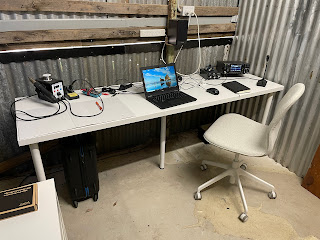
The shack is improving! I ordered a 2m bench, a gas chair, and a 4 draw unit from Ikea. Delivery cost almost as much as the furniture.
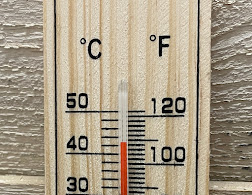
The afternoon sun hits the other side of the corrugated iron in front and it gets very hot. Next step is to insulate and line that wall at least.
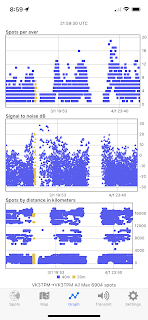
Update: Winning at WSPR reception
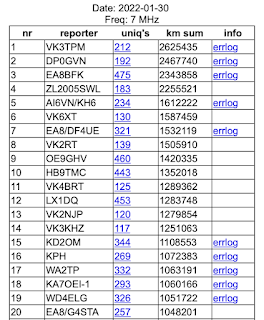
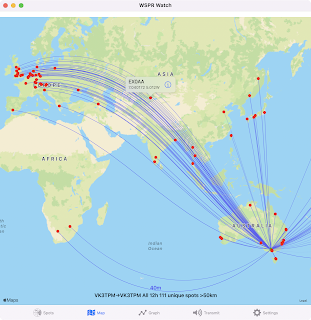
It's a combination of height, antenna and of course the low noise location. I'm pleased to see that after 24 hours of WSPR reception on 40m I'm at the top of the global chart by accumulated distance.
The WSPR challenge is a wonderful idea. I love the concept of competing by reception rather than transmission.
(Of course it's a bit unfair as we VKs are very distant from most stations so we have an advantage).
Thursday, January 06, 2022
Another antenna improvement - more height
At my new location I was able to throw a line up a tree to support the balun for a 40m dipole. Dallas, VK3EB, kindly visited with an 18m squid pole and was able to get a line over a much higher branch.
With extra height, reception, as measured with WSPR, is visibly improved.
Sincere thanks to Dallas for visiting and helping to improve the antenna.
Thursday, December 30, 2021
Further improved antenna in country Victoria and noise fighting
I've continued to work on the 40m dipole here at Drummond and, despite an arm in a sling, managed to throw a line with a rock attached over the branch of a tree and hoist the balun up about 6m above ground. I've also got the dipole to be resonant within the band for a change.
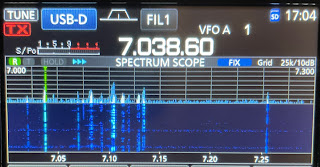
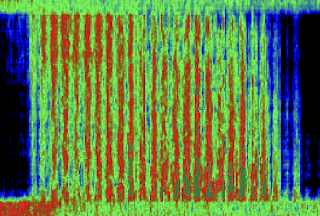
All was going well until a very regular interference pattern appeared across the band. It didn't look like a switch mode power supply as the carriers are quite narrow and didn't drift. Very annoying as some were dead on popular frequencies like 7100kHz.
My first theory was that it was from the micro-inverters in the solar system here. They have a bad reputation and the sun was strong. I isolated the inverters and it stayed. In the end it turned out to be a switching wall power supply for a Synology NAS that I had recently installed. Now the band looks clear:
At 6:30pm local time I had a contact with stations VK2ASU at Maitland and VK2KB at Emu Plains. I could hear them both perfectly but due to the short distance they struggled to hear each other. Here's a video of just tuning around 40m. Hugely different to the experience in the city.
I normally look for good times to talk with John, VK2ASU by watching my WSPR reception of his club station VK2ATZ. Here's a signal to noise plot from the WSPR Watch App. Times are local. (There's a gap when we had our voice contact).
So, very happy with 40m operation now, the next step is more bands and general coverage reception.
Thursday, December 16, 2021
Shack in shed and improved antenna
I've moved my shack into a shed and strung up a better dipole in some trees but away from everything electrical. Signal reception is improved and I heard Mark, VK3MJ, calling CQ and had my first voice contact from Drummond. The band looks great with very little noise at the moment.
It was great to meet Mark, who's in Geelong - so just 150km away. He recognised me from a recent video where I tuned across his transmission! An amazing coincidence. For him, I was just above the noise, for me he's clear as can be. Here's a bit of a recording of today's conversation.
The hum you can hear is a linear power supply sitting on the bench which unfortunately hums loudly. I'm not sure what to do about that.
I left WSPR receiving on 40m over night and got very good results, (not quite up to VK7JJ's fantastic reception performance though).
I even received Ross, EX0AA, from Kyrgyzstan, many times at up to -13dB SNR. These screen shots are from the WSPR Watch app.
Wednesday, December 15, 2021
Hearing the FreeDV 700e beacon on 7177kHz
With my new low noise QTH I'm able to hear Alan, VK2ZIW's FreeDV 700e beacon on 7177kHz.
He's running 20W from Emu Heights in NSW. The beacon transmits every 10 minutes.
Normally I use Linux but the version of FreeDV in the Debian library is too old for 700e so I used the macOS version.
At Alan's prompting, I grabbed the freeDV GUI software and built it on Ubuntu 21.10 with no problem. There's a build_linux shell script that does all the hard work.
Alan's beacon has a feature where if you put your callsign in the text message it will replay your transmission back to you.
Unfortunately the macOS build seems to have a bug where the message field isn't editable. UPDATE: I found the message field in the "options" dialog. My mistake.
I'm looking forward to some FreeDV contacts in the future!
Monday, December 13, 2021
How much better is HF reception outside of cities?
It's long been a dream of mine to have a location for HF reception in a quiet place outside of the city. Since we moved to Thornbury about two years ago I've been plagued with high levels of broadband noise which has left the HF spectrum, particularly on 40m, at often S9 +20 DB.
That's the worst example. Amazingly even through high-level noise like this digital modes such as WSPR can still receive a few signals and I'm able to copy Steven VK2BLQ sometimes.
The dream of a second location has finally come true with the purchase of 5 acres north of Melbourne at a place called Drummond.
40m looks completely different here:
Between signals it's S0 most of the time.
To measure the difference in signal-to-noise, Stephen transmitted five watts of WSPR from Sydney and I received simultaneously in both locations. The difference is huge. The largest difference I saw was 21dB better signal-to-noise at the country location!
Here is WSPR reception of stations more than 400km away:
For the initial setup, the antenna is far from optimum, it's just a wire dipole hanging up right next to the house with some coax going in through the kitchen window. This can be greatly improved in the future.
How much better is HF reception outside of the city I measured at up to 21dB.
PS: Unfortunately it's going to take me a while to improve antennas as during the initial move in I missed a step and fell heavily, breaking my left arm. This post has been written using the Apple built-in dictation system which I find to be excellent.
Sunday, December 05, 2021
Why is every state's daily COVID report different?
We're not a big country really. It seems odd that each state has evolved a daily COVID report that broadly looks similar but has the various statistics in different orders.
I favour the South Australian approach which focusses on hospital patients and deaths.
Wednesday, November 17, 2021
I'm a panelist on ABC's Download This Show
"The Commonwealth Bank is adding cryptocurrencies to its banking app, becoming the first Australian bank to offer such a service.
Plus, Twitter launched its new subscription product, Twitter Blue, in the US this week but some experts are asking why some simple features are hiding behind the paywall.
And the US Justice Department is suing Uber over allegations it has been overcharging disabled people".
In the old days we used to go to an ABC studio to record shows like this. These days we're all remote. I've been working on improving my audio and the latest addition is a pop filter which lets me get closer to the mic without popping and I think my sound is comparable with Marc in the studio.
Listen on 300 big power AM stations on Thursday at 11:05 or you can listen on line here or via podcast.
Saturday, November 13, 2021
Programming a Yaesu VX-6 with Chirp
I've moved to Melbourne, Victoria, and my 2m hand held radio didn't have any of the local frequencies in it. It's a real grind to program memories through the keyboard and, while I'd done a few, I'd also made mistakes along the way.
A serial cable was purchased from AliExpress and this morning I got it going.
The cable came with some software on a mini CD ROM but I don't have a way to read those so the next step was to get Chirp. I tried it on macOS, Linux and finally Windows, before the UI told me what I needed to do to get started..
Turns out, with a VX-6, you need to hold the F/W button down during power on and then press BAND to start the upload from radio to Chirp. (Those instructions weren't visible on macOS or Linux for some reason).
In the end, I threw away my own memories and grabbed the Chirp CSV file from the WIA which has all of the repeaters in it, with names showing the call signs. Great stuff WIA!
Uploading to the radio is similar, power on with F/W but then push V/M to start download. It took a few attempts to get all this to work, it seems timing sensitive.
Anyhow, now my radio is filled with repeaters and I was very happy to find that I could trigger the Macedon repeater, VK3RMM, from home for the first time. (Clearly I had something wrong with my manual configuration).
Note that the CSV file from the WIA which could be imported by Chirp was from the file titled "Example VBScript, Sorted Directory csv and CHIRP csv files and other csv formats WiaRep2 211009.zip" from this page.
My sincere thanks to whoever put this file together.
Monday, November 01, 2021
Response to attacks on the ABC by the Institute of Public Affairs
Last Monday the IPA published the first of five episodes in a new podcast series, “Their ABC”. Its preposterous proposition is that the ABC – in the words of the podcast’s anchor, the IPA’s Director of Communications, Evan Mulholland – is “a bloated, out-of-touch, biased broadcaster”.
The ABC Alumni, of which I'm a member, has published a video taking on the IPA’s “research”. It’s presented by our chair Jonathan Holmes, former presenter of the ABC’s Media Watch.
I realise that responding like this invites the Streisand effect but I think it's worth countering their misleading statements.
Sunday, October 24, 2021
Surface mount on home drawn circuit board
I've been slow to adopt surface mount components for home construction but watching Paul, VK3HN's, technique has convinced me it's the way to go. The way he lays components on a board, draws the tracks with a pen, then simply solders components on to the surface seems particularly elegant.
As a test I've built a simple emitter follower audio stage with a 3904 small signal NPN transistor. The transistor is tiny but able to be soldered. I've used a normal Sharpie pen in the past but recently picked up some Staedtler permanent markers which are often recommended. Here's the resist and you can see the transistor top right:
I etch with ferric chloride in a small plastic container.
Wednesday, October 13, 2021
On ABC RN's Download This Show
"We’ll soon be walking around with them and flashing them to wine, dine and travel – but how easy will it be to spot a legitimate vaccine passport compared to a fake one? We discuss what could have prevented a security flaw and what’s being done about fake vaccine passports.
Meanwhile, the Commonwealth Bank of Australia will be using an artificial intelligence tool to stem abusive messages being sent on electronic payments.
Plus, Facebook and Instagram introduce new features in an effort to protect young users from harmful content.
And would you wear a smart headband that claims to make you calmer?"
Marc was in the studio, I'm at home using an Audio-Technica USB microphone and I think it sounds as good as the studio.
uSDX tiny multi-band transceiver
The uSDX is not a great receiver or transmitter but it is usable and amazingly small. I bought mine through AliExpress. "uSDR uSDX 10/15/17/20/30/40/60/80m 8 Band SDR All Mode HF SSB QRP Transceiver Compatible with uSDX QCX-SSB".
Here's a recording of how a fairly week signal on 40m sounds:
The first unit I bought arrived with a broken screen. The AliExpress vendor provided free shipping for the return and refunded my payment.
I previously built the same circuit but this fully built version is more compact.
Manuel, DL2MAN who is the original designer of the uSDX sandwich contacted me with some comments about this (and similar) clone of his design. He has a video commentary and makes the following points:
- His design is used but there is no credit to him at all
- The license on the design was for non-commercial use only
- He was never asked about a commercial license
- The selling price is way above the actual cost (he thinks it would cost about US$40-$50) particularly as they are not supporting the developer
- No effort was made with documentation, they've added no value for their margin
- There are some changes to the schematic:
- Output transistors have been changed but other parts of the circuit have not been adjusted
- Harmonic suppression will be worse than the original design (and way below legal requirements)
- Firmware upgrading is not easy as it was in the original design
- The battery charging circuit is noisy
- A physical design problem can short circuit the battery in the version with a battery
Friday, October 01, 2021
It's a good idea to update the Arduino IDE
Recently, I was talking with Paul, VK3HN, and he mentioned that he had a sketch that, when built for an Uno, was short of RAM.
Paul sent me the code, I compiled it, and didn't get the warning.
This was puzzling of course. I figured it could be one of two things:
- One of the libraries had been improved to use less RAM
- The gcc compiler bundled in the IDE had improved.
The figure is dynamic memory use:
Thursday, September 30, 2021
Dallas, VK3EB's HF bush antenna
Dallas, like many of us, doesn't have much scope for a decent HF antenna at home so he has perfected the art of putting up antennas in trees. Check this out:
Excellent work!
Here's a previous video where I visited and you can hear some of the low noise reception available:
Tuesday, September 28, 2021
Facebook fake account scam promising "Mega Bonus"
This morning a friend said hello on Facebook messenger. The message said that we hadn't talked before - which was believable as we normally use other modes. I accepted the message and we were away:
The instant I reported the account I started getting "query error" on it so I suspect others had also reported it. Facebook did act quickly in this case.
To create the fake page they must have been able to see Richard's page and copy his profile image. The scammers must be able to see his friends list too - which is concerning.
I looked at my privacy settings but they seem to change frequently and I'm really not sure if I'm still vulnerable. There should be one big switch that defaults to private but there's not.
The Facebook platform seems to be a major location for scams including all the posts designed to go viral that gather engaged users or capture information that could be used for identity theft.
Wednesday, September 22, 2021
Resistive tap built with sharpie PCB etch
I'm keen not to burn out the input to the spectrum analyser. It's 50 ohms in with a maximum of +30dBm. The solution is to transmit into a dummy load and sample the signal with a resistive tap.
A good candidate for a simple PCB and I used Paul Taylor, VK3HN's, technique of drawing resist on the board with a sharpie. Components are all soldered on to the top of the board so laying them out to figure out where the tracks go is easy.
Here's the circuit and the components for the board:
I've got some more of the nice board edge mounting SMA sockets coming so had to make do with a panel mount for the tap output.
What should I use to protect the copper? I think Paul just tins the whole board but maybe there's a spray lacquer that would still allow solder modifications but prevent oxidation.
Sunday, September 12, 2021
An OWON XSA815-TG Spectrum Analyser for the bench
I've wanted to try a spectrum analyser for many years but they've been prohibitively expensive. Just as oscilloscopes have come down in price, spectrum analysers are also getting cheaper. I bought an OWON XSA815-TG Spectrum Analyser from Banggood for just under US$1,000.
This one is good to 1.5GHz which should be plenty for my use.
So far, I'm really impressed. It's very easy to use - easier than many CROs. Certainly easier than the TinySA. Here it is showing the local FM broadcast band:
There is lots to learn but I feel that after a CRO, a spectrum analyser is a wonderful piece of test equipment that is now within financial range of some of us lucky hobbyists.
The terrible interference I often see on 40m has just returned. Here's how it looks on the IC-7300:

I think I need to play with attenuation and gain to see what's going on. Much to learn!