Sunday, February 28, 2010

Wyong field day 2010 - much bigger this year

Just returned from the Wyong field day and I'm pleased to report that it felt about twice as big as the past two years. Probably this is due to the weather being not wet and not too hot.

The "car boot sale" area was huge:

R0011889.jpg

The undercover area packed:

R0011925.jpg

Lot's of money and boxes changing hands in the flea market.

R0011924.jpg

I bought a dual tone SSB test oscillator, something I need, for $8.

The home brew table was full of excellent projects

R0011934.jpg

including this marvellous receiver from Steven 2BLQ:

R0011930.jpg

Stephen told me that the modules all work - but not together.

My little SSB transmitter in a children's tin lunch box looked pretty funny up against these professional jobs, it was great to participate as always.

Lots of fancy black boxes on display too:

R0011917.jpg

A highlight for me was attending a talk by Jeff Johnson who took it upon himself to walk across Australia from south to north wearing a solar panel, carrying an FT-817, and living mostly on "two minute" noodles.

R0011939.jpg

It was great to look through all the gear, meet up with friends and munch on some cheese cubes once again.

Sunday, February 21, 2010

Steve Jobs is right to avoid Adobe flash

html5 logo.pngThe combination of new features in HTML5 and fast execution speed of Javascript in modern browsers means that it's time to finally cast off dependance on Flash for sites that want to do animation or play video.

Jobs is right, when using laptops I notice the operation of the fan and very often a web page with Flash in it single handedly uses enough CPU to heat up the device so that the fan kicks in. Undoubtably this sucks battery and there's nothing I hate more than a portable device that goes flat too soon.

The effect on memory and CPU of using Flash can be simply seen by comparing memory use on the Flash or HTML5 version of YouTube.

Here's Flash:

flash memory.png

And here's the HTML5 version:

html5 memory.png

So 76.9MB to play flash compared to 53.9MB using HTML5. A total of 37.7% CPU for Flash, compared to 10.3% for HTML5. Hardware acceleration of H.264 video promises to further reduce CPU and power consumption in the future.

The thing that Flash has is mature development tools. Recently I've been using the animation effects in jQuery and they look very smooth. What's needed is a tool to construct animations that play in the modern browser.

Step one is for manufacturers of potentially very popular devices, like Apple with the iPad, to have the guts to not allow Flash on there. Once major site builders see their site littered with little lego bricks they'll have to start getting by without flash.

I choose battery life, stability and standards over Flash any day. Only Apple and Google (YouTube) have the power to pull this off, I support them.

Saturday, February 20, 2010

Where I get my news

sort by magic.pngAs we count the days until the iPad arrives, many of us have been thinking about how it will fit in with daily life, and in particular, how it might change the way we get my news fix each day.

Over night, if I can't quite sleep, I have an earphone plugged in to ABC News Radio which broadcasts BBC and other news services. So often, I've heard a news story develop through the night that it's shocking to see the newspaper arrive declaring some out of date story as the biggest thing on this morning.

Breakfast is consumed in front of a computer monitor, which isn't totally satisfying but it gives me an efficient rundown of all the news that matters to me compliments of Google Reader and Google News. Recently I've been using Google Chrome as my default browser and that now has extensions including Feedly which makes a nice looking "newspaper" out of my subscriptions.

feedly.png


I can easily imagine reading the news on a tablet in this form.

If there is a big story that happened sufficiently long ago that TV might have video, I'll watch the evening news to see it for myself. TV news is a slave to video content, for good reason, but as a balanced run down of current news it's with newspapers as "aged news" (is that an oxymoron?).

The other side of breaking news is analysis and for that you can't go past the ABC news and current affairs radio and TV. You probably know by now that I'm a devoted addict of all things Radio National but podcasts now illuminate any commuting time. Recently I've been listening to WNYC's Radio Lab which has some great content.

It's going to be a big year for news consumption. The challenge is not getting news, it's sorting and filtering it. As you see at the top, Google reader can sort your news by magic.

Thursday, February 18, 2010

The epub book format supported by the iPad

A short chat on ABC Radio about the epub book format which seems to have emerged as the standard format for electronic books.


Listen out for the first use of the term "nerd herd" on ABC radio.

Friday, February 12, 2010

Sunday, February 07, 2010

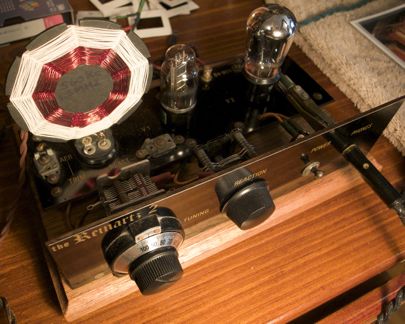
Restored Reinartz two valve radio

After this morning's WIA news broadcast I got a call from Rob, VK2ZNZ, inviting me to drop in to see a new acquisition. It's a beautiful Reinartz radio. WW1 vintage he thinks.

reinartz 2 radio.jpg


Apparently these were available in kit form and this one has been well restored and was in working condition. I played with the "reaction" control but couldn't get it to take off so I'm a little suspicious about the circuit. AM stations were audible though.

Australian repeater finder - iPhone version

It's basically working here. It won't do anything unless you view it on an iPhone with the javascript GPS code supported. When opened, the page will request your position from the device, (you need to agree to this). Then a list of the nearest 40 repeaters are shown like this:

repeaters front.jpg


Tapping on an entry in the list takes you to some more detail:

detail.png


The iPhone version was built by developing a webservice that returns a JSON format list of near repeaters given a query with lat and lng. I used Dashcode to handle that json service as a "datasource" and then it was almost trivial to wire up the user interface.

Dashcode is an amazing, free, tool from Apple that can be used to make data driven web sites for Safari, Mobile Safari (iPhone, iPod touch, iPad etc).

Saturday, February 06, 2010

Australian amateur radio repeater finder

I love working with the Google Maps API. There are so many useful applications of a technology for presenting information on a map. Here's my latest: repeaterfinder.

repeaterfinderscreen.png

Like all good software projects, I wanted this myself when recently travelling to Coffs Harbour. The only way I could find where repeaters are was via the WIA's PDF listing.

Screen shot 2010-02-06 at 1.56.04 PM.pngWhat I dreamed of was to be able to go to a site on my iPhone and have it use the GPS location and then show me all the nearest repeaters in order of distance along with their frequency, CTCSS and other info. I'm not quite there yet, but I am on the way to that objective.

The current web app uses browser geolocation to open up where it thinks you are - this isn't terribly accurate but it's a good start.

Data at the moment is derived from the text list the WIA kindly sent me, it's pretty rough and I haven't fixed up all the modes such as DV which I'm interested in.

I have loads of ideas about where this could go, and would be interested to hear from potential users about what they'd like to see - please comment below.

Enjoy.

Sunday, January 31, 2010

First home brew meeting in the WIA Dural shed

An exciting first, at long last we were able to meet in the new shed at Dural. It was a day of trash and treasure:

trash.jpg

Some calibration of test equipment:

calibration.jpg

The shed it coming together quite well:

shed.jpg

Although it got a little stuffy for some attendees who started to doze off I think:

sleeping.jpg

There was a special visit from John Maizels, the Governor, Asia Pacific Region of SMPTE, showing off the very latest in 2m hand held radio:

maize.jpg

The sausage sandwiches were excellent as usual.

Saturday, January 30, 2010

Getting started with D-Star digital radio

ic92.jpgAt the Coffs Harbour radio expo last weekend I also purchased an IC92 hand held radio capable of digital radio using the D-Star system.

I've been rather sceptical of this technology due to the proprietary nature of the audio codec but as no alternative has emerged I jumped in.

Getting started is not as easy as it could be. I found this video by KN4AQ very helpful.

Next, in order to use the internet gateways you must register here but the amazing instructions here include things like:


  • Enter your Callsign and Password and select the LOGIN option. THE CALLSIGN MUST BE IN UPPER CASE.

  • Enter a space character eg:" " in the Initial field. Do not just leave it blank, it must contain a SPACE character.


I kid you not!

There have certainly been some "bun fights" around all this, I note a document here says, in part:

"When ICOM released the first version of the D-STAR Gateway program, the amateur community worked our way through several challenges, and built a viable network. This was largely due to the spirit of cooperation among the Gateway administrators. Even with a mandatory training course, there were still "experts" who were sure that they knew more than the rest of us, and felt that they didn’t need to follow our recommendations. Some of these "experts" caused serious problems for the rest of the network, to the point of many of us not being able to add users." So it's not just a little unfriendly for end users.

Anyhow, I registered on Tuesday, it's now Saturday and it still hasn't gone through so I don't know what's going on there..

My local repeater is VK2RWN C on 146.9625 MHz. I've been listening and it's pretty quiet. The only thing I'd heard until today was an automated message advising users that they must leave 4 seconds gap between transmissions or bad things will happen.

I called CQ and one of the two stations listed here, VK2HL, kindly responded and answered a bunch of my questions. Now the activity looks like this:

Screen shot 2010-01-30 at 10.05.12 AM.pngThe big list of global D-Star activity is here and it looks impressive.

Anyhow, there's lots to learn. I'm interested in the data channel that can transmit at 1200 baud even while you are speaking. Pity about the proprietary connector on this radio.

The IC92 is full of features but the LCD screen is very disappointing and hard to read. It does seem sensitive but the signal strength indicator is a bit "all or nothing" in my observation.

Thanks VK2HL for being my first digital contact and patiently answering my questions.

Update Saturday 30th at 13:20

My registration just came through from the VK2RWN administrator, Terry, VK3BMX, and I was able to register my single call sign/radio as recommended. Amusingly in this context you must type your call sign in lower case or it gives an error.

For anyone else following along, note that the registration confirmation email directs you to dstar.org.au but you need to go to http://www.dstar.org.au to get there.

Tuesday, January 26, 2010

A Leica for the digital age

Dear friend Tony pointed me to an essay by Michael Reichmann titled "A Modest Proposal For Reinventing the [Leica] M Series".

Like Michael, my brain knows that digital has so many advantages that it is the way to make pictures today, but my hands crave the speed and ergonomics of the Leica rangefinder cameras.

My favourite camera today is a Ricoh GR Digital III. On my recent trip to Coffs Harbour it served me well.

R0011633.jpg


I've started shooting RAW as a matter of course. The extra dynamic range is often handy when I'm trying to capture scenes with a mix of shadow and harsh daylight.

R0011685.jpg


I did purchase the external optical viewfinder for the Ricoh but I need the heads up display that you get on a digital viewfinder. I think what's needed is a mix - an optical viewfinder with a HUD that shows all the stuff you get on the back of the camera but the live view with depth that Michael alludes to.

There's more I want in digital cameras, more form-factors. I want a digital cube camera with a look down viewfinder (like a TLR) too. These days my skill at taking shots unobrutively is reasonable but I need a camera that is able to focus where I want and hold that with ease. Rather like you could on a Leica M3 way back in 1953. Thanks Tony, thanks Michael.

Tecsun PL-310 DSP shortwave radio review

When travelling, I always pack a short-wave radio. Normally it's a little Sony or if I'm not travelling so light, I pack the excellent Sangean ATS 909. At the Coffs Harbour radio expo I plunked down $89 to Av-Comm and purchased the first consumer radio with digital signal processing that I've seen. Welcome to the Tecsum PL-310.

radio front.jpg


It's actually very small, it would fit in a large pocket, like in cargo pants, without too much trouble. 135x85mm not including the tuning knob or antenna.

They had me at the block diagram:

block diagram.jpg


The radio is based around a Silicon Labs si4734 CMOS radio receiver chip. Just look at all the features you get:

features.jpg


The DSP feature means that on AM and shortwave you can choose between bandwidths of 1, 2, 3, 4 and 6kHz. They really work.

Both knobs, tuning and volume are rotary encoders so there's nothing to get scratchy over time.

knobs.jpg


The radio runs off 3 AA batteries and can charge them internally via a mini USB socket. When turned on, the radio defaults to a mode where it will run for 90 minutes (selectable) and then turn itself off. This suits me fine as I tend to go to sleep listening to the radio.

Sockets are the USB charging socket (wouldn't it be great if that was a USB audio output!), stereo earphone out (it accepts a long iPhone plug with no problems, and an external antenna socket.

sockets.jpg


The front panel buttons work well but are a little slow to respond, I suspect keyboard scanning is slow to reduce interference.

Tuning, for a consumer digital radio, is reasonably good. There is some muting as you step frequency but it's not as bad as some I've used.

Sensitivity was equal to or better than the Sangean, but intelligibility was much better on the little PL-310. Side by side, for short wave listening it was much better in my tests. One complaint is that the built in temperature seems a little high to me.

temperature.jpg


Interestingly, station reception is measured in dBu and dB signal to noise. I'm not quite sure how to interpret this, the station it was tuned to in the first shot above seemed pretty weak but read 15dBu and S/N of 6dB. These readings update only every few seconds and I'd prefer a bar meter or at least an option.

The radio has every other feature you might want, lots of memories, scanning and auto memory setting, clock and alarm. The only thing I miss is side band.

It comes apart easily with six screws. The RF stuff is well shielded and the rest just looks like a pocket calculator with a ferrite rod.

inside.jpg


I've used the radio heavily for two days on a set of three 2500mAh NMH batteries, it reported full battery all that time and then suddenly dropped to low. It will operate, and charge, via a USB cable.

Frequency coverage is:


  • LW 153-513kHz

  • MW 522-1620kHz

  • SW 2300-21950kHz


So no 160m I'm afraid. Long wave was disabled by default.

Sunday, January 24, 2010

Mid North Coast Radio Expo 2010

The highlight of our visit to Coffs Harbour has been to again attend the wonderful Mid North Coast Radio Expo. It didn't seem as big as last year, although I came and went very early in the day so perhaps it picked up.

R0011707_2.jpg


Lots of tables with friendly and informative people in attendance.

R0011711.jpg


Some second hand gear at bargain prices.

R0011713.jpg


Like last year the display of antique radios, and not so antique but obsolete gear, was thoughtfully presented.

R0011714_2.jpg


R0011717_2.jpg


R0011715.jpg


Some interesting home brew gear was on display.

R0011723_2.jpg


Remote motorised tuning capacitor.

R0011724.jpg


Lee Andrews was in good spirits and doing a brisk trade.

R0011729.jpg


I purchased a Tecsun DSP radio and a MW Loop antenna that I'd never seen before from AV-Comm. Disappointed that they didn't have any DRM radios on display as advertised.

loop.jpg


A review of the Tecsun PL-310 will follow after I've had a good play with it.

Friday, January 22, 2010

Kempsey Museum visit

We've just arrived at Coffs Harbour ready to attend the Mid North Coast radio expo on sunday. On the way we stopped at Kempsey and stumbled in to a museum. $4 to enter and worth every penny.


Full of interesting historical items from all walks of life including schools, crafts, military, shoe making, and even telephone equipment. A "working" model of a saw mill was particularly amazing.


The museum is well hidden, it's next to the visitor's information centre and looks most uninviting from the front.

We're now in Coffs at a motel. I'm pretty technically confident but I have to admit being a little daunted by the collection of remote controls one has to master to operate things here.


I now realise I missed one - for the air conditioner. This is madness - there has to be a better way. Surely remotes can be unified in some way?

PS: I'm online thanks to my tethered iPhone which seems to work pretty well.

Sunday, January 10, 2010

"Lunchbox" 80m QRP SSB rig progressing well

With pleasure I can report that the single sideband 80m transmitter I started recently is progressing well now that some technical difficulties have been overcome.

Basically the power amplifier stage, an IRF510, oscillated magnificently at 600kHz - something I haven't experienced before. Now that it all works on the bench I've started mounting it in an excellent case I found at the local "$2" shop, a metal lunchbox.

Lunchbox qrp.jpg


This simple rig is crystal locked to 3.58Mhz and I'm planning to put a matching direct conversion receiver in the spare space at the lower left.

Update

The transmitter is all boxed up and puts out very little power. I'm having trouble adjusting the oscillator for decent sounding sideband. I think it's time to make one of those dual-tone sideband test oscillators.

Last week I did a guest spot on local canberra radio 666 and on the way in to the "tardis" (small remote guest studio) I saw this magnificent valve display in a case on the wall:

valve display.jpg


The title reads "The First Transmitters of the Twentieth Century" - Edward D Huckell, Smiree (Aust), 'The Slave of the Magic Lamp'.

Brewing the perfect cup of coffee

So much I didn't know!

How to Brew a Good Cup of Coffee from Ben Helfen on Vimeo.


Great stuff guys.

Friday, January 08, 2010

The cat is making money!

How weird is this:

Screen shot 2010-01-08 at 6.12.07 PM.png


My wife suggests we invest any income into better food for the cat.


Cats and laser pointers seem to be a major meme on YouTube.

Sunday, January 03, 2010

Making soldersmoke again after a gap

soldersmoke.jpgI bought Bill Meara's book "Soldersmoke - A global adventure in radio electronics" many months ago but until the recent holiday break haven't been able to get in to it.

It's a charming book and really inspiring for people like me who love to tinker with amateur electronics. Bill reveals a bit of his interesting life as a US diplomat and shares with us his desire to understand the actual operation of those circuits we construct and hope will work.

When amateur electronics enthusiasts get together and someone talks about a mixer, we all nod as if we know exactly how it works - Bill admits that he didn't fully, and his quest is to understand. As with a lot in physics, there's more to it than you think.

The book mixes stories of Bill's journey through ham radio with technical topics illustrated with diagrams that appear to have been scribbled on napkins.

Bill's soldersmoke blog and the associated podcast, are on my "must listen" list, his book, available through Lulu is to be recommended.

Shortly after I finished the book, my neighbour dropped in with a satellite phone that needed fixing, nothing too exciting just an external antenna connection that had been damaged in a vehicle accident. Primed by the book, the smell of soldersmoke in my nostrils drew me back into the shack and I'm happy to report I've just spent a pleasurable day beginning construction of a single frequency 80m (colour burst) single sideband transmitter.

ssb transmitter.jpg


Above you see a 741 mic pre-amp, an NE602 mixer (Bill knows how it generates the difference frequency) and a crystal filter to accept just one sideband. I'll update as it progresses. Yes, it's real "ugly" construction, but I'm sure Bill would approve.