Sunday, February 28, 2016

Beautiful day at the Wyong field day 2016

This year was a perfect day for the annual Wyong field day.


Rowetel had a table this year showing FreeDV and the SM1000s were selling like hot cakes.


Something I hadn't come across before was the excellent (for communications) JRC ST-3 headphones.


The Home Brew Group had a display with amazing work from all including Stephen Vk2BLQ and in the background you can see my tiny crochet loop antenna.


Arduinos and other small computers continue to draw radio folks over to "the dark side" and John VK2ASU showed his serial radio link experiments.


There were lots of great old radios for sale, but I resisted this year.


As always it was great to catch up with many new and old friends including John VK2JPM, William VK2NWB and Nigel who has the very latest in phone technology.


Finally, hidden away at the amateur TV display were some incredible home made - working - valves.


My thanks to the organisers who ran a terrific show again this year. I loved the tea and cheese cubes and experienced a new dish not tried before - sausage on a stick.


Hmmmmm.

Friday, February 26, 2016

esp8266 Arduino programming

The esp8266 is a tiny board that costs from about $5 and has a processor with Wifi capabilities. I bought a pack of the 1Mb upgraded version.


Following these instructions I've built a rat's next of a programmer:


My USB serial interface has a jumper for 5 or 3V so I set it to 3V and there was no need to add the voltage regulator. So far I've got it to join my wifi network and pull a web page.

I'm able to program it with the Arduino IDE which is convenient.

Using code derived from Sparkfun I'm able to create a hotspot with a web server on it.


The device has two GPIO pins and a serial port so it can be used to monitor and control devices. John, VK2ASU, drew my attention to the incredible range some experimenters have been getting from these modules.


At the Wyong field day I had a great chat with someone from the Sparkcc group who is using even lower priced esp8266s than me.

Monday, February 22, 2016

Compiling VfoSource from QST's excellent article on DDS for Forty-9er

QST March 2016 has a terrific article on using a DDS controlled by an Arduino to be the VFO for a cheap CW transceiver known as the Forty-9er.

Download it here: http://www.arrl.org/files/file/QST%20Binaries/Mar2016/Purdum-Zia-Kidder.zip

But the instructions on compiling the code leave a few things out and I thought I'd document it here for others who might run in to problems.

  • I'm Running Arduino 1.6.7 from: https://www.arduino.cc/en/Main/Software
Opened VfoSource

Users/marksp/Downloads/Purdum-Zia-Kidder/VfoSource/VfoSource.ino:11:76: fatal error: rotary.h: No such file or directory
 #include <rotary.h>   // From Brian Low: https://github.com/brianlow/Rotary
                                                                            ^
compilation terminated.
exit status 1
Error compiling.

--

Went to Sketch - Include Library - Manage Libraries
Searched for Rotary but not found.

--
 
Now, following the instructions from the top of the source code.

Went to https://github.com/brianlow/Rotary
Clicked the "Download ZIP" button which downloaded the zip file.

Choose Sketch - include library - Add .Zip library and chose the downloaded Rotary-master.zip.

Choose Sketch - include library - Chose Include Rotary-master.

I note that the IDE now shows:

#include <Rotary.h>   # Note angle brackets around Rotary.h (I can't get this blog to include them)

rather than

#include <rotary.h>

So case is important.

Clicked the tick and the error now is:

VfoSource.ino:21:31: fatal error: LiquidCrystal_I2C.h: No such file or directory
 #include <LiquidCrystal_I2C.h>
 
--

Visit https://bitbucket.org/fmalpartida/new-liquidcrystal/downloads

Downloaded the latest LiquidCrystal which for me is LiquidCrystal_V1.2.1.Zip

Unzip the download to LiquidCrystal. I renamed this to LiquidCrystal_I2Cqst to avoid a collision with an existing library.

Copied these files over to that directory:

LiquidCrystal_I2C.cpp
LiquidCrystal_I2C.h
I2CIO.cpp
I2CIO.h
LCD.cpp
LCD.h

Choose Sketch - include library - Add .Zip library and chose the folder LiquidCrystal_I2Cqst
  • Choose Sketch - include library - Add .Zip library and chose the folder LiquidCrystal_I2Cqst


Hit the tick and all compiles now:


Sketch uses 9,460 bytes (30%) of program storage space. Maximum is 30,720 bytes.
Global variables use 544 bytes (26%) of dynamic memory, leaving 1,504 bytes for local variables. Maximum is 2,048 bytes.

I hope this saves someone else a little frustration.

Sunday, February 07, 2016

CubicSDR with SDRPlay on Linux

I love tuning HF with this configuration. CubicSDR is a very good piece of software and it's open source.  With an SDRPlay device you can see the whole band at once and click to listen in. Here's a little video.


I wish the SDRPlay USB driver wasn't closed source so it could be built in to software.


Sunday, January 31, 2016

QSL card for 100mW contact 16,194 km hand delivered

Yesterday I was emailed by Marek Petko, OK1BIL, of the Czeck Republic, who is visiting Australia for work. He noted that I had received his club's 100mW U3 WSPR beacon on 20m. Today at the ARNSW trash and treasure meeting, we met up and he handed me a QSL card.


Here's the report in the WSPRnet database:


The club is running a multi-band vertical antenna at their end and on my side it's a half size G5RV. The transceiver is an FT-817 and WSJT-X is running on MacOS.

Marek alerted me to the WSPR Challenge site which ranks wspr reporters on their relative 'receiving power'. I note that I'm the winner of the total of the distance to transmitting stations that I receive, presumably being in Australia and very far from everyone else helps us VKs:


I'm happy with my overall world ranking on 20m, the highest I've seen is 8.


Sunday, January 24, 2016

Cheap Windows 10 tablet running SDR# with SDRPlay

Wanting to get some hands on experience of Windows 10 in tablet mode led me to pick up a very reasonably priced Teclast tablet via Banggood. It's a "Teclast X98 Plus 64GB Intel Cherry Trail Z8300 Quad Core 1.84GHz 9.7 Inch Windows 10 Tablet PC".

The feature that attracted me is the screen resolution of 2048*1536, most of the cheap ones are much less.

I paid AU$276 including postage but the price seems to have crept up a little since then.

One thing I wanted to try was to see how well it would run SDR software so here it is running SDR# with an SDRPlay (which is powered by USB from the tablet).


As you see it's pretty usable although a bit more CPU performance would make the drag tuning smoother. This really has to be the future of radio receivers and possibly transceivers. A big responsive touch screen showing the spectrum is a great way to see what's on the band. The SDRPlay has a particularly wide band so you can zoom out to find activity.

Friday, January 22, 2016

Digital QST - does anyone like this reader?

I recently re-joined the ARRL so that I can get QST magazine. These days I prefer to read books on tablets or a Kindle. I was hoping that in the years since I last subscribed it might have improved but alas it's as bad as before.

The publishing and reading system is the proprietary nxtbook system. I'm an iOS user, it might be different on Android, but I find the reading experience:

  • Slow
  • Ugly
  • Extremely annoying to use
Judging by the "Digital QST FAQ" I'm not alone in having a bad experience.


Why is QST in digital format instead of PDF format?

"Research has shown that those who read magazines on electronic devices prefer this type of format. The digital format also allows us to use multimedia content and other features that are not available with "raw" PDF files. In addition, the Nxtbook digital format allows us to use digital rights management so that the digital edition of QST  cannot be viewed or downloaded unless you are an ARRL member."

Really ARRL? What research is this?

My QST app is slow and/or crashes. What can I do?

"We are sorry to hear that you are experiencing crashing and download problems. For best performance, shut down any other apps running in the background, force quit the app, then re-open it, or turn your device off and then turn it back on. Finally, you can try deleting and re-installing the app."

Hmm, or fix the app.

I suspect that the reason the ARRL has gone with the horrible nxtbook technology is that it appeared to offer some sort of DRM (digital rights management). Aside from a tiny bit of security through obscurity, this is certainly not the case at the moment.

I'll refrain from revealing the details but it seems that after a bit of logging in and reading JSON, pages of the magazine are downloaded by the app as simple JPEG image files with guessable urls like this. Click and you'll find that the image urls are not protected at all.

Others, like MikeW have proposed schemes to print to pdf from the app, but that is not a good solution (but again illustrates that the ARRL are being ripped off if they think they are buying DRM).

What I want, as a digital reader

First, what I don't want... tablet screens are mostly too small to show a full printed page with three or more columns of text. Zooming in and out is painful. Don't give me an image or even a PDF of the printed magazine.

The native reading experience on iOS iBooks, Android's reader and the Kindle reader are all excellent. They each have DRM that pretty much works.

I recommend selling QST (and that goes for you too WIA Amateur Radio Magazine), through each platform's native publication system. Arrange the content as a stream of single column text (with images) and give up the page layout.

This means that users can choose how they view, can increase or decrease the font size and pay you for your good work.

Monday, January 18, 2016

Radio gear as used at Mawson's hut in the antarctic

We visited the replica of Mawson's hut in Hobart this week and it has an interesting reproduction of the radio gear that would have been used.

One thing that immediately struck me was the spiral inductors used in the antenna tuner.


The capacitors are also novel.


I assume this gear generated very high voltages.


Saturday, January 09, 2016

VFO with Si5351 and rotary encoder

Playing around with the Si5351 clock generator to make a VFO for a 7MHz direct conversion receiver that will be tuned with a rotary encoder. Here's the simplest Arduino sketch:

#include "si5351.h"
#include "Wire.h"
#include

Si5351 si5351;

Encoder myEnc(5, 6);

void setup()
{
  // Start serial and initialize the Si5351
  Serial.begin(57600);
  si5351.init(SI5351_CRYSTAL_LOAD_8PF);

  // Set CLK0 to output 14 MHz with a fixed PLL frequency
  si5351.set_pll(SI5351_PLL_FIXED, SI5351_PLLA);
  si5351.set_freq(7000000ULL, SI5351_PLL_FIXED, SI5351_CLK0);
  Serial.println("Starting");
}

long oldPosition  = -999;
void loop()
{
  long newPosition = myEnc.read();
  if (newPosition != oldPosition) {
    oldPosition = newPosition;
    unsigned long int frequency = 7000000ULL + newPosition;
    Serial.println(frequency);
    si5351.set_freq(frequency, SI5351_PLL_FIXED, SI5351_CLK0);
  }
}

And here's how it behaves (listen for the tone on the receiver in the background).


The flaw with this code is that if you turn the knob too fast it can't adjust the Si5351 fast enough to keep up. I have some vague ideas about how to deal with this, perhaps only updating a few times a second.

Sunday, December 27, 2015

Codan 6924 Mk2 on 40m

Picked up a Codan 6924 Mk2 at Dural a few months back. Always wanted one of these lunchbox radios. The IF is 1650kHz so by feeding a 5450kHz signal from a bench VFO in to an empty crystal socket I'm able to tune 7100kHz (for example).

It sounds a bit wobbly, but it's a good start.


The next step is to put together a little DDS oscillator small enough to be mounted internally. I'm not sure if I should try one with multi channels or just make separate ones to replace crystals.

I've now got it receiving 40m quite well using a DDS VFO with programmable offset that I purchased on ebay last year and badly boxed up.


Tip: You power it on while holding the CAL button to set the offset.

Saturday, December 26, 2015

WSPR on Ubuntu 15.10 using WSJT-X

The original WSPR software is an amazing construction, built with c++, Fortran, lots of library code and the UI is hung together with python. I've battled with building it and getting all the dependencies resolved in recent years.

Joe Taylor has re-written the suite as a C++ application that does not just the QSO modes but also the WSPR beacon mode. Here's a few notes on getting it going on Ubuntu 15.10.

Full documentation is here, but below are my abbreviated notes.

Grab the package from the URL on this page:

wget http://physics.princeton.edu/pulsar/k1jt/wsjtx_1.6.0_amd64.deb

Install it:

sudo dpkg -i wsjtx_1.6.0_amd64.deb 

I recommend you install the time synchronisation software ntp like this:

sudo apt-get install ntp

Apparently you also need the kvasd decoder:


sudo add-apt-repository ppa:ki7mt/kvasd-installer
sudo apt-get update
sudo apt-get install kvasd-installer
kvasd-installer

Then you get a text menu with install and test options:


I ran WSJT-X, switched to WSPR-s mode. When the first 2 minute cycle ended I got an alert saying "/usr/bin/wsprd Error loading shared library libfftw3.so.3".

To resolve that I installed the library:

sudo apt-get install libfftw3-bin libfftw3-dev

I have no idea if -dev is required but sometimes it has helped in the past in other contexts.

Now all seems well and I'm merrily decoding WSPR beacons.


This runs nicely on an old MSI U200 laptop with a dual core 1.2GHz processor. The short but wide screen doesn't particularly work well with the dual window design of WSJT-X but it quite usable and seems to decode very well.

Wednesday, December 23, 2015

Low cost 45W HF linear amplifier kit

I can't resist the low cost electronics kits out of China these days. On the bench at the moment is a 45 W HF linear for US$20.


My kit was missing the large capacitor and had extras of many of the surface mount components. The strips were marked with the values.

It's a familiar design with a pair of IRF530s in push pull on the output. The surface mount components are tiny and I have run in to a few problems with bad connections due to my giant sized soldering iron but it has come together.


The instructions are machine translated from Chinese and are quite amusing.

Here's some excerpts:

* I will Stress that the fourth point is Pandora's box, and you will feel good, if you do well. But if you do it not very well, you will reinstall after buying a new one!
* The welding way should be correct, no mistake, and no
missing.
* Postscript: Pay more attention please, because of the discreteness of component, the initial conditions may be not the optimization. In order to make discharge waveform best, experienced worker can make adjustments. In practical use, you must insert low pass filter after outputting, and filter the higher harmonic.

At this point I'm debugging the input stage which isn't biased correctly for some reason.

Update

OK, I had destroyed Q3, a 2SC3357. I've roughly replaced it with a random NPN transistor and now for 2V in I see over 50V peak to peak out. The waveform looks pretty bad but that's mostly coming from the input stage having a totally wrong device in there. They are easy to source so I've ordered a bunch more.


So, it looks like the kit is good. I had one bad surface mount joint but otherwise it seems to have come together ok.

Sunday, December 20, 2015

WSPRnet down up down...

The fantastic JT65 mode which is used for the WSPR beacon network relies on the web site at http://wsprnet.org


For several years, but dramatically lately, the site has been down.

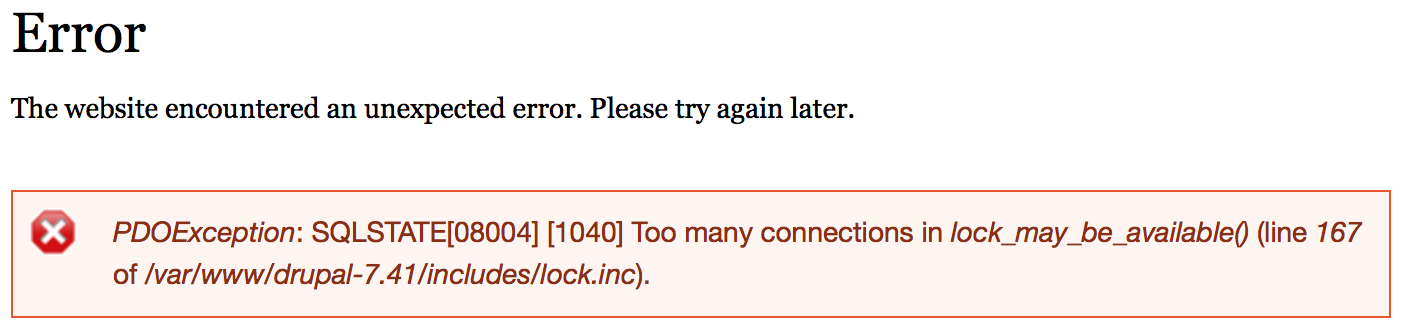
WSPRnet.org is both a Drupal based discussion board with key information about WSPR but more importantly a database of sports reported by the client applications.


At the time of writing, the site reports:

346,759,392 total spots
326,804 in the last 24 hours
7,653 in the last hour

It wouldn't be so bad if just the discussion forum was down, but when the site goes down we lose the reports from remote stations as well. This could be critical for hams tracking beacons on balloons and of course is now relied on to get a view of propagation around the world.

The problems have not gone un-noticed not just in the forums (when up) but also on Twitter.

JT65 creator Joe Taylor posted on the site this morning:

"This excellent web site is written and maintained by Bruce Walker, W1BW. We haven't heard from Bruce in quite some time; presumably he's very busy with work or other obligations.
I get frequent emails from people saying something like "I applied for a WSPRnet account and received a confirmation email telling me approval was pending. Then nothing... Can you help?"
I always tell people to contact W1BW. But I can guess what happens, because I can't raise Bruce by email, either.
I think we need a volunteer who knows web programming to pitch in and help, perhaps sending Bruce a priority letter by FedEx or something to get the process started.
-- 73, Joe, K1JT"

I'm the author of an iOS application "WSPR Watch" that crawls the site to report spots and in the past I've tried to contact the site administrator to make sure I am being kind to the site. I was unable to get a response.

The site is well designed and has a great deal of functionality for displaying, searching and mapping spots.

The spot upload web service works like this:

http://wsprnet.org/post?function=wspr&tcall=ZL3DMH&dbm=37&tgrid=RE66&drift=0&date=151219&dt=-0.7&rcall=vk2tpm&version=3.00_r2328&sig=-19&rqrg=14.0956&time=2304&tqrg=14.097178&rgrid=QF56of

function wspr
tcall ZL3DMH
dbm 37
tgrid RE66
drift 0
date 151219
dt -0.7
rcall vk2tpm
version 3.00_r2328
sig -19
rqrg 14.0956
time 2304
tqrg 14.097178
rgrid QF56of

Response:


1 out of 1 spot(s) added
Processing took 65 milliseconds.


What's to be done?

The Drupal based discussion forum is fine and should remain as is, but I think that the spot database should move to a different domain and be backed by a cloud based scaleable architecture. The project should be managed by a team in the open.

The spot database should provide APIs both for client apps and reporting apps (like my WSPR Watch and iWSPR). These APIs should require a license token and be protected from overuse.

Hopefully wsprnet.org can return 301 Moved Permanently responses and the clients will jump over to the new API if not there will be a period of disruption but in the end we will end up with a system that can take us all forward.

I'm here to help as are many others. I'm grateful to the work done by Bruce Walker and I hope he's ok. What's the next step?

Reading a GPS with Arduino

Bought a u blox neo 6M:


$15 http://www.ebay.com.au/itm/191599051316

Works well:


Even inside the house it found 7 satellites (I’m not sure if that’s the max).

I used the TinyGPS++ library https://github.com/mikalhart/TinyGPSPlus/releases

The "Device" example was my start. Turned out that my GPS baud rate is 9600.

When I first built the gps example the compiler printed some warnings (something about can't inline a static) while building the software serial library. At first glance these looked like errors but in fact they were just warnings and once built the first time all was clean on subsequent builds.

I've heard other hams complaining that the library they want to use won't work with the latest Arduino IDE and to overcome errors they resorting to running old versions of the IDE to overcome these problems - which of course leads to other incompatibility problems.

Struggling a bit with number to string conversions but starting to drive a little display now:

Sunday, December 06, 2015

Simple copper pipe loop for 40m

After several false starts, including complex schemes involving stepper motors and long rods, I've settled on a very simple design for a loop that nicely covers 40m.


The loop is about 1m in diameter, a cat is shown for scale.


Contrary to some other designs, I've put the coupling at the top. Two turns on a FT-114-43 toroid. (Since this picture I've anchored things with some cable ties and removed one turn to get a lower SWR).


The tuning is at the bottom. I needed an extra 180pF to get this on to 40m. A larger knob is better, a reduction drive would be even better. (Tuning is very sharp).


Here's a rough drawing of the circuit:


Sitting at the table in the back yard yields decent reception - not as good as the full size dipole - but not bad.


The 3m length of copper pipe was a standard cut length at the local hardware store.

To find where the loop was resonant and make sure it was working, I used a miniVNA pro  and the vna/j software. I'm running Ubuntu Linux and ran in to some problems getting vna/j running. The trick is to remove the open source Java implementation and install the version from Sun. Also there's the JNI libraries that are required the Arduino IDE that needed to be removed to get it running.

Here's the plot showing the SWR dip at 7.1Mhz to 1.4:1. The KX3 tuner nulls out the mis-match without problem.


I've transmitted up to 50W SSB without any bad things happening.

Thursday, November 12, 2015

Another visit to the Kurrajong Radio Museum

I visited the fabulous Kurrajong Radio Museum once in the past with my partner in tow and while she found it "mildly amusing" I thought it was time for a repeat visit.

I contacted Ian via the email on the site to organise the visit in advance and he was most gracious with his time and knowledge.

With Mal, VK2BMS and Robert VK2ZNZ in tow we met up with Jules, VK2EXT for a grand tour. Some photos from the day: