I spotted John "magic fingers" Diamond setting up along with a retired camera operator. Great work by all involved. Thanks for the memories.
Tuesday, September 04, 2012
80 Years of ABC display at Ultimo
If you can get to the Australian Broadcasting Corporation's Ultimo Sydney building there is a wonderful display of historical equipment from the archives in the public area. Here's a few snapshots.
I spotted John "magic fingers" Diamond setting up along with a retired camera operator. Great work by all involved. Thanks for the memories.
Sunday, September 02, 2012
Model helicopter for antenna examination
Checking out the antenna with a model helicopter, no it seems that antenna wires draw in helicopters due to some sort of, as yet, explained force. Picked up a model helicopter for under $100 at Jaycar complete with an on board video camera.
You get a nice view of the shack and we quickly collide with the G5RV antenna and then fall to earth. It's a bit windy today and our back yard is full of obstacles but this is a fun toy for the money.
Saturday, August 25, 2012
Low cost 40m SSB rig from China - KN-Q7A
While there are several decent but very low cost VHF/UHF rigs out of China so far this is the first HF transceiver I've come across. For $200 built, including Icom compatible microphone, a few of us have bought them.
Here's a video of a QSO with Stephen, VK2BLQ.
The KN-Q7 was designed by BA6BF and uses familiar components such as NE602s. The kits or assembled units are available from CRKits from US$115. It's a crystal VXO arrangement and you order according to the sub-band you want.
The case is very solid and will survive a trip in a backpack with no trouble, coupled with low power requirements, this makes an excellent QRP rig for camping or emergencies.
Adam Rong, BD6CR/4, provides excellent service and communicates well via email.
The manual, which includes a full circuit diagram is here.
Update
I received a nice note from Adam, thanking us for the writeup. Cheers Adam!
Friday, August 24, 2012
Prominent ham radio antenna
Each morning I travel to work by bus. Mal, VK2BMS, drew my attention to an interesting antenna that is visible on the left as you start on the Sydney Harbour Bridge.
I captured this on my phone through the bus window and high speed, that's my excuse.
Mal writes: "The domed rod on the right is a lightening conductor and left is a Hygain 40 to 10mx trap vertical 14AVT of the late Ray,VK2BBP.
It looks professional and repair people on the roof probably think it's part of the building or don't know what it is and frightened to touch it."
Not sure that being pointy and higher than a nearby lightning conductor is a good idea.
Sunday, August 19, 2012
Model helicopters old and new
We headed for a local park armed with two model helicopters, one traditional, the other was a Parrot AR drone version 2. The difference is amazing.
To be fair, the old one is pretty beaten up and the gears are grinding. Still good fun.
The Parrot AR drone creates a wifi network that you join with an iOS device. The software has "absolute" mode where you tilt in the direction you want the drone to fly and it takes care of figuring out which way it's facing, which is the hardest part about flying these things.
Let's hope the military never gets hold of this technology..
Wednesday, August 15, 2012
Radio-Kits Digital SWR/power meter kit review
Ross, VK1UN (and several others) writes: G'dday Peter,
Yesterday afternoon, I finally got the Digital SWR/power meter kit from Radio-Kits in the UK and built it last evening.
A very straight forward build as all the parts came in separate zip-top bags wit a component list in each. Instructions for building are down-loadable from the above site and are quite complete.
I added all the resistors first, capacitors, diodes, transistor and then the op-amp IC. The PIC was socket mountable so that remained out until the "smoke test!"
There are two boards, firstly the main meter and control board and the detector board, both can be built concurrently as there are resistors, caps and diodes on the detector, as well as the toroids and sockets.
It passed the "smoke test" - a check of DC resistance (using diode setting on the meter to make sure semiconductors did) and then I connected the 9V battery. Display lit up and no pops, bangs or smoke!
I then adjusted the display contrast pot and the display showed all the right screens so all appeared to be working OK and first time, no diagnosis needed at all!!
I waited until morning to test on RF as the WSPR station was in use all night.
Morning, put the device in line between the SGC MAC-200 tuner and the transceiver and got readings that I was able to play with. The SWR showed 1.72:1 so I was a bit suspicious, however a dummy load showed 1.0:1- good! I then QSYed from 40m I was using for the initial test to 17m and the SWR dropped to 1.29:1, better but not wonderful. I do realise that the MAC-200 is not designed to auto-tune at low powers, so maybe I was a bit unfair.
I then calibrated the power readings using my coffee can dummy load with diode inside to measure the peak voltage across the dummy load. It calibrated nicely.
Finally, I thought I would insert the LDG Z11ProII inline and got a nice low reading on 17m of 1.04:1 - much better. The LDG is much happier tuning at very low powers.
I've attached some photos of the device on the test bench with a ruler lying beside, so one can see the dimensions clearly. My only criticism is that the only case available tom R-K with the kit, is way too big - I could probably fit a couple of Ensemble RxTxes in with it!
Very happy with the kit as with the built-in 9V battery it is entirely stand-alone.
73
Ross
Thanks Ross!
Saturday, August 11, 2012
Big winds but the right rig for reception
We've had very big winds here in Sydney over the past 24 hours. The half G5RV between tree and house broke at the centre insulator due to unexpectedly large tree movement. I've repaired it today and have been tuning around listening to all the stations in the contest today.
My favourite rig these days is the Elecraft KX3, which has always seemed very quiet and well behaved. Turns out it's just topped the chart at Sherwood labs.
Their ranking is by "dynamic range narrow spaced", which I don't fully understand but presumably means it behaves well when a strong signal is very close to the frequency you are listening to. The next rig on the ranking has a list price of $7,700 so that makes the KX3 a real bargain. It looks like it's uncommonly sensitive too from the table snippet above.
I find the KX3 a very quiet receiver, my only wish is that the tuning knob would spin freely but that's a minor quibble.
Congratulations Elecraft!
Tuesday, August 07, 2012
VK2BLQ's USB Powered Radio
Stephen wrote: "I fired up a SDR board, not sure whose circuit I used, very similar to
YU1LM. The oscillator is a 28322 osc block, so is 7080 when I/Q'd. It is
powered by the USB port. What is significant is the USB sound card,
Jaycar type, actually works. The software is from Italy, I2PHD. Software
provides for a +/- 24KHZ bandwidth and the USB sound card seems to work
to that B/W."
Great work! You also get a glimpse of Stephen's excellent new home built workbench.
Sunday, July 29, 2012
Amateur Radio Home Brew group meeting
A great meeting today at Dural. Perhaps it was the weather but the biggest turn out I think I've seen.
The topic of the day was switched mode power supplies, but regrettably I had to rush off to be a taxi so missed all but the start of that part. There were two great 'show and tell' presentations about valve transmitters.
It had not occurred to me how valuable microwave ovens are as a source of components and particularly high voltage, high power power supplies.
I brought along my little 40m AM rig but it looks terrible next to Stephen, VK2BLQ's wonderful construction style:
But just look at the board:
Stephen was also showing a nice valve CW rig built on two rails of angle aluminium.
One of the speakers said that he'd been ringing Drew Diamond with questions about the design he'd built - sounds like Drew was taking calls and answering enquiries with good humour - what a national treasure that guy is!
Peter, VK2EMU, brought along the nifty KN-Q7A SSB 40m transceiver for under $200, which does look like a nice robust little radio for camping or emergency use.
Great to catch up with everyone and I'm looking forward to Winterfest on August 26th.
Thursday, July 26, 2012
KX3 on air with a Signalink USB
Today I roughed up a cable to get on air with WSPR and the new KX3 via a Signalink USB.
Ground, PTT and audio are wired from the RJ45 plug to the TRRS 3.5mm plug, while speaker out goes to the SPKR socket on the back of the Signalink. If WSPR spots are anything to go by it seems to be working pretty well and on air my transmissions sound reasonable (no outlandish hum or anything).
Looking at the received WSPR signals, it seems that the KX3 drifts a little in frequency compared to the FT-817. Here's a screen shot using the KX3 after running for about 30 minutes:
Here's an old shot of reception with the ft-817:
However, after running for a few hours the KX3 looks much better:
It's now been a day of operation at 2W 10% transmit and I feel that the receive drift is pretty clear:
Ever helpful Wayne Burdick from Elecraft responded in the Yahoo forum to say "I'm experimenting with algorithms that reduce short-term drift." It seems like the issue is related to VFO temperature compensation so it's possible they might be able to slow the effect for narrow, slow, digital modes in a future firmware update.
I'm really loving the KX3, the latest firmware update gave us really good noise reduction, and I'm starting to think about selling off the FT-817 which is really redundant. My hesitation is that the ft-817 is kind of compact and robust compared to the KX3 which really needs a case to be carried without worrying about bashing a knob off.
Saturday, July 14, 2012
Australia Network iPhone app
If you have an iPhone and are interested in all things Australian, including news, sport, learning English and Radio Australia then you might be interested in the second app I have in the iTunes store called AustNetwork.
While I wrote the code this is very much a team effort including a project manager and graphic designer. One key thing I learned from the "One more thing" conference was that most apps require a team effort between a designer and a programmer.
Climbing the iOS programming learning curve has been a great pleasure and I look forward to more apps in the future. If you have an iPhone please click to install the app (or search for Australia Network in the store), and of course I'd appreciate ratings and reviews.
Thursday, July 12, 2012
Let's have unmetered ABC on the NBN
The problem for many users is that they run the risk of exceeding their internet plan's limit.
It occurs to me that a great synergy that the Australian Government could take advantage of would be to make the streaming of ABC content unmetered over the National Broadband Network.
I think that so called "catchup TV" is actually the future of TV. Podcasts are the future of a great deal of radio. Tablet based news aggregators are the future of newspapers (it feels archaic even using that term already).
We'll have broadcast TV and radio transmitters for a while yet but in the end it's all data. Making the NBN a free distribution channel for ABC content seems like a logical idea. Anyone in favour?
Wednesday, July 11, 2012
Softrock Ensemble RXTX with Quisk on Ubuntu
I recently purchased the nice box for the Ensemble RXTX from the KM5H store and it does make it into a very professional looking little software defined radio.
The audio labels are ambiguous, "line in" means "this connection goes to your line in". There is an amazing bit of python/C software called Quisk that can be used to control the Ensemble.
Here it is receiving a station from Kuwait (I'm in Sydney by the way).
To get this working on Ubuntu 12.04, I did try using the install from the Ubuntu software centre but I couldn't get it to talk to USB so I ended up simply downloading the software, doing a 'make', and running it from the command line.
Quisk comes with a config file preset for the Ensemble RXTX at quisk-3.6.2/softrock/conf_rx_tx_ensemble.py which I copied to ~/.quisk_conf.py and edited to point the audio to my creative USB external sound device.
Tuesday, July 10, 2012
Stop spamming me Ebrahim Kariel
I keep getting these emails:
I click No.
So, why are you sending these messages? Then when I try to leave the page "flipora" does this:
Which really gives me a bad feeling about this scam. Stop it or you'll get a bad reputation on the internet. We now return to our regular transmission.
I click No.
So, why are you sending these messages? Then when I try to leave the page "flipora" does this:
Which really gives me a bad feeling about this scam. Stop it or you'll get a bad reputation on the internet. We now return to our regular transmission.
Sunday, July 08, 2012
KX3 to KX3 contact
Friday, June 29, 2012
Elecraft KX3 first contact
The Elecraft KX3 serial number 371 arrived this morning. First contact was with Patrick, VK2PN, who immediately drove over, delivered a congratulatory QSL card and snapped this fine picture:
Before giving some impressions of the device, I want to moan a bit about the process of importing such a gadget in to Australia. When Gerry Harvey says that local retailers are threatened by online shopping he fails to realise what a fine job our Customs department is doing in putting people of importing goods of any value.
Once Elecraft shipped my KX3 it was here in three days, it took another 14 days to make it through Customs. Here's the trail:
Shipment Activity Location Date & Time
--------------------------------------------------------------------------------
Delivered AUSTRALIA 06/29/12 8:19am
Customs clearance AUSTRALIA 06/28/12 1:39pm
processing complete
Customs Clearance AUSTRALIA 06/18/12 6:41am
Customs Clearance AUSTRALIA 06/15/12 4:51pm
Processed Through Sort AUSTRALIA 06/15/12 2:51pm
Facility
Processed Through Sort ISC SAN FRANCISCO (USPS) 06/13/12 4:43pm
Facility
Arrived at Sort ISC SAN FRANCISCO (USPS) 06/13/12 4:40pm
Facility
Electronic Shipping 06/12/12
Info Received
Processed through USPS SAN JOSE CA 95101 06/12/12 6:11pm
Sort Facility
Processed through USPS WATSONVILLE CA 95076 06/12/12 4:53pm
Sort Facility
Shipment Accepted WATSONVILLE CA 95076 06/12/12 3:58pm
The box was accurately declared, there was no duty to pay (a little GST), and I had the correct classification. Surely there has to be a more efficient way to import an off-the-shelf product?
KX3 First Impressions
I've been looking forward to this day since May 2011. Thirteen months. I'm not disappointed. Very compact, it looks like the remote head to a larger transceiver. A few early comments, and bear in mind that I've never owned an Elecraft device before and have only had this for a few hours:
- The knurled knob arrangement which tightens the fold out feet is instantly annoying. Opening one side loosens the knob, the other side tightens its knob. The manual has special warnings about this part and surely it can be improved in the future.
- Mine came with rather scrambled initial settings, every band seemed different, it didn't know it had roofing filters, audio was set to stereo "effect", and so on. Took me a while to get things sorted out.
- Works great with a Mac, the KX3 Utility checked firmware version and works nicely with PSK31 with just the included cable.
- I love the receive audio, really quiet, wonderful filter narrowing effect. Great to have a "normal" long-press button to get back to a starting point. Looking forward to the noise reduction which is coming in a future update.
- The built-in speaker and audio section is under-powered. Great for headphones but in a base station it is really improved by an external amplified speaker.
- Patrick reported that my transmit audio was good and even sent a spectrogram from his K3 panadapter to show that I need to reduce the bass a little.
This is a very feature rich radio and it's going to take a while to get the hang of it. So far so good.
Update - I busted it
I found a cable from a video camera that looked like it might be handy - four conductors and it was wired out to RCA plugs. I pushed it in to the mic jack and it turned out to be too long and damaged the socket!
It kind of worked if I held the elecraft mic plug in just the right position - but it was not good.
So, I opened up the kx3 hoping to do some light bending, but it's a sealed socket. I raced down to Jaycar but 4 conductor sockets are not available off the shelf.
So now I've replaced it with a standard 3.5mm stereo socket with tip wired to the mic, the up/down and ptt are currently unconnected. There's a transmit button on the rig so it's not a big issue.
The good thing about this arrangement is that I can now use a standard PC headset right into the rig although the mic gain is rather low. I had to try a second headset as the first one didn't have enough output.
My kx3 has now been modified, perhaps it's a good step to take as I won't hesitate to do more to it in the future. Perhaps it's time to start a KX3 modifications page?
Update 2 - more contacts
Called CQ on 40m and got an immediate response. I've had several contacts now including assistance from Mal, VK2BMS, to get the transmit equalisation set up nicely to match my PC headset mic. (I cut the lowest frequency 10dB to get rid of some close mic boom).
So far the audio reports have been excellent and even running 5W has resulted in good contacts over hundreds of kilometres.
I love this radio. It's the best receiver I have and after only a few days I'm feeling very comfortable with the features and controls.
Installed the bleeding edge software updates: DSP 092 and MCU 106. All seems good. The most noticeable improvement is the action of the AGC which is much smoother. I understand this update will go live on Monday. The great thing about a software defined radio is that we get upgrades purely in software in the months ahead (there's a few features that come up as not available that I'm looking forward to including voice record and noise reduction).
Headless raspberry pi on the network
A raspberry pi finally arrived. Amazing embedded linux platform for very little money.
I'm not really interested in using it to drive a TV, but more as an embedded device for some ham radio project, so I wanted to get it on the network in a headless configuration that I could easily locate. Here's what I did:
I must be getting old, but it's astonishing that I'm using a computer for under $50 that is much more powerful than systems I used to share with dozens of users only a few decades ago.
Now to think of a good application for it!
I'm not really interested in using it to drive a TV, but more as an embedded device for some ham radio project, so I wanted to get it on the network in a headless configuration that I could easily locate. Here's what I did:
- Grabbed the recommended Debian Squeeze image from here.
- Wrote it to an 8GB SD card using dd on the mac as per instructions here.
- Mounted the card and enabled remote ssh by "sudo mv /boot/boot_enable_ssh.rc /boot/boot.rc"
- Unmounted the card, stuck it in the raspberry pi, connected ethernet
- On my Mac, did an "arp -a" to note the network devices on my lan
- Powered up the raspberry pi (I'm using an iPhone charger which seems to work fine)
- Waited a few minutes, until the lights stabilised, did another "arp -a" and looked for new ip addresses
- In my case "ssh pi@10.0.1.16" (but your address will be different) {password is 'raspberry'}
- I'm in! For convenience I create my own user account using "sudo useradd -m USERNAME" and then add the account to /etc/sudoers
The Debian image only uses 2GB of my 8GB card, so I followed the instructions here to resize the root partition up to use it all. After a reboot, it looks like this:
I prefer not to give things fixed IP addresses so to make it easy to locate on the network I install avahi-server with "sudo apt-get install avahi-daemon". Then I add the following configuration file as /etc/avahi/services/ssh.service
Now I can simply "ssh raspberrypi.local" to log in.
I must be getting old, but it's astonishing that I'm using a computer for under $50 that is much more powerful than systems I used to share with dozens of users only a few decades ago.
Now to think of a good application for it!
Tuesday, June 19, 2012
Terry's homebrew Tricopter
I am working but a distraction dropped in.
And in a park.
I recently bought a tiny key fob shaped "spy" camera which we put on board one of the tricopters:
These Tricopters were built from instructions on RCExplorer.
And in a park.
I recently bought a tiny key fob shaped "spy" camera which we put on board one of the tricopters:
These Tricopters were built from instructions on RCExplorer.
Monday, June 11, 2012
iPhone app to watch your WSPR spots
If you use the WSPR propagation beacon system and frequently visit wsprnet.org to see who is reporting your signal, I'm pleased to announce that there is a simple alternative if you have an iPhone, WSPR watch.
It's a free app and it's my first app to be accepted in to the store.
WSPR watch pulls it's data from the old database page on wsprnet.org but focuses in on people who can hear you and who you can hear. It plots the location of stations on a map and can show you all the available info on a spot if you tap it.
I hope you'll download it, send me feedback and feature ideas, and even rate it. There is a much more complex app by me, not ham radio related and for a commercial client, coming soon and going through the process of getting an app in the store has been very interesting.
Saturday, May 26, 2012
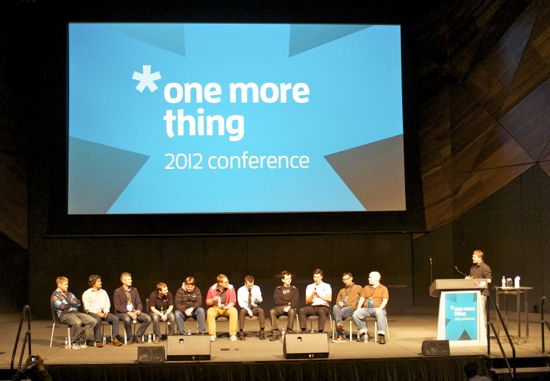
One more thing conference 2012 in Melbourne
Today I've had the pleasure of attending the One more thing conference in Melbourne.
I can't praise the organisers highly enough, the conference was well run, well designed and the speakers represented a galaxy of stars from the ranks of successful iOS developers around the globe including Flipboard, Tapatalk, ShipFinder, Pano, Trainyard, Calvetica, Doodle Jump, Elements and others.
Much of the discussion was about gaming the App store and dealing with the inconsistent Apple review process. Clearly the store, while extremely successful, is broken in important ways.
I came out of the day inspired, motivated and informed. Many of the developers gave valuable real data about their earnings, what worked and more valuably what didn't.
See you next year.
Subscribe to:
Posts (Atom)


.jpg)
.jpg)
.jpg)
.jpg)


.jpg)