Richard, VK3TXD, kindly sent me a preview of two of OzTenna's new antennas for the QRP enthusiast. Now that the rain has stopped I took the medium duty EFHW and his 64:1 coupler out into the field and had good results.
The "medium duty" antenna is quite easy to put in the portable case but if you want even less to carry OzTenna has a "light duty" version as well:
The "coupler" is particularly notable as it includes both a 64:1 unun with a 1:1 balun in the same compact case. Mine was supplied screwed to a wire winder but I removed to make it more compact.
Here's my current "go box". All fits very neatly.
It's great to see some products being created for the QRP operator here in Australia. The OzTenna products are well thought out and nicely put together. Check their website for details.
Update
Richard gave an interesting presentation to the EMDRC club on the topic of Unun efficiency with half wave end fed antennas and shares some of his very interesting research.
I've been having a good time with the Creality Ender 3 v2 3D printer here but today something weird happened and it refused to print.
At the end of a print the control panel became unresponsive and I had to power off the printer. I cleared settings and next time I tried to print neither the nozzle or bed heating started. It said it was trying to heat to 0, but I didn't notice that clue until much later.
Various forums suggested checking cables or that the motherboard might have failed. Other's suggested re-flashing the firmware. I tried a few different versions of the firmware, clearly not right for my printer as they included auto bed levelling which my printer doesn't have.
After flashing the interface came up in Chinese and my first thought was that I had the wrong file but it turns out you can set the language to English in the settings "Control" area.
In the end I flashed firmware 1.2.1 and navigating around I noticed that the bed and nozzle temperatures were set to zero. I changed them to 200C and 60C and tried printing again. This time the nozzle and bed came up to temperature but no printing started.
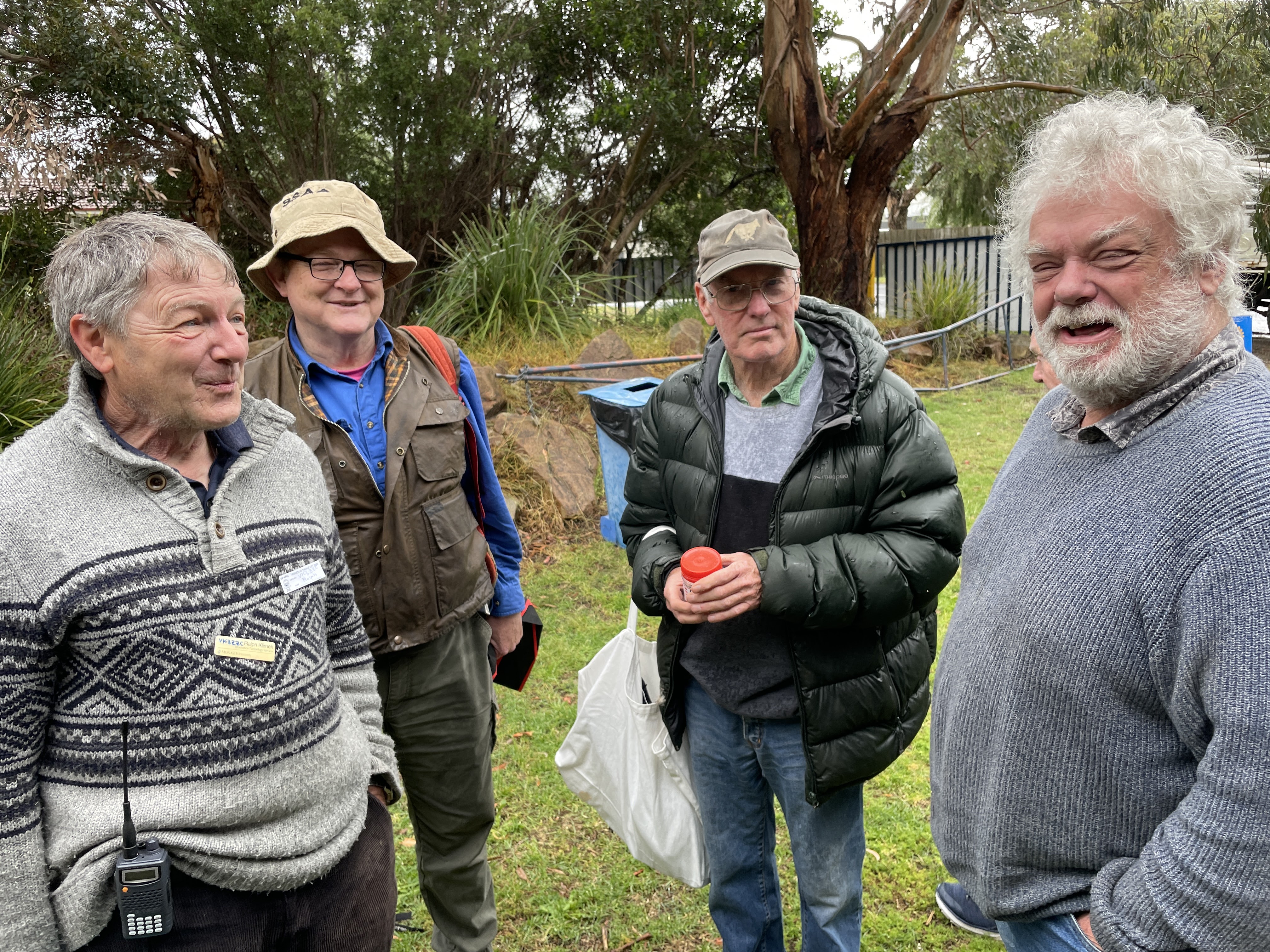
I'm working on a small job for Ralph, VK3ZZC, who asked for some caps for all his BNC sockets.
Earlier I'd got the cap working well and I used the slicer to duplicate the object so I could print six at a time. This was the first time I'd used the object duplicate feature in the slicer.
It turns out that this gcode was upsetting the printer. I went back to just printing one and all is again working as expected.
So... if your printer stops don't assume it's hardware. I was pretty depressed thinking my new toy had died so quickly. All worked out in the end.
I purchased a LiPo battery pack from Paul Paton, VK3AHM, at the Rosebud Radio Fest and it triggered the desire to make a portable setup for my KX3. In the past I've put it in a waterproof box (Pelican case clone) with cubic foam spacers but it's not very efficient. My 3D printer can't print a large enough object to do this in one go so I divided the task up in to separate modules. Here's the result.
The cutout below the tuning know reflects the small speaker's audio up which helps quite a bit. Other segments on the left and above have holes for access to the sockets for power and microphone.
What you see here is my first attempt and I'm pretty happy with how it went. Obviously there can be improvements such as better fitting with the sloping sides of the case interior.
Radio Australia was founded in 1939 by Prime Minister Robert Menzies to project the perspective of Australia during the second world war. At the time propaganda, what we might now call “fake news”, was being broadcast in our region by the Japanese, Russians and Germans.
Shortwave transmissions could be received with low cost, low power receivers and were difficult to censor locally. It was estimated that millions of suitable radios were in the field.
After the war, Radio Australia pivoted to sharing Australia’s outlook and appealing to people who might like to do business with Australia or even migrate here.
Radio Australia was relatively free to run programs sometimes critical of the Australian government and thereby demonstrating the freedom of independent media in a democracy. This freedom of reporting was, at times of conflict or coups, very annoying to local strongmen. The fact that Radio Australia had programs in local languages gave it a direct line to the people.
The book, Australia Calling – The ABC Radio Australia Story, by Dr Phil Kafcaloudes includes many accounts of times when balanced information, from an Australian viewpoint, played a part in informing people on the ground in places like Timor-Leste, Solomon Islands, Bougainville and notably Fiji.
The broadcaster’s favour with our government has ebbed and flowed and funding levels have changed over time, leading to many changes in resources and programming.
While brand recognition of Radio Australia was very strong and positive throughout the Pacific, the service was virtually unknown within Australia and despite strong support by some politicians, it came to be seen as disposable by those wielding the razor.
Looking back, the glory days of high power shortwave broadcasting seem like a golden era but at the time we despaired at the difficulty of measuring the audience, many of whom were isolated and unable to even write in (although millions did). Today, with internet streaming and local FM relays, measuring the audience is easier but the vulnerability of local transmission or internet-based delivery to being cut either by natural disasters or local politics is surely a step backwards.
Phil Kafcaloudes’ book is a fine piece of work, brimming with high quality photographs of smiling staff. Stories of people who have learned English by listening and the avalanche of letters that arrived at times are tempered with tales of dramatic changes in direction and the trauma of savage cuts.
For me, a shortwave listener since childhood, most moving is the story and image of Nigel Holmes who “seems to be equally proud and distraught as he presses the last button on a huge panel and watches the light go out [on shortwave transmission], ending nearly 80 years of Australian broadcasting history”.
At the ABC Friends Victoria Christmas dinner in November, I took the opportunity to ask the Minister for Communications, Michelle Rowland, if there were any plans to re-invest in shortwave. She reminded us that it was the ABC’s decision, under MD Michelle Guthrie, to end that mode and that it would be considered as part of future plans. The decision to cut shortwave broadcasting was, of course, in the context of cuts to the ABC and additional costs required to roll out DAB+ transmissions in major population centres.
Even if Radio Australia’s direct influence has waned in recent years, it has had a lasting influence on journalists and media in the region. Many RA staff have trained and mentored the current generation of program-makers throughout the region and the standards and practices of our programs have set an example to emulate.
Phil Kafcaloudes moved from domestic ABC duties to present the breakfast program on Radio Australia for almost a decade. He seems genuinely proud of what he was a part of and presents a warm and engaging account.
Australia Calling – The ABC Radio Australia Story was commissioned and published by the ABC.
This year's Rosebud Radio Fest was a first for me. It was a very well organised event with a wide range of equipment to buy and excellent talks to attend. At entry there was a welcome from some ladies from ALARA.
An interesting talk on pinpointing and reporting noisy power poles:
Is it ever the rational to pay a hacker's ransom? Controversially, I make the case that sometimes it is. I'm a guest again on Marc Fennell's "Download This Show". You can listen here.
As an aside, I have appeared on ABC shows quite a few times over the years. My commentary stems from a perspective as a software developer - so I hope I bring are deeper technical understanding than some other speakers. People sometimes ask me if we prepare and if we know what we'll be asked? Yes and generally yes.
I keep my notes for each appearance and a count of documents indicates that I've done 325 of these so far, probably more.
Many years ago, when I lived in Suburban Sydney, I built an e-field or "probe" antenna.
The benefits of these antennas is their small physical size and broad band operation including down to very low frequencies.
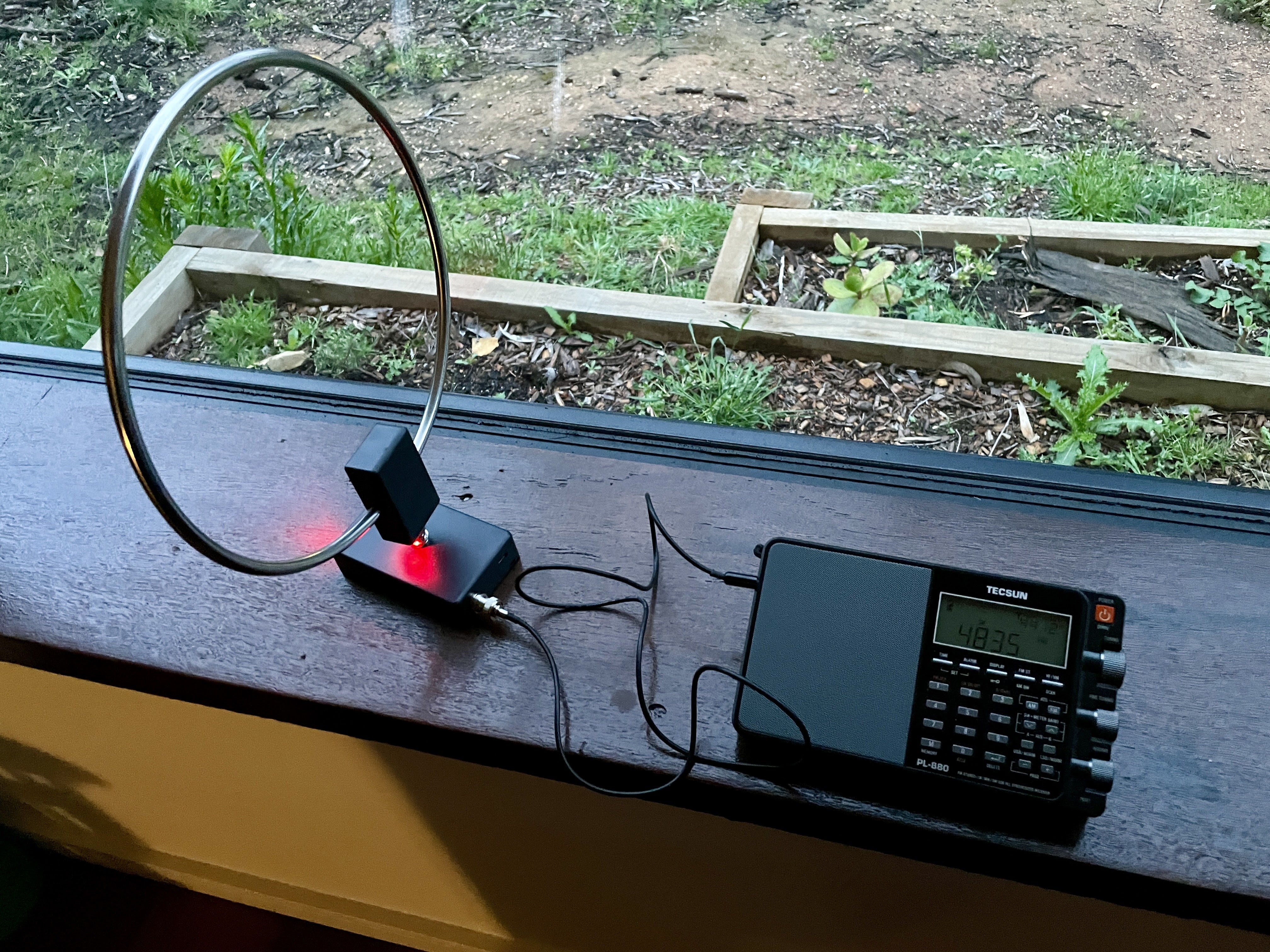
My home made one was disappointingly noisy. I purchased the PA0RDT mini whip and while well made, it was similarly noisy at that location.
These days I'm at a low noise location and thought I'd give it another go.
It's certainly much better here than it was in the city but does pick up electrical noise particularly at low frequencies.
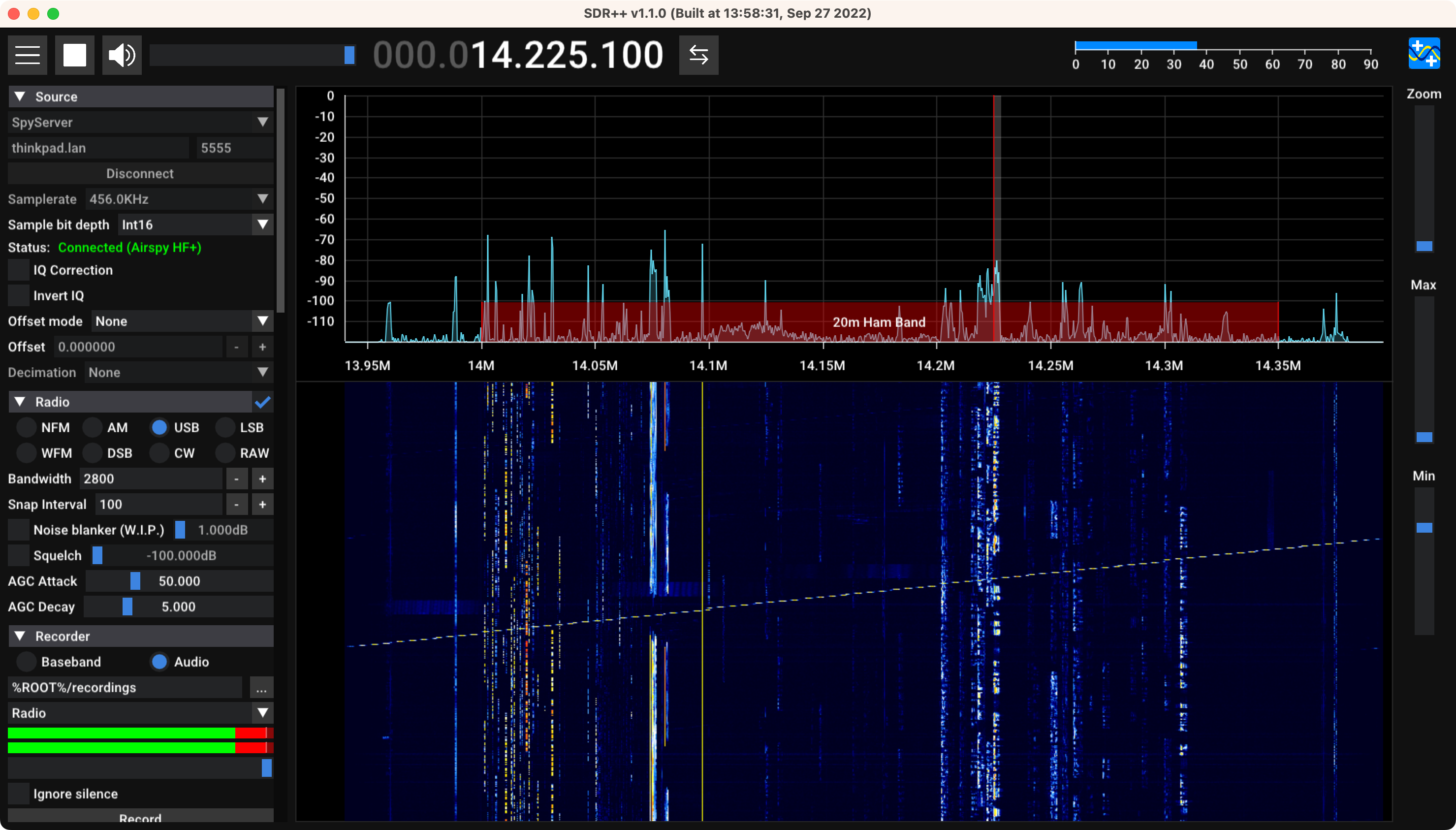
Power is fed up the coax from a little injector box that runs on 12V. For a while I ran it in to an AirSpy HF+ using SDR++ in the server mode (note that you need to get a nightly build for this feature to be there). Here's a look at 40m from a remote machine:
I'm not sure what those bands of noise are but I think they're related to power mains noise of some sort.
To test the low frequency receive performance, I set up WSJT-X to band hop 160m, 630m and 2200m. No luck on 2200m but I did receive spots from a station in VK5.
Amazing to receive a 1W signal on 475kHz from 1,380km away! Most spots were on 160m.
I'm finding that all antennas work better in the bush than they do in the city.
My 3D skills are improving. This morning I was out testing an end fed half wave supported by a squid pole and a tree. Attaching a wire to the top of a squid pole is troublesome. The top segment is too flexible so I tend to use the second segment but attaching a wire to the tube is difficult and although duct tape works - it's messy. I've considered dog clips but don't want to squeeze the tube and risk it cracking.
I had an idea - a cylinder with a hole for the wire which can be dropped over the end of the squid pole.
It's a simple object and the 3D print is strong enough for QRP use. Marvellous to be able to think of an object and make it in just a few minutes.
Starting to see some useful products from the 3D printer. I've designed and printed a nice case for the TTGO ESP32+LCD boards I like using around the house. The box and lid were designed in TinkerCad and printed on the Creality Ender 3 v2.
Not perfect but good progress for me. Here's the board sitting in the case part.
My approach was to measure the board with vernier caliper and use those measurements in the 3D design. To get the lip of the lid to fit snugly into the lower case I sized it down 0.5mm on each of the 4 sides. It's a very tight fit and sure to vary by printer but it's working for me.
Here's the models in TinkerCad:
I've made them public. Case. Lid. TinkerCad is a little frustrating to use and I'm looking around for alternatives. I wish OmniGroup would do a 3D version of OmniGraffle.
A few months ago I purchased a low cost 3D printer. I had just one project in mind but that was enough to get me started. The Creality Ender 3 v2 is excellent value for money and I've had good success with it.
Bed levelling is important for the success of prints. I had it right for a while but it drifted off which led to some prints not adhering to the base. A YouTube video suggested that replacing the wire springs with machined springs to improve the stability. At $8 for 10 it was not a big investment.
Here's a new spring along side the ones that came in the printer:
You can see how the spring is used to push the base plate up from the adjustment knob.
The new springs are slightly taller than the originals so I had to slide the print head limit switch up a bit. Doing this upgrade has helped me better understand the printer.
It's a week later and I've just had to re-level the bed. I would have to say that replacing the springs has not been the miracle cure I was hoping for.
Software
I started by using Blender for 3D design. It is great but overkill for this sort of thing. Several people mentioned Tinkercad which is a web based, but free, solution. I miss some of the advanced features but it is easier to use. Recently I made a little box to hold a TTGO ESP32+Display board:
Here it is in Tinkercad:
To be honest a 3D printer at home is a bit of a solution looking for a problem but no ham radio station is complete without an official station callsign statue:
There's a lot to learn about designing and printing 3D objects but my experience so far has been very positive.
It's silly but sometimes I feel sorry for the printer when I send it a complicated job to print.
I've been raising antennas by running a line over tree branches. Various techniques have been used including an arborist's throw, a squid pole, and tying a line to a drone. The last method invariably ends with the drone's rotors getting tangled in the line on the way down.
Recently I discovered little remote control releases, apparently meant for dropping fishing lines. It's hard to know what to search for but this one is titled "Universal Remote Thrower Hanger Airdrop System Fishing Bait Deliver Life Rescue for DJI/FIMI RC Drone Quadcopter Accessories" - wow.
This device works but the servo is tiny and quite weak.
This approach seems promising and I hope to try it out with a real antenna raising soon.
I've updated WSPR Watch in recent weeks. It's a free app for iOS that pulls data from WSPRnet and other sites so that you can conveniently check propagation on your phone or tablet.
Recent changes include:
* Fixed a layout issue triggered when a spot doesn’t have a tx grid square
* Handle small displays with large text better
* Searches now persist over to maps and graphs. This is handy for plotting propagation between two grid-squares for example.
* User can edit band colours in settings
* Shows bands in list headers
* Displays Grid Square codes in spot list
* Can now search for callsign or grid square
* Buttons in info alert to search for TX or RX Grid square
* Refresh buttons on map and graph view
The most interesting new feature is that searches in the spot list used to be cleared when you switched to the map or graph view. Now these searches persist. I use this when I'm using WSPR spots to see the best time for a voice contact to a specific place. Now I can run WSPR for 24 hours and search for the target grid square, then go over to the graph and see a plot of signal to noise ratio.
Round spots are received, triangles are reports of my transmissions.
In recent versions I've been adding more information into the spot list display and I hadn't realised that there's users who have small screen phones and they increase the text size. Thanks to feedback, and screenshots, sent in I was able to duplicate the problem and have improved things somewhat.
The colours used for each band has always been controversial. Initially I copied those used on WSPRnet but some people were not satisfied so recently I added the ability to customise band colours.
Thanks to all those who reported issues or sent suggestions. I don't have any monitoring in the app but downloads indicate quite a large user population these days. If you like the app, please consider leaving a review.
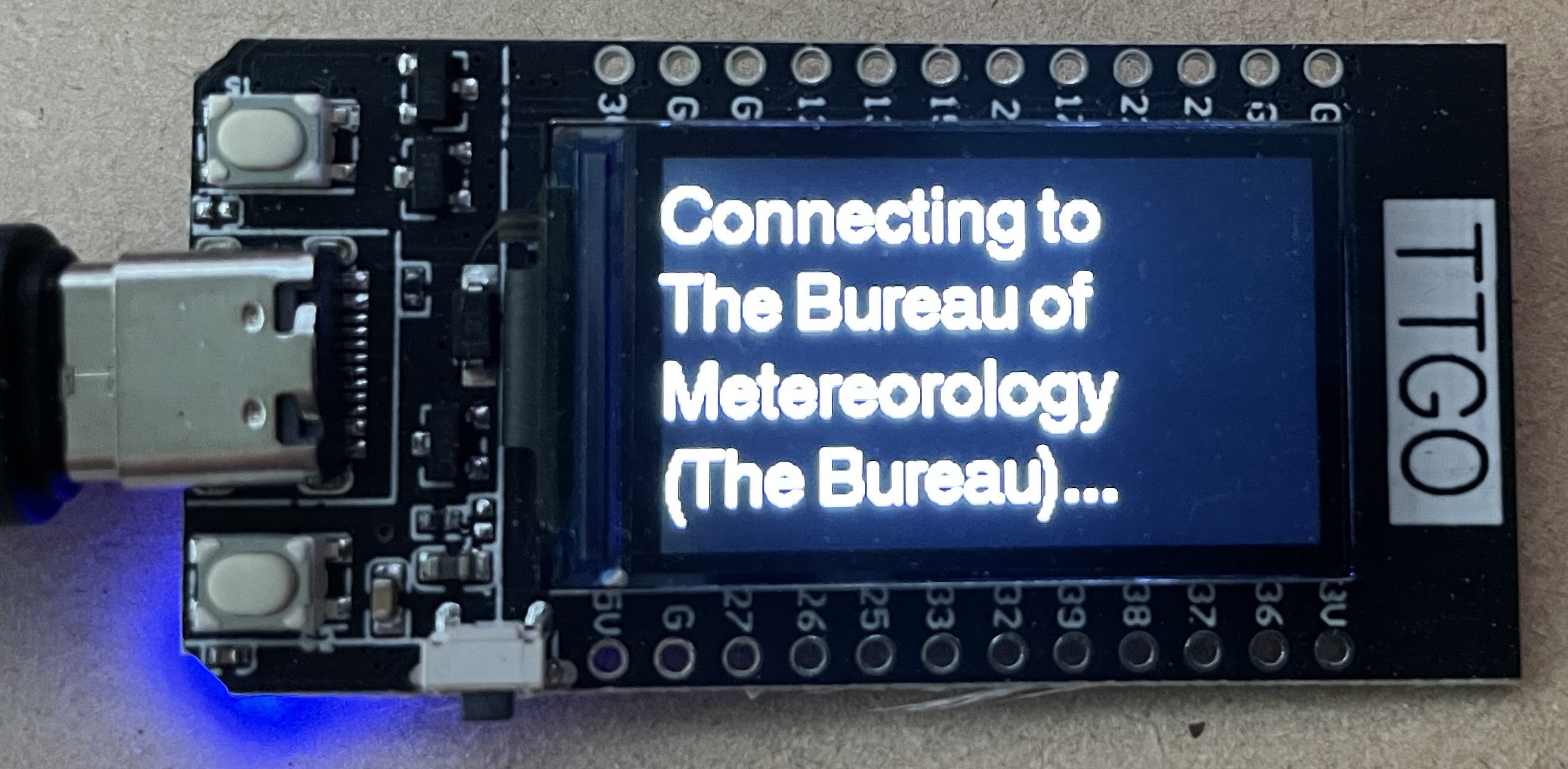
The re-branding of the BOM to The Bureau of Meteorology, hereinafter to be referred to The Bureau is reported to be costing $220,000. But what about all of us developers who use their excellent APIs? My little K index reporter used to look like this during startup:
Never fear, we've pulled the team in and made the necessary changes:
But of course the website and api URL domain names still have "bom" in them so we're standing by for any breaking changes. ;-)
I was a guest again this week on Marc Fennell's "Download This Show" on ABC RN.
As I no longer live in Sydney I'm a remote guest and this week my audio is a little weird as we used FaceTime audio to get me there.
Alex Jones must pay Sandy Hook families nearly $1 billion for hoax claims made on his conspiracy news service Infowars. Will it help to deconstruct one of the most potent engines of misinformation in the history of media?
And what is the point of going to work in an office if you’re just going to spend the day on video calls?
If you don't catch it on air, you can listen here.
Uncivil Wars - How contempt is corroding democracy
I've just read the essay by Waleed Aly and Scott Stephens in issue 87 of the Quarterly Essay. I wish I'd read this before we made the program.
The authors argue that treating people with whom we disagree with contempt rather than trying to see the world from the best version of their point of view hinders proper debate and, by extension, undermines democracy.
Recently I've interacted with several people who believe that COVID vaccination is some sort of conspiracy that ranges from being motivated by money making all the way up to a deliberate plan to kill people. I must admit I have sometimes treated people with contempt, not requiring serious debate.
Aly & Stephens have shown me the error of my ways and I will try to do better.
A GDO is a useful little test instrument for finding the resonance of a tuned circuit. These tuned circuits might be in a VFO or perhaps a trap for an antenna. Many years ago I had a commercial version that was quite large and had a large tuning dial. (The plug-in coils deteriorated over the years). Recently I ordered a modern version in kit form from HecKits.
The instructions are good although I found that the board deviates slightly from the image in the instructions and, as there are no component overlays, it can be a little tricky to figure out where each component goes.
The board went together quite smoothly, with just a little head scratching. Clearly there are a few changes since the manual was written but all worked on first power up for me. The kit comes with the lowest frequency coil pre-wound, which makes it easy to test.
In the end the kit all worked and fits into a nice compact case. I made one error in that I reversed pin 1 and 3 in a coil I wound and consequently had trouble getting it to oscillate. It didn't take long to figure out the problem and reverse them.
As well as finding resonance in tuned circuits, this device is a handy small signal generator. The kit isn't cheap - US$100 plus some extra postage to me. My kit came with some spare multi-turn pots for some reason.
To get a line over high branches here I've been using a cheap but decent drone out of China called a Flyhal FX1. They are about AU$300 but seem to have gone up in price since I purchased.
I've used it quite successfully to inspect the roof and solar panels. The camera isn't great. It's 4K but not very clear. Live video is sent back over Wifi which doesn't have good range but I tend to fly just by eye anyhow.
Here's some video of me using it to raise a line over a tree:
As a result of this activity, the drone has suffered damage from a few heavy landings. One arm broke and has been glued a few times.
Today, for some reason, the battery pack will no longer charge. It has convenient USB-C charging and a set of LEDs to show what it's up to. Now the LEDs just all flash together and it doesn't charge. I pulled the battery pack apart and it seems that the 12V is simply connected to the far left and far right pins so a standard Lipo battery connector was soldered in place.
A 3S battery can be connected and held in place with velcro or rubber bands and the drone appears to power up as normal.
As I write this I haven't flown it yet (the glue on the broken arm is still setting). I'll update this post when I do take it up. Update: It looks like two other pins are needed to measure the battery level. I tried to fly but the controller thinks the drone is flat.
Recently I've been tinkering with antennas here and one of the resonant dipoles I put up is for 20m. I normally run digital modes on the IC-7300 which conveniently connects to a linux computer via a single USB cable but thought I'd get out the QDX again.
The QDX from QRP Labs is an excellent little transceiver for travel or portable operation. It's a bit hard to compare reception as conditions change so frequently but my impression is that it's almost (but not quite) as good as the IC-7300.
What is astonishing is how good the transmit is. On a single 2 minute transmit over just now on 20m I was spotted by 79 stations all over the world.
Here's the graph of spots over a 24 hour period.
The little triangles on the graph are transmit spots. This is a new feature of WSPR Watch that should be in the App Store (free) in a few days.
The reason that QDX transmissions are so well decoded is, I think, because it does direct frequency generation by measuring the audio frequency rather than mixing the audio up to RF. It's a very pure signal.
All over the world on a pocket sized transceiver.
I wrote a small review for the Macedon Ranges Radio club here by the way.